Trapped Cash in Restricted Currency Markets
Misclassifying restricted cash as trapped costs multinationals millions in unnecessary losses.

Trapped cash isn't usually trapped. That word implies a wall, a hard stop, funds sealed off with no way out, and for most multinational cash sitting in emerging markets, that's not the actual condition. A leading treasury professionals' association puts it more precisely: cash is more often hampered than blocked, more likely facing some loss of principal or leakage than a total barrier to movement. Getting that distinction right matters, because the label a treasury team puts on a market determines the tools it reaches for, and the wrong label costs money in both directions.
Citi's research on this makes the point cleanly. Genuinely trapped cash, meaning countries with hard currency reserves too thin to support offshore remittance at all, is rare. Citi names Angola, Argentina, and Egypt as the clearest cases. Everything else sits somewhere on a spectrum running from fully unrestricted to semi-restricted to restricted, and each of those middle categories still has legal paths for cash to move. Treasury teams that write off a semi-restricted market as trapped leave real money on the table. Teams that treat a restricted market like an open financial hub get blindsided by a documentation delay, an unexpected withholding cost, or a conversion cap they never planned for. What follows maps that spectrum tier by tier, and lays out what actually works at each point along it.
The four-tier classification framework that replaces binary thinking
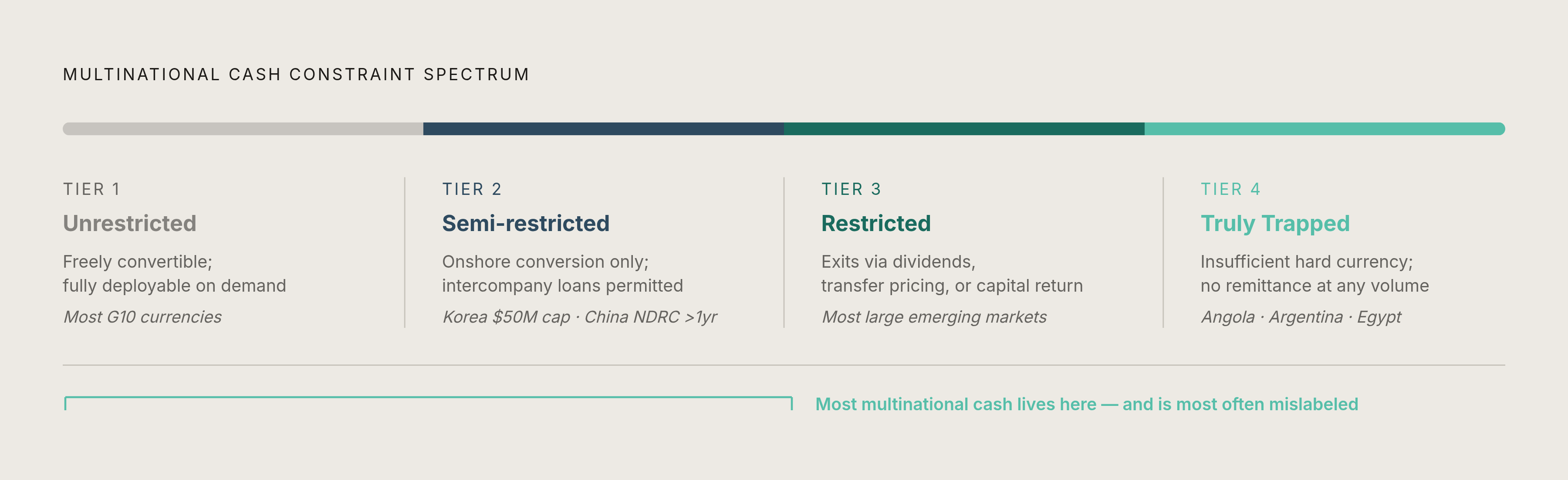
Citi's model sorts markets into four categories, and each one carries a different operational reality. The two middle tiers are where the money actually is, not the two-bucket free-or-frozen split most treasury teams collapse these into.
Unrestricted markets are the easy case: local currency trades freely and is available offshore without friction, so cash sitting there is fully deployable on demand. Semi-restricted markets are more interesting, and more common than most finance teams assume. Here, local currency can't be held or traded offshore, but it can be converted onshore against a hard currency, with the proceeds lent back out to the group offshore. Each market attaches its own conditions to this. China, for instance, attaches specific currency and registration conditions to this kind of structure. Korea caps the amount at $50 million. China also imposes tenor limits through NDRC registration requirements for loans running longer than a year, though there's no hard one-year ceiling, just a registration hurdle past that point.
Restricted markets close off the direct route. Cash can only leave through transfer pricing adjustments, dividend distributions, or a return of paid-in capital, and this covers most large emerging economies, not the exotic edge case treasury teams sometimes assume it to be. Then there's the fourth tier, true entrapment, where the country doesn't hold enough hard currency reserves to support remittance at any volume. This is Citi's Angola, Argentina, Egypt group, and it stays a short list for a reason: most governments that restrict currency flow still want foreign capital coming in, so they build in official, if narrow, channels.
The planning consequence is easy to skip: cash management metrics need to be set tier by tier, not against one global benchmark. A treasury team measuring days-to-repatriate in Brazil against the standard it applies in an open, developed market is measuring the wrong thing. Before any of this gets applied at the country level, Citi's framework asks a company to look inward first: what share of revenue gets invoiced locally versus offshore, how the transfer pricing model is built, how intercompany flows actually move. Layered on top sits the finance and treasury architecture itself, capital structure choices between intercompany loans and equity, the cash forecasting process, and any long-dated intercompany balances sitting unresolved on the books. All of that decides which tools from which tier actually apply to a given entity.
Quantifying the portfolio: what measuring liquidity quality means
CFOs are increasingly measuring something more specific than aggregate liquidity: liquidity quality, meaning how fast, how cheaply, and how legally the cash sitting in a given market can actually get put to use. A liquidity quality audit asks a short set of pointed questions. Is the treasury management system able to flag trapped cash before it becomes a live constraint, rather than after the quarter closes and the number's already a problem? Can it forecast down to the entity, currency, and market level, instead of spitting out one consolidated global figure that hides where the friction actually sits? Can it move cash automatically while still respecting local compliance rules? The real question that produces all of that is what can this specific pool of cash do right now, not where does it happen to sit on a balance sheet.
Treasury practitioners name the most common failure bluntly: companies don't always accurately quantify the level of constraint they're actually facing. Cash gets labeled trapped when it's really just procedurally delayed, stuck behind a document that needs filing or an approval that hasn't cleared, not a currency that legally can't move. That mislabel gets expensive fast, since it triggers write-offs, discount-rate adjustments, or defensive capital allocation calls that never needed to happen.
Three numbers do the real work here, and most dashboards track none of them. Convertibility cost is what it actually costs to turn local currency into something usable elsewhere. Time-to-deploy is how long the full cycle takes from decision to cash landing where it's needed. Leakage rate covers withholding taxes, stamp duties, and the conversion spread eaten up along the way. Putting a number on all three, market by market, makes the portfolio look nothing like a single trapped-cash line item on a treasury dashboard.
Where the constraints live: a market-by-market picture
A Deutsche Bank survey of treasury professionals names China, India, and Russia as the countries treasurers rank worst for fund repatriation. Across restricted markets generally, documentation and regulatory hurdles top the list of obstacles, cited by 82% of respondents, with central bank FX controls at 72% and high transaction costs behind that. Latin America and Asia Pacific together account for 33% of the highest-risk regions, with Sub-Saharan Africa at 26%. A number of frontier markets are flagged separately as carrying elevated transfer obstacles.
China deserves its own walkthrough because the mechanics are genuinely distinctive. Cross-border cash pooling is permitted, but only under joint approval from the People's Bank of China and the State Administration of Foreign Exchange, running through an integrated framework that treats RMB and foreign currency together rather than as separate regimes. Direct intracompany loans face significant structural restrictions. The workaround that's emerged is the entrusted loan structure: one group entity deposits funds with a bank, and the bank lends that same money to another entity in the group. It's a roundabout mechanism, but it's the accepted one. Starting January 1, 2026, commercial banks running e-CNY digital yuan wallets will begin offering interest on balances at rates aligned with standard demand deposits, a signal that moves e-CNY away from functioning purely as a digital cash equivalent and toward something closer to a regulated financial asset in its own right.
India is at the more restrictive end, with few repatriation routes open to multinationals beyond dividend distributions. There's been a partial easing: companies can now transfer abroad an amount equal to 10% of annual sales. Real concession, limited one, and nothing points to broader liberalization coming soon.
Techniques for releasing or optimising cash within each tier
None of these techniques travel across tiers, and treating them as interchangeable is where treasury teams waste the most time. What frees up cash in a semi-restricted market, an intercompany loan or a cross-border pooling structure, simply won't work in a truly trapped one, where the only lever left is optimizing what the cash earns while it sits in place.
In semi-restricted markets, the goal is getting cash out, and the toolkit runs wider than most treasury teams actually use. Intercompany netting, transfer pricing adjustments, and direct intercompany transfers are the well-known options, though some are outright forbidden in specific jurisdictions, and every one needs local legal sign-off before execution, not after. Dividends remain the primary channel for many companies, and one detail trips people up regularly: some countries impose strict limits on the frequency of dividend distributions. Staggering entity fiscal year-ends around that constraint lets a company spread dividend payments across the calendar instead of bottlenecking them all at once.
Dollar and hard-currency accounts offer another route, since emerging economies frequently impose fewer restrictions on USD holdings than on local currency, and an offshore dollar account can service import payments directly. Capitalizing a subsidiary through an intercompany loan rather than equity is another lever worth setting up early, since it opens loan repayment as a repatriation path later, subject to whatever thin-capitalization limits the local tax code sets. When cash piles up in a subsidiary faster than the business model predicted, that's the trigger to pull the transfer pricing model back out with the internal tax team and check if it still reflects reality. In Poland, some companies have used subrogation structures to move internal liquidity around without triggering the stamp duty a straightforward intercompany loan would incur there. Structures like that always need local regulatory confirmation before use, since what clears for one company's fact pattern doesn't automatically clear for another's.
Restricted markets call for a different mindset. The cash isn't leaving soon, so the job becomes maximizing what it earns while it stays put. Large global network banks offer interest optimization schemes across restricted currencies, including India, China, and Brazil, letting companies offset compensation in ways that only a bank with genuine global deployment capacity can support, since the offset depends on the bank redeploying those funds somewhere else in its own network. Local cash pools and local money market funds are the other lever here, improving the return on cash that has to stay onshore without stacking counterparty risk on top of the currency risk already in play.
The longer game is restructuring the business model itself so costs get generated in the same local currency as revenue. Mark Raddan at KPMG points to automakers relocating manufacturing into China as the clearest example in practice. It's slow, and it demands real capital, but it removes the currency mismatch at its source instead of managing around it forever. Equinix's approach shows a lighter version of the same idea: contracting with vendors in local currency, borrowing and disbursing funds locally where the market allows it, and in a market like Nigeria, funding operations through intercompany loans or USD equity injections while structuring payments to sidestep local currency bottlenecks. That sidesteps the local liquidity bottleneck instead of fighting through it.
Emerging payment infrastructure reshaping restricted corridors
ISO 20022 tends to get described as a back-office messaging upgrade, a technical standard nobody outside payments operations needs to think about. That undersells it. For treasury teams working restricted corridors, the real consequence is richer transaction data flowing with every payment, and that data sharpens reconciliation and tightens compliance checks across restricted corridors.
Virtual accounts, tokenized deposits, and faster payment rails are all improving how companies concentrate local cash. But the advantage doesn't go to whoever adopts the newest rail first. It goes to whichever treasury team can move cash globally while still respecting the local rules mapped out under the four-tier framework above. Technology organizes complexity that already exists locally. It doesn't make that complexity disappear, and any vendor pitch that implies otherwise is selling past the actual constraint.
Stablecoins are the case to watch most closely right now. Among global finance leaders surveyed, 74% believe stablecoins can improve cash-flow efficiency and unlock working capital currently sitting trapped, and 72% believe offering some form of digital asset capability will be necessary just to stay competitive. The gap between that conviction and actual deployment runs wide: most of these same organizations still lack the operational infrastructure to act on what they believe. Where adoption has taken hold, it concentrates almost entirely in cross-border cases, paying overseas suppliers, accepting international B2B payments, managing treasury flows that cross a currency boundary. Restricted-currency friction runs highest there, and that's exactly why the fit works.
Building a treasury operating model around a portfolio of constrained positions
The core shift this framework demands is simple to state and hard to execute: stop treating trapped cash as one aggregate number on a dashboard, and start managing it as a portfolio of positions, each carrying its own constraint, its own toolkit, and its own acceptable outcome. A single global "trapped cash" figure hides more than it reveals, and any CFO still reporting one is measuring the wrong thing.
The framework outlined above turns into a fairly concrete operational checklist: assess capital structure market by market, sharpen cash forecasting until it's genuinely granular, push cash movements toward a centralized pool wherever the rules allow it, and stay disciplined about settling intercompany transfer pricing and dividend payments on schedule instead of letting them drift. None of that is glamorous, and all of it sits within a treasury team's direct control, which matters more for setting priorities than chasing the next infrastructure upgrade does.
A handful of process disciplines separate a mature treasury operation from a reactive one. Classification reviews need to run on a regular cycle, since markets move between tiers: a country that was semi-restricted eighteen months ago may have tightened, or loosened, since. Cash forecasting has to run at the entity and currency level, not just consolidated, because that granularity is the foundation every other technique in this piece depends on. Pre-entry due diligence deserves the same rigor before a company sets up in a new market as after: capitalization rules, payment and receipt restrictions, funding and repatriation limits, FX regulation, local entity requirements, all mapped before cash starts accumulating, not discovered once it already has. Dividend extraction needs its own discipline too: know distributable earnings precisely, compute withholding tax on the full dividend amount rather than a partial estimate, work through double-taxation relief and available tax credits with tax counsel, and know how long central bank approval will take before the money actually moves.
The architecture that supports all of this stays hybrid rather than fully centralized, and that's the right call. Cash pooling, virtual accounts, in-house banks, and payment factories all coordinate liquidity across a global footprint, but local complexity produces friction that none of them erase, as the market-by-market cost and timing figures show. They organize it. Treasury teams that grasp that coordinating liquidity and erasing local complexity are different tasks are the ones getting the most out of every tier on the spectrum, restricted or not.
Sources
- Background - Releasing Trapped Cash - CTMfile
- Trapped cash - Hub
- citigroup.com
- Navigating trapped cash: treasury tactics for unlocking funds in complex markets - EuroFinance | The global treasury community
- euromoney.com
- events.economistenterprise.com
- Official Release of the 2025 Cross-Border Cash Pooling Regulations: Strategic Transition from “Dual Track” to “Integrated” and Practical Guidance | DLA Piper