TMS Selection for Multi-Currency Treasury Operations
Focus your TMS evaluation on FX tracking, cash visibility, and bank connectivity.

Selecting a treasury management system for multi-currency operations means evaluating a different set of capabilities than a standard TMS comparison covers. A platform's value for this job comes down to FX exposure tracking, real-time cash visibility across currencies, the breadth of bank connections, and how the system consolidates numbers across dozens of legal entities, yet most evaluation checklists still underweight these criteria. Deloitte's 2024 Global Corporate Treasury Survey found that 58% of treasury respondents named lack of visibility into global operations, cash, and financial risk exposure as a top challenge. That's not a training gap or a staffing problem. It points to systems that were never built to answer the question a multi-currency treasury actually asks every morning: what does the group's cash position look like right now, across every entity and every currency, at once?
What a multi-currency TMS has to do that a standard TMS does not
A standard TMS pulls cash balances together and automates payment runs. That's useful, but it stops short of what a multi-currency operation needs. A multi-currency TMS has to track exposure by currency pair, manage forward contracts and open currency positions, and run intercompany netting across borders so cash doesn't cross the same border twice in opposite directions.
Five things separate the two categories in practice. Real-time cross-currency cash visibility means a consolidated view of liquidity across accounts, entities, and currencies at the same moment. FX exposure management means tracking exposure by currency pair, flagging when a hedge is needed, and keeping a live view of forward contracts rather than a spreadsheet someone updates on a periodic schedule. Intercompany netting cuts down the volume of cross-border transfers and consolidates internal funding, which directly reduces bank fees and the cost of converting currency back and forth. Multi-entity consolidation means reporting that rolls up automatically, intercompany transactions that clear themselves, and an architecture that doesn't buckle when the group adds its fortieth subsidiary. Multi-currency payment processing means SWIFT compliance and support for the payment formats each currency corridor actually uses.
An ERP like SAP or Oracle can hold multi-currency data. It was built to hold it, not to move it. ERPs process treasury data slowly and on a schedule, batch by batch, while a TMS is built to do the same job continuously and in real time. Spreadsheets fare worse: they can be made to hold multi-currency logic, but they break down at the exact moment a treasury team needs them most, when currency exposure is moving fast and across many entities simultaneously. A purpose-built TMS exists because that gap between ERP and spreadsheet is wide enough to lose money in.
The four criteria that separate capable multi-currency TMS platforms from adequate ones
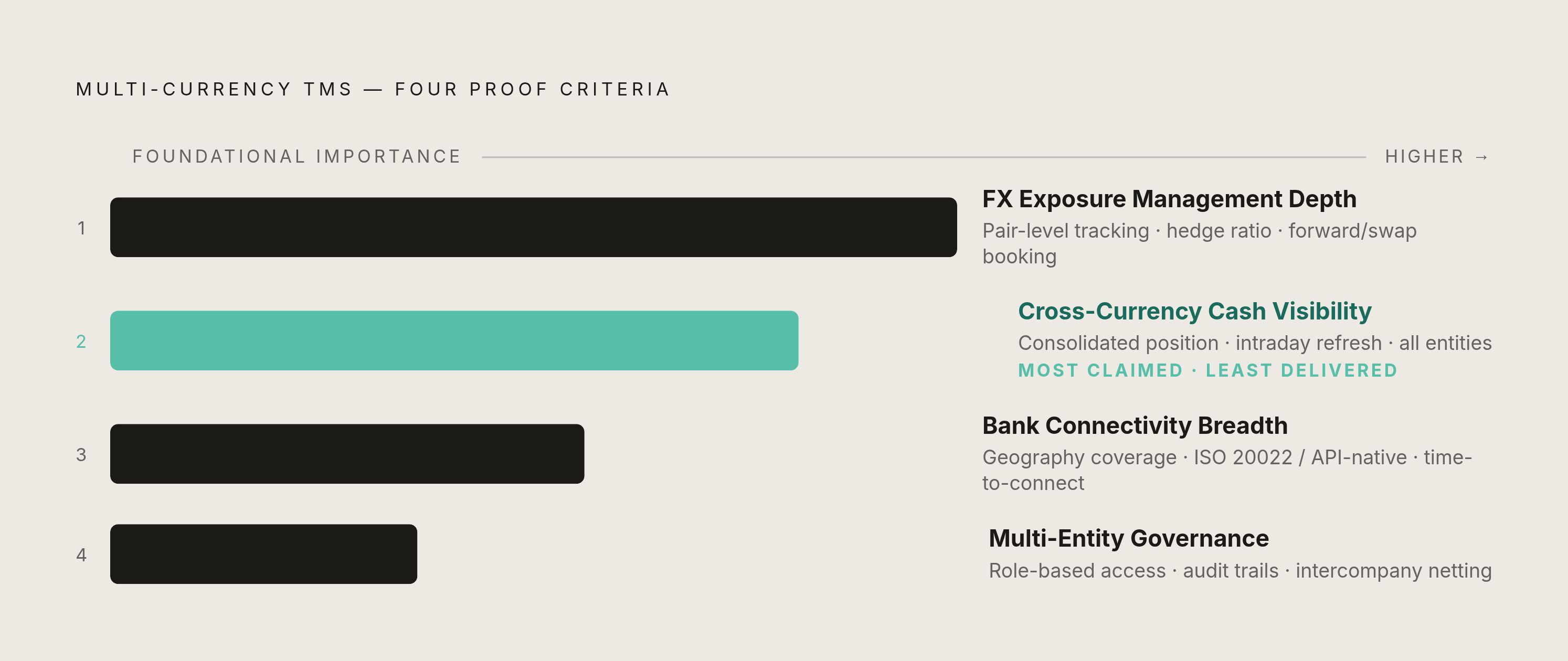
Four criteria do the real work of separating a capable platform from one that just checks the multi-currency box on a sales sheet. They shouldn't be treated as a flat checklist, since different treasury structures will lean on some far harder than others. That weighting comes later. First, the criteria themselves.
FX exposure management depth is the first, and it's worth pushing on hard in a demo. Does the platform track exposure by currency pair, or only in aggregate by entity, which hides more than it shows? Can it flag when a hedge requirement kicks in automatically, and show open positions across forward contracts without someone exporting data into a separate tool? Does it actually support instruments like forwards and swaps inside the platform, or does the workflow dump out to an external system the moment a real hedge needs to be booked? The Association of Corporate Treasurers' guidance for 2026 recommends modeling multiple scenarios to show the board earnings-at-risk, and building contract flexibility, including payment options in alternative currencies, into commercial agreements. The fourth quarter of 2025 delivered real losses to firms sitting on unhedged FX exposure, which pushed many to raise their hedge ratios. Apply this test to any platform: does it support adjusting a hedge ratio dynamically as conditions shift, or does it only run a static hedging program set once a quarter?
Real-time cross-currency cash visibility is the second criterion, and it's the most commonly claimed and least commonly delivered. Can the platform pull bank balances, AR and AP flows, and intercompany positions into one cash position across every currency at once? How often does that number refresh: intraday, truly real-time, or on a batch cycle that's stale by lunchtime? The single best demand to bring into a demo is blunt: show the consolidated cross-currency cash position for every entity, right now, on screen.
Bank connectivity breadth is the third, and it gets measured wrong more often than any other criterion. A vendor's total bank count means little if none of those banks operate where the organization actually does business. The platform must connect to the specific banks in the specific geographies the group operates in, offer SWIFT access and API-native connectivity, and support the regional payment formats those corridors require. ISO 20022 compatibility has become a real dividing line in the market, splitting vendors still running on legacy message formats from those built API-native from the start. Time-to-connect for a new banking relationship is a concrete, testable number that deserves to be asked about directly rather than inferred from a client logo wall.
Multi-entity governance and consolidation rounds out the four. Role-based access, approval hierarchies, and audit trails aren't nice-to-haves in a multi-entity structure, they're compliance requirements. A regional finance manager needs entity-level access. Group treasury needs the full consolidated view. The architecture has to support both at once without one undermining the other. Automated intercompany netting and in-house banking cut FX conversion costs and transfer volume across the group, and TreasuryXL's 2026 comparison of multi-entity platforms found that the best-designed systems keep a human in the loop on every decision, so nothing moves without being traceable and auditable after the fact.
Secondary criteria still matter, just less urgently for most organizations: debt and investment management, covenant tracking, and hedge accounting compliance under IFRS 9 or ASC 815. Worth evaluating. Rarely the deciding factor.
Weighting Criteria by Operational Complexity
Not every organization needs to weight these four criteria the same way, and pretending otherwise is how finance leaders end up buying more platform than their operation requires, or worse, less. Three structural variables drive the weighting: how many currencies are actively managed, how many legal entities exist and how far they're spread geographically, and how much cross-border payment volume the group actually moves.
A mid-market manufacturer running operations across three regions and five currencies has a fairly clear answer. Real-time cash visibility and FX exposure management carry the most weight here, and bank connectivity, while still necessary, is achievable with a narrower network than a sprawling multinational would need. A multinational with twenty or more entities spread across emerging markets faces a different calculation entirely: bank connectivity breadth and multi-entity governance become just as important as FX management, and intercompany netting turns from a nice efficiency gain into a high-value necessity, since transfer costs and conversion fees compound fast once dozens of entities are moving money across borders. A high-volume importer or exporter with narrow currency exposure but heavy transaction counts often finds that payment automation, fraud controls, and reconciliation speed serve it better than sophisticated hedging tools it will rarely use.
Currency pair exposure deserves specific attention going into 2026. The ACT recommends modeling multiple scenarios and building contract flexibility into commercial agreements, and any organization with meaningful currency exposure should weight FX exposure management higher than it might have a few years back.
Governance complexity is the criterion most often underweighted in this exercise, and it shouldn't be. Multi-entity groups operating across borders need role-based access and audit trails because regulators and auditors require them, not because they're convenient. Treat that self-assessment, currencies, entities, payment volume, as the homework to finish before a single vendor call gets scheduled.
Total Cost of Implementation and Vendor Fit for Multi-Currency Operations
Research from bestfinancesites.com found that enterprise TMS implementations run six to twelve months on average, with integration work routinely extending the timeline. Total cost of ownership extends well past the license fee: implementation services, bank connectivity setup, and module activation charges together can run 50 to 100% of the first year's cost on top of licensing alone.
Multi-currency operations push both numbers higher. More bank connections have to be established across more geographies. Data mapping gets more complex once multiple currencies and multiple entities are involved. Hedge accounting modules are worth confirming in any vendor proposal, since scope and pricing for specialized modules can vary significantly from the base platform quote.
The timeline carries a strategic weight, too. A twelve-month implementation means the organization runs without the TMS's FX visibility for a full year, and currency markets don't pause during that window. Put this question directly to a vendor before signing anything: what's the specific timeline to cross-currency cash visibility, not full implementation, just visibility? How many of the organization's actual banking relationships are pre-connected versus requiring new integration work? What's the per-entity or per-currency cost for adding scope later? Bestfinancesites.com found that over 85% of new TMS implementations now run on SaaS, which has become the default deployment model and shapes both upgrade cycles and the ongoing cost structure a buyer signs up for.
Leading Multi-Currency TMS Platforms Against These Criteria
Kyriba was named the world's best TMS for 2025 by Euromoney. It connects to more than 9,900 banks and supports 66,000 payment formats, the broadest documented bank connectivity among the platforms covered here, and it serves over 3,400 corporate clients across 170 countries. According to Euromoney, in 2024 it processed three billion transactions worth $15 trillion, and it holds a 16.8% share of the mid-to-large enterprise market. It has added generative AI capabilities including anomaly detection and AI-driven payment risk features to its platform. It had already launched TAI in May 2025, with commercial availability from October 2025, an agentic AI system trained on twenty years of liquidity data. On the four criteria: strong bank connectivity and cash visibility, with AI-driven FX hedging recommendations now built in, and implementation timelines in the sources ranging from two to twelve months.
Ripple Treasury took shape after Ripple's 2025 acquisition of GTreasury combined an enterprise TMS with Ripple's payments network and digital asset infrastructure. It differentiates on speed, with a 90-day path to cash visibility against Kyriba's two-to-twelve-month range, and claims auto-match rates up to 98% on reconciliation. New banking relationships connect in as little as seven days, and the platform supports SWIFT, ACH, RTP, and FedNow. Its GSmart AI runs across the full platform rather than sitting in a separate reporting module, handling variance analysis and anomaly detection natively. On the four criteria: fast implementation to visibility, native digital asset infrastructure that matters for organizations with digital currency exposure, and reconciliation automation at real scale.
ION Treasury, built around the Wallstreet Suite, carries particular depth in capital markets, debt and investment management, and risk analytics. It's trusted by large corporates, financial institutions, and public sector bodies, and ION Group serves more than 4,000 clients globally across treasury, trading, and risk management, built up through acquisitions including Openlink and Reval, now folded into ION Treasury. Its hedge accounting credentials run deep, which matters for any organization working under IFRS 9 or ASC 815. On the four criteria: strongest on risk analytics and hedge accounting, and generally favored by large corporates with heavy capital markets exposure.
SAP S/4HANA Treasury leads with ERP integration for organizations already standardized on SAP. MarkWide Research found that SAP holds its installed-base advantage by embedding treasury modules directly into the broader ERP ecosystem. On the four criteria: ERP integration cuts down data mapping work for SAP shops specifically, multi-currency handling is native to the SAP data model, and implementation complexity tracks closely with however complicated the existing SAP landscape already is.
Trovata acquired ATOM in July 2025, a full enterprise TMS originally built by Financial Sciences Corporation. That integration is still recent as of the available sources, and merging a cloud-native API platform with a decades-old TMS is real engineering and go-to-market work that takes time to settle. On the four criteria: the cloud-native API approach is strong for bank connectivity, but full multi-currency enterprise capability through ATOM is still being integrated, so ask directly in a demo exactly where that integration stands.
A Cobase roundup found that FIS Integrity, part of the larger FIS financial services business, covers bank connectivity, cash positioning, and complex risk analysis in one package. On the four criteria: a broad toolkit suited to organizations wanting comprehensive multi-currency risk analysis bundled with connectivity, backed by a large financial services ecosystem.
Cobase focuses on payment hub functionality and multi-bank connectivity, built around a user-centric interface. It connects to a wide range of banks and financial institutions for consolidated cash visibility, and it uses secure APIs along with multi-factor authentication. On the four criteria: strong at the payment hub and connectivity layer, aimed at corporates that prioritize treasury connectivity and day-to-day operational efficiency over deep analytics.
Across the category, AI is reshaping forecasting accuracy. Dataintelo.com's TMS market report found that machine learning models are delivering accuracy improvements of 30 to 45% over traditional rule-based forecasting. The market has split cleanly between platforms with AI built natively into the workflow and platforms that bolted AI onto an existing reporting module after the fact. Its GSmart AI runs across the full platform rather than sitting in a separate reporting module, handling variance analysis and anomaly detection natively, rather than living off to the side in a report nobody opens.
The questions to bring into vendor demos once the criteria are weighted
Once the weighting is set, the demo itself becomes a test. Map the questions to each of the four criteria directly, rather than working from a generic feature list.
On FX exposure management: ask the vendor to pull up exposure by currency pair, live, not by entity. Ask whether hedge requirements get flagged automatically, and whether the platform supports adjusting a hedge ratio dynamically as conditions change, or only running a static program set once and left alone. Ask whether forwards and swaps get booked and tracked inside the platform itself.
On cash visibility: ask for the consolidated cross-currency cash position across every entity, on screen, at that moment. Ask how often that number refreshes, and get a specific answer, not "real-time" used loosely.
On bank connectivity: name the specific banks and countries the organization operates in, and ask the vendor to confirm which ones are already connected versus which would need new integration work, along with a real timeline for each.
On multi-entity governance: ask how the platform separates entity-level access from full group consolidation, and ask for a walkthrough of the audit trail on a single transaction, from initiation to final approval. That single walkthrough tends to reveal, faster than any sales deck, whether a platform was actually built for multi-currency, multi-entity treasury, or whether it just says so in the pitch.