ERP Integration Patterns for Cross-Border Payment Automation
Choosing the wrong ERP integration pattern breaks quietly as cross-border volume climbs.
Cross-border B2B payments hit $31.6 trillion in 2024, on track to reach $50 trillion by 2032, according to research from apideck.com. At that scale, how a company wires its ERP into payment infrastructure stops being a tooling decision. It becomes an architectural one, because the pattern chosen decides whether automation still holds once currencies, entities, and compliance regimes start multiplying.
The pain shows up in the numbers finance teams report today. In a Flywire survey of 300 U.S. finance leaders, 83% named poor integration between their A/R platform, ERP, and CRM as a top operational challenge, despite years of spend on connectors and plug-ins meant to fix exactly that. The usual failure sequence is familiar: a team picks a tool, a bank portal or a plug-in connector, without first deciding on an integration architecture. It works fine at low volume. Then transaction counts climb, a second entity comes online, or a regulator changes a filing requirement, and the tool buckles.
Part of the root cause is structural. ERP systems were built to run the general ledger, not the granular mechanics of cross-border payment work: multi-currency reconciliation, FX rate capture at the moment of execution, local compliance stamping, exception routing when a payment stalls mid-route. Fewer than half of corporations say they're happy with how their financial systems connect to their banks, per apideck.com, so dissatisfaction here is closer to the norm than the exception. Each new market a company enters adds more currencies, more rails, more tax regimes, and more counterparty banks to reconcile against.
The visibility failure often does more damage than the payment failure itself. A customs hold shows up in a broker's portal but never makes it into finance's view. A packing list gets updated in one system while the commercial invoice in another sits stale. The ERP tells one story, and the ground tells another.
None of what follows is a vendor beauty contest. Each pattern answers a different operational question, and picking one depends on how many systems a company runs, how tangled its transaction mix is, and how wide its compliance surface has grown, not on which dashboard looks nicer. And the pattern most companies default to first, a single native connector, is usually the wrong long-term bet. It's the one that breaks first, and it breaks quietly.
API-direct (native connector). The payment platform talks straight to the ERP over REST, no middle layer involved. It hands back the payment status, FX rate, and related settlement details so the ERP can post to the general ledger and reconcile against it. Pilots can typically go live quickly, with full rollouts following in a matter of weeks. This works cleanly when a company runs a single ERP, uses one payment provider, and sees steady, predictable volume with compliance rules that aren't shifting under it. It breaks the moment a second ERP shows up after an acquisition, or the payment provider changes its API without warning, which is exactly the scenario most growing companies are heading toward, not away from.
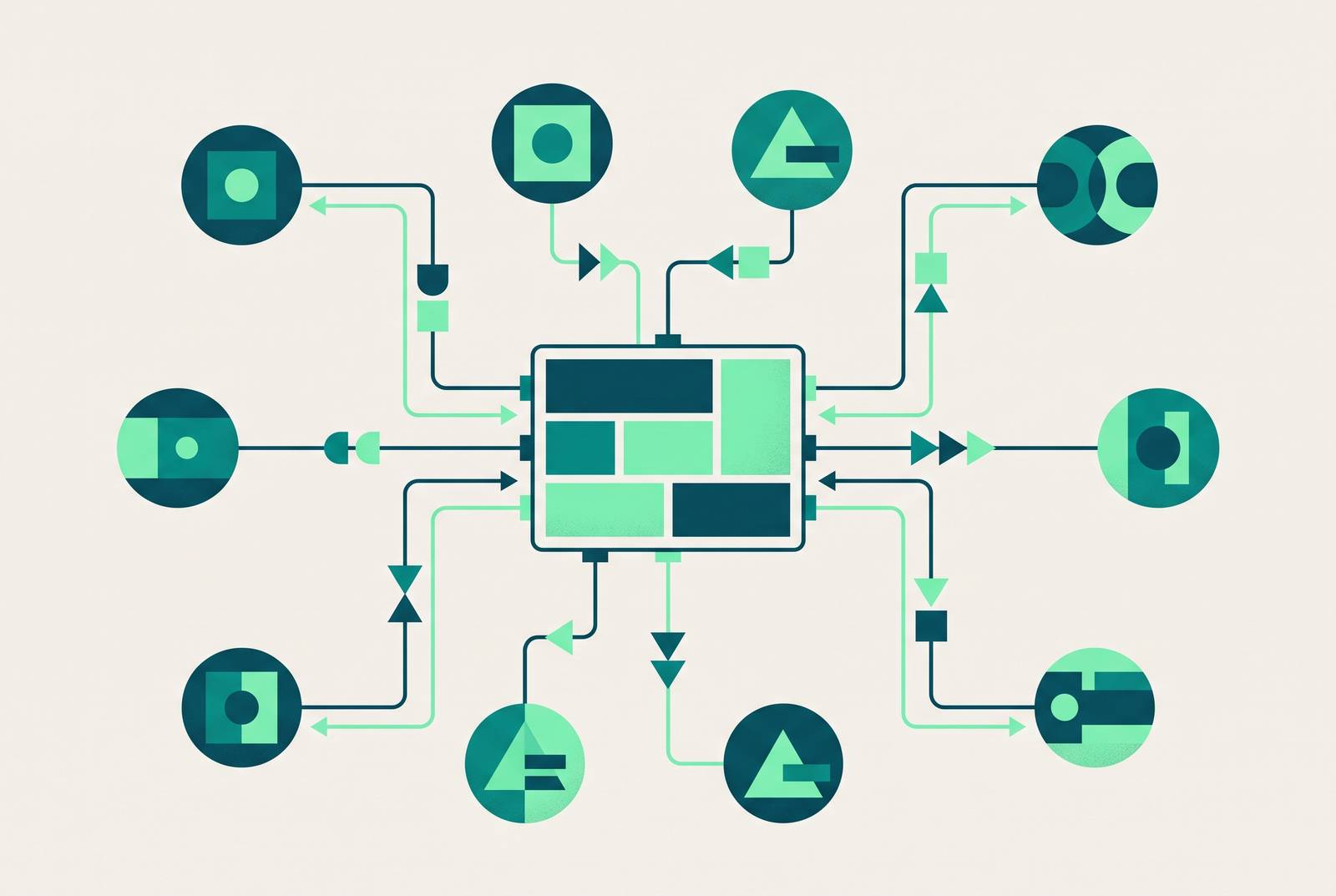
Middleware as a control layer. A middleware platform sits between the ERPs and the payment rails, centralizing routing rules, a shared data model, and monitoring in one place. This is the pattern for multi-ERP environments, where SAP, Oracle, Microsoft Dynamics 365, NetSuite, and Infor might all be running at once because of acquisitions or regional autonomy. Without middleware, each subsidiary builds its own logic, and the group ends up with duplicated rules and integration drift. Middleware also solves the duplicate-payment problem directly: routing rules stop two platforms from paying the same invoice twice.
Embedded FX. Currency conversion and cross-border payment execution get built right into the ERP or accounting workflow, so a user never has to leave the tool they're already working in. Xero's partnership with Wise lets small businesses send international payments from within their accounting workflow. Shopify's integration with Airwallex handles multi-currency processing for merchants. SAP Concur embeds TransferMate for enterprise invoice and AP payments. The routing logic behind these integrations is designed to optimize processing paths, reducing FX leakage and improving settlement success rates. This pattern fits best where the payment decision happens inside daily operations, not off in a separate treasury system.
Batch reconciliation. Payments run through one system, and reconciliation happens later, in a scheduled batch that matches settlements to invoices and posts the GL journals. This suits companies where real-time posting isn't required operationally, but month-end accuracy is non-negotiable. Exception worklists catch the cases automation can't close on its own, usually multi-currency B2B scenarios where invoice references don't match across borders. The lag itself is the risk: batch cadence means the ERP's view of reality trails the actual payment state, and that's the visibility gap described above, at its worst.
Most enterprise deployments end up running more than one pattern at once, not by design but by necessity. API-direct on the primary ERP, middleware layered in for subsidiary systems, batch reconciliation still limping along for legacy entities nobody's gotten around to migrating.
How native ERP connectors work for SAP, Oracle, and NetSuite, and where each one stops
SAP has partnered with TransferMate to build B2B payments infrastructure directly into SAP Multi-Bank Connectivity, so businesses running SAP Cloud ERP or SAP S/4HANA Cloud can execute cross-border payments without ever leaving the platform. Through that integration, customers get TransferMate's global payables, receivables, and stored funds capabilities from inside the ERP itself. SAP's Business Technology Platform also supports blockchain integration patterns that connect SAP ECC or S/4HANA to outside networks through APIs or middleware, useful in supply chain payment scenarios that need an immutable audit trail. The friction point for SAP shows up when a company tries to connect it to anything non-SAP: its proprietary BAPI interfaces and IDoc structures need careful, deliberate mapping, and that mapping work is where hybrid and middleware deployments spend most of their time.
Oracle Integration Cloud includes a B2B module built for AS2 and SFTP connections, and it handles X12 and EDIFACT document formats: things like the 850 purchase order, 810 invoice, 856 advance ship notice, and 855 PO acknowledgment. A bidirectional CRM-to-ERP sync built on OIC can require meaningful design, build, and test effort, a factor teams should account for when scoping the work. Complex, multi-system integrations, say eCommerce plus CRM plus HCM plus banking, can run substantially longer and consume a significant share of total ERP implementation cost. Integration at that scale demands resources far beyond a line item on a budget. It's its own budget category. Oracle Blockchain Platform, built on Hyperledger Fabric, adds integration accelerators and API-based connectivity into Oracle ERP Cloud, Oracle SCM Cloud, and other Oracle Cloud Applications.
Hybrid setups combining two enterprise systems turn up often enough to be their own category, usually when a parent company runs one vendor's software while subsidiaries stay on another, or during a phased migration off one and onto the other. That connection usually runs through adapter-based connectivity or file-based exchange using standard formats. The adapters take away a lot of the pain, but they don't remove it: SAP's proprietary structures still need manual mapping underneath, adapter or no adapter.
NetSuite gets grouped alongside SAP and Oracle in most cross-border payment integration talk, with native connectors that support a comparably fast pilot timeline as the other platforms, provided the deployment stays single-ERP and single-provider.
That "provided" is the whole story. Native connectors get sold as the finish line, and they're really a starting gate. The single-ERP, single-provider condition they require rarely survives contact with growth. The moment an acquisition brings in a second ERP, or a regional subsidiary starts operating under different payment rails and tax rules, the connector hits its ceiling and stays there. Treating a native connector as a long-term architecture, instead of a starting point a company will outgrow within a couple of years, is the mistake that produces the integration drift finance teams get stuck cleaning up later.
When middleware becomes necessary, not optional
A few conditions reliably push a company toward middleware. A post-acquisition landscape where SAP, Oracle, Dynamics 365, NetSuite, and other platforms are all running at once, each with regional autonomy, is the clearest one: trying to standardize cross-border payment logic separately inside each ERP produces duplicated rules, inconsistent mappings, and monitoring nobody can see across systems. Running multiple payment providers at once, a domestic payroll provider, an international AP platform, a cross-border receivables tool, is another, especially once it's clear no single provider covers every corridor a business needs. Compliance requirements that differ by entity or region and can't be encoded uniformly into one ERP connector round out the list.
Once any two of those conditions show up together, middleware stops being a nice-to-have and becomes the only architecture that actually holds. What middleware does, once it's in place, is centralize the routing logic. It decides which payment provider handles which transaction type, currency pair, or geography, and that's what stops the duplicate-payment problem before it starts. It normalizes supplier and invoice references across domestic, cross-border, and payroll payment providers that otherwise speak slightly different dialects. It also keeps one canonical data model for shipment, order, item, and trade document structures across the ERP, logistics tools, and partner systems, so mapping sprawl doesn't grow every time a new system joins the stack. And it mediates across protocol differences between modern and legacy systems, which matters most when older platforms simply can't be forced onto a modern API pattern.
The operational payoff is visibility. With middleware in place, a customs hold, a payment exception, or a rejected declaration surfaces in one operational queue, instead of staying trapped inside whichever system happened to generate it. Skip middleware once those conditions are already present, and the cost shows up later as integration drift: each ERP's payment logic quietly diverges as local teams customize their own connector behavior, and reconciliation at the group level gets shakier every quarter.
The compliance layer that every integration pattern has to accommodate
Every country runs its own AML and KYC rules, its own sanctions screening requirements, its own reporting obligations, and a single cross-border payment can get screened by several institutions along its route before it ever settles. None of this holds still, either: regulations roll out on their own schedules, new legislation keeps working its way through various jurisdictions, and each FX provider handles compliance differently inside its own API. Any integration built to pass today's rules and nothing more is already behind.
E-invoicing is where this pressure shows up most concretely. Under a clearance model, an invoice has to pass through the tax authority's platform before it can legally circulate, which means the integration needs a direct API connection to that authority, usually through a certified provider. Italy's SDI system validates each invoice and forwards it to the recipient, so the ERP integration has to call SDI as a required step in the invoice workflow, not as something bolted on afterward. Mexico's SAT requires an authorized provider to stamp the invoice before it's legally valid; an invoice without that stamp isn't a payment trigger, it's a compliance failure waiting to be discovered. These are now the common cases. They're the direction B2B invoicing is heading across most major trading jurisdictions, and any company building an integration without a clearance-model contingency is building for a rulebook that's already out of date.
Sanctions and AML screening are built into most modern cross-border payment platforms, checking against global watchlists as part of the payment workflow. Whether that screening happens automatically at the right point in the payment workflow, or requires someone to stop and manually check a box, depends entirely on the integration pattern chosen. In a Flywire survey of international businesses, 54% named poor visibility into A/R processes and customer interactions as their biggest roadblock to managing receivables well, and compliance opacity is a big part of what drives that number.
The architectural point follows directly: compliance logic belongs in the integration layer, not hardcoded separately into each ERP's configuration. When a rule changes, a centralized system gets updated once. A rule buried in five different ERP instances gets updated five times, on five different schedules, by five different teams, and that's exactly how gaps open up.
Event-driven and exception-driven patterns for real-time operational accuracy
The failure that drives this pattern points to a deeper structural flaw. A shipment leaves the dock while the ERP still shows it pending export review. A packing list gets updated in one platform while the matching commercial invoice in another sits untouched. These are timing failures and propagation failures, not errors of fact.
Event-driven architecture addresses this by publishing discrete events (shipment creation, departure, customs clearance, arrival, delivery) so that ERP, TMS, CRM, and analytics platforms all stay in sync in something close to real time. Each event carries a payload the receiving system can act on right away: the ERP posts a GL entry the moment settlement is confirmed, rather than waiting for a nightly batch job to catch up. That's what closes the lag between payment reality and ERP state, the same lag that makes the batch pattern risky once volume climbs. It does depend on the payment platform actually emitting structured status events with enough detail to act on, and providers vary widely here, so checking event schema granularity belongs in any evaluation of a platform before signing on.
Exception-driven architecture handles the other half of the problem: holds, missing fields, rejected customs declarations, carrier failures, payment failures, all get routed into operational queues with clear ownership and a service-level clock running. The core design decision is treating exceptions as first-class objects assigned to a named owner, rather than silent failures that only surface once someone's doing the month-end close. This ties straight back into the compliance layer, where a sanctions flag, a missing KYC document, and a rejected e-invoice stamp each becomes a routed exception with an owner attached, instead of a transaction that just quietly stalls with nobody watching it. Businesses report faster settlement demands and real reconciliation pain at the same time, which points to exception handling, not the mechanics of payment execution itself, as the actual bottleneck.
The two patterns aren't substitutes for each other, and picking one over the other is a mistake. Event-driven architecture shows what's happening right now. Exception-driven architecture shows what's gone wrong and who owns fixing it. A system that's genuinely auditable and operable at scale needs both running at once.
What the ERP integration layer must return for reconciliation to close cleanly
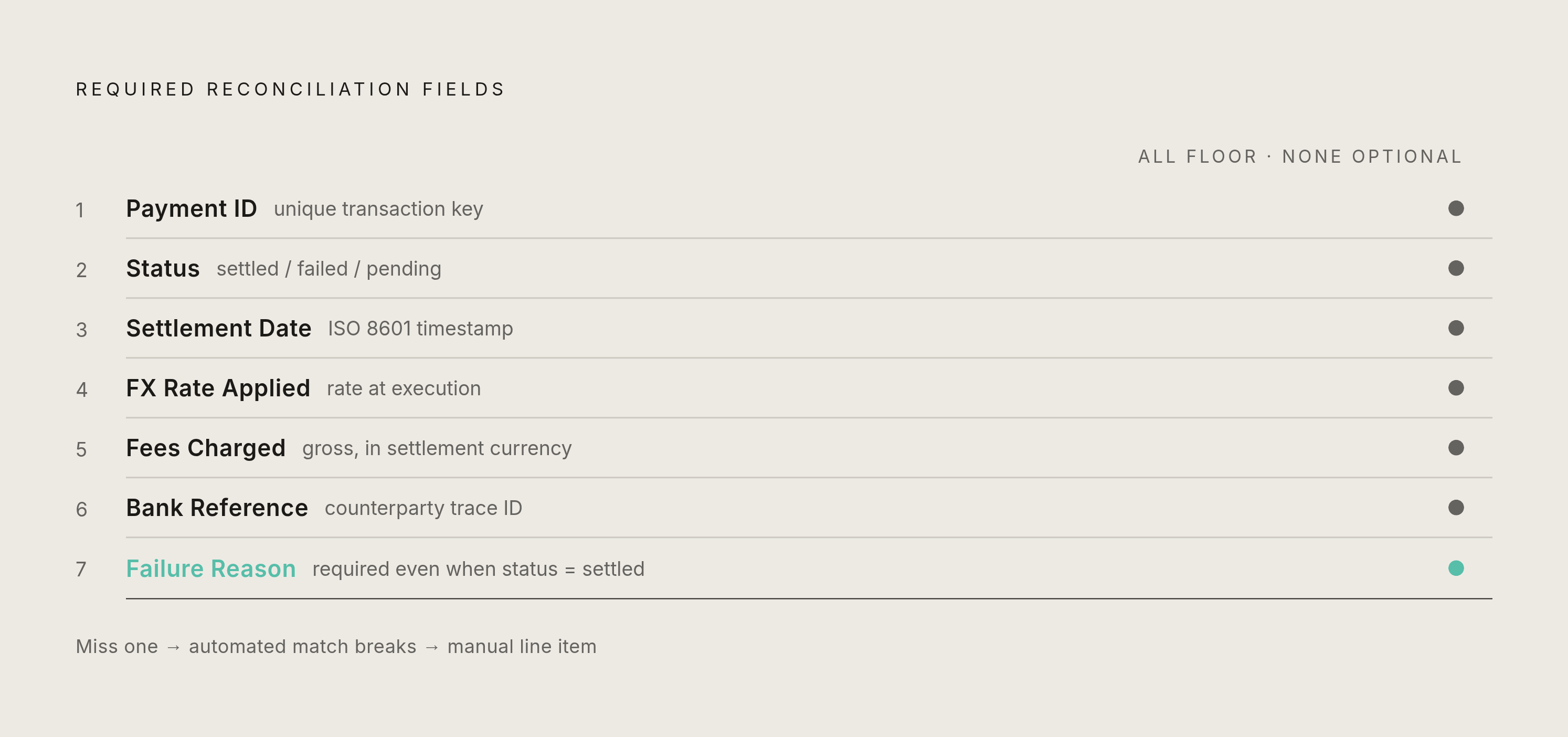
Reconciliation only closes without a manual scramble if the integration layer hands back a specific, consistent set of fields every time: payment ID, status, settlement date, FX rate applied, fees charged, bank reference, and failure reason. These seven fields are the floor, not a nice-to-have. Miss even one, and what should have been an automated match turns into a manual line item somebody has to chase down before the books close.
That's the real test of whether an integration pattern is working. Not whether the payment goes through, but whether the data trailing behind it lets finance close the loop without picking up the phone.