Payment Orchestration vs Payment Gateway
Orchestration layers route transactions intelligently; gateways execute single paths.
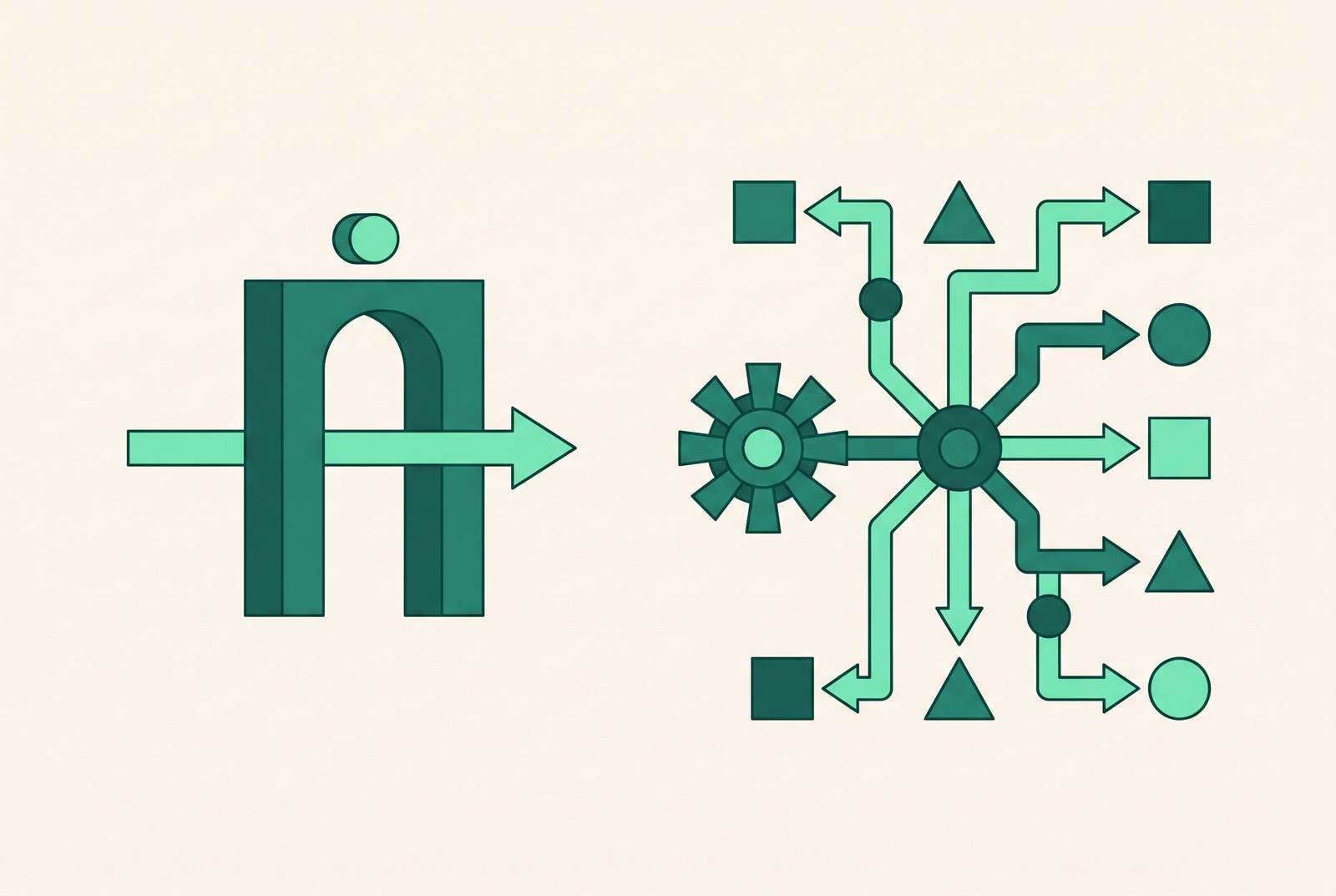
A payment gateway moves a transaction from checkout to approval. Payment orchestration sits above it, deciding which gateway, acquirer, or processor should handle that transaction in the first place. These aren't rival products competing for the same budget line, and treating them as an either/or choice is where most of the confusion in this market starts. The real question is when the second layer becomes necessary, not whether.
Start with the gateway, because nothing works without it. At checkout, it collects the customer's card details, encrypts them before they leave the browser, and sends the authorization request through the acquiring bank to the card network and on to the issuing bank. The response, approved or declined, comes back in seconds, and that round trip covers four jobs the gateway does on every transaction: encryption, authorization, fraud screening against a rule set, and storing the record so the merchant can check it later.
A gateway is not a processor, and conflating the two is a common mistake worth correcting early. It opens and secures the authorization handshake, but the actual movement of money, clearing and settlement, happens separately and typically lands one to two business days after the sale. Stripe and Adyen bundle gateway and processing into one service, which is part of why early-stage merchants gravitate toward them, since fees are predictable, and for a business selling in one country with one currency and no unusual payment flows, that predictability is a real advantage, not a compromise. Banks run their own gateways too, alongside their acquiring services, and that alone tells you something: the gateway is commodity infrastructure. It was never meant to be anyone's competitive edge.
Orchestration doesn't replace any of that. It's middleware that sits on top of multiple gateways, acquirers, processors, and payment methods, and exposes them through a single API, a framing Primer uses that gets the idea across cleanly. The checkout still talks to gateways. What changes is who decides which gateway handles which transaction, and that decision now runs in the background, automatically, on every transaction that comes through.
A handful of capabilities only exist at this layer. Smart routing checks each transaction, usually within 20 to 50 milliseconds according to Crafting Software, against cost, historical approval performance, geography, currency, and whether a given provider is healthy right now. Cascading picks up where a decline would otherwise end the sale: if the first provider rejects the charge, the system retries it through a different one, invisibly to the customer. Tokenization becomes provider-agnostic, so stored card credentials live in a vault usable across gateways instead of being locked to whichever one first collected them, and payment method coverage expands without a checkout rebuild, since orchestration platforms now connect a wide range of localized payment methods. Settlement data from every connected provider gets normalized into one reconciliation report instead of several separate dashboards, and compliance work for PCI-DSS and GDPR gets built into the orchestration layer itself rather than repeated for each new gateway integration.
Building that single API costs more upfront than wiring up one gateway. But it replaces what would otherwise become a growing stack of separate technical integrations, separate reporting formats, and separate operational habits for every provider added later. ACI Worldwide draws the line cleanly: orchestration manages the entire payments flow from one API and one interface, while a gateway manages a single transaction path. That's the whole difference, and it's not a small one.
Why the two are sequential rather than competing choices
Orchestration contains gateways rather than standing apart from them. An orchestration platform still routes transactions through one or more gateways underneath it, and take the gateway out, there's nothing left to orchestrate. That makes the "vs." in most vendor comparisons a little dishonest, and any pitch that frames the two as competitors is selling something it shouldn't be.
For a business just starting out, selling in one market, with simple payment flows and a small engineering team, a control layer above the gateway solves problems that don't exist yet. Paying for it early is close to a waste of engineering time. The gateway's fixed routing and fixed fees aren't a limitation at that stage. They're exactly what a lean team needs: one integration, one predictable cost structure, one thing to monitor.
The picture changes as volume grows, as the business enters new markets, or as customers start expecting payment methods the current gateway doesn't support. The routing decisions a gateway makes by default, the same provider every time, a fixed scope for stored tokens, start costing real money and carrying real risk. Stripe frames it well: with a gateway, most of the decisions about how a payment gets processed are fixed by the provider's own system. Orchestration hands those decisions back to the merchant.
None of this is a knock on gateways. Their fixed decisions are the right decisions when a business doesn't yet have the volume or the geographic spread to benefit from second-guessing them. What matters is how the two work together over time, and what breaks first once the gateway that used to be sufficient stops being able to keep up.
The revenue cost of routing every transaction down a single path
A single gateway sends every transaction down the same path, even when that path performs badly for certain card types, certain currencies, or certain regions. Nothing notices, nothing corrects for it. The transaction either clears or it doesn't, and the merchant has no lever to pull mid-flow. That's the actual cost of a single gateway: not that it fails outright, but that it can't tell a bad route from a good one, and it never finds out because nothing is watching.
Authorization rate is where this shows up first, and the size of the number is what should change a finance team's math. Merchants report a 2 to 4% immediate lift in authorization rates after turning on intelligent routing, according to Orchestra Solutions, climbing to 5 to 10% as the routing system builds up transaction history. Nuvei's 2024 research, cited by BAMS, found smart routing turns as much as 5% of declined transactions into approvals that would otherwise have just been lost sales.
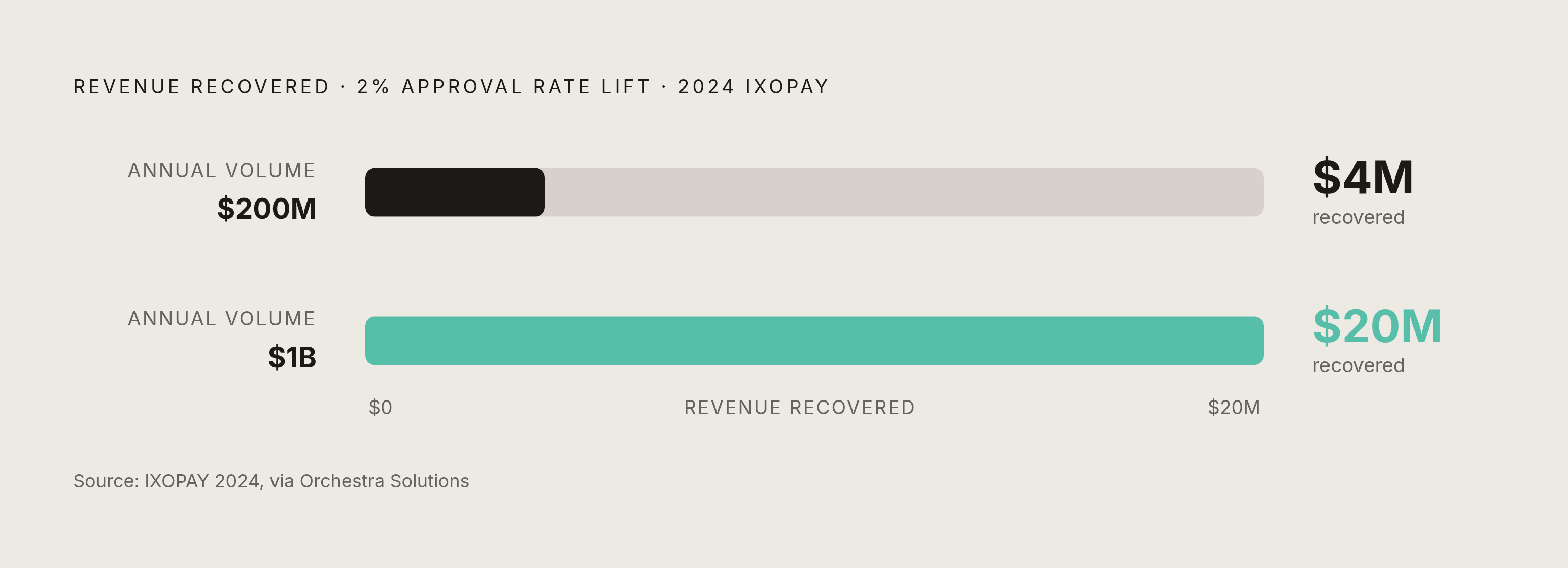
Put a dollar figure on it and the argument stops being abstract. A 2% improvement in approval rates works out to $4 million in recovered revenue on $200 million in annual volume, and $20 million on a billion dollars in volume, according to 2024 IXOPAY figures cited by Orchestra Solutions. Real companies bear this out: Banxa recovered more than $7 million in the first half of 2024 alone using Primer's cascading fallback system. inDrive lifted payment approvals by 11%, and Preply recovered 30% of previously failed payments, both running on Payrails with unified analytics behind them. Zeely scaled processing volume 100x over three years with Solidgate, routing and cascading across JPMorgan Chase, Adyen, and Checkout.com for an 8-percentage-point lift in approvals.
Subscription businesses carry a version of this risk that compounds every billing cycle. FlyCode projects involuntary churn, cards that fail to renew for reasons unrelated to fraud, will cost subscription companies substantial lost revenue. A 2024 Forrester Consulting study found every subscription brand surveyed reported some negative impact from failed payments, no exceptions. Single-path routing strips out the retry logic and fallback routing that would otherwise recover a meaningful chunk of that automatically.
What happens when a single gateway goes down
An outage on a single gateway stops payment acceptance cold. Every transaction on that path fails at once, according to Stripe, and there's no alternate route to fall back on, because none was built.
That's not a rare event, either. Unplanned outages are common across the industry, and businesses running a single gateway have no alternate route when one occurs. Orchestration's answer is automatic failover: transactions reroute to a working provider during downtime, and checkout keeps functioning even while one piece of the underlying infrastructure is down.
There's a commercial version of this risk too, separate from downtime itself. FreedomPay calls it the puppet-master effect: when gateway, processor, and point-of-sale get bundled into one all-in-one setup, the merchant has no lever to pull if that provider's performance slips. The same lock-in shows up again at contract renewal, where a single bundled provider knows switching costs are high and can let fees drift upward without much pushback. Orchestration flips that balance. A merchant can add, swap, or deprioritize a provider through configuration rather than a rebuild, and that optionality alone is what keeps a vendor's pricing and uptime honest.
The threshold signals that tell a business it has outgrown a single gateway
No single number marks the moment. It's a cluster of signals, and they tend to show up together rather than one at a time.
Geographic expansion usually comes first. Entering a new market means local payment preferences, new currencies, and local compliance rules, and a gateway built around one region handles that poorly, if at all. Orchestration platforms support a wide range of currencies and connect a broad array of localized payment methods. High transaction volume paired with visible decline patterns is the second signal: once reporting shows authorization rates dipping for certain card types or regions with no way to reroute around it, the revenue cost of fixed routing has already started accruing.
Scale itself is the third, blunter signal. At sufficient scale, the return on orchestration can show up within weeks. Spark has reported that intelligent routing can deliver a 30% reduction in processing costs, making the case against orchestration platform costs compelling at scale. Recurring billing at scale changes the calculation on its own too, since failed-payment recovery through automated retries and alternate routing simply isn't available on a single gateway, and the revenue at risk grows with every subscriber added. Engineering overhead is the quieter signal: once a team is maintaining separate integrations, separate reconciliation formats, and separate dashboards for each gateway, orchestration replaces that patchwork with one governance layer instead of five. Outage exposure grows with volume on its own, too. The cost of one provider's downtime eventually gets too large to sit with unprotected.
Primer's own checklist is a useful shorthand. Single market, simple payment flows, modest growth plans, spare engineering capacity, and outage risk the business can live with, all point toward staying on a gateway. Multi-market ambition, the need for cascading, the ability to switch providers fast, and a push to raise approval rates point the other way. A business that matches more than one or two items on the second list and stays on a single gateway anyway is taking on unmanaged risk. It's leaving money on the table it can already see.
How the orchestration market reflects the breadth of businesses crossing that threshold
Estimates of the orchestration market's size vary depending on how analysts define it, landing somewhere between $1.7 billion and $2.7 billion in 2025, but growth estimates cluster tightly around 18 to 21% a year. Mordor Intelligence puts the market at $2.65 billion in 2025 growing to $7.27 billion by 2031, an 18.31% compound annual rate. SkyQuest starts lower, at $1.69 billion in 2024, but projects growth to $9.34 billion by 2033 at a 20.9% rate. The spread matters less than the direction: both point to a market growing faster than payments volume overall, which means the businesses adopting orchestration aren't a niche. They're the leading edge of where volume is headed.
Adoption is already happening, not waiting to happen. More than 1,200 new integrations between merchants and orchestration vendors went live globally between the first quarter of 2023 and the first quarter of 2024, a 19% year-on-year jump, according to Market Reports World. Among large enterprises, 70% had adopted multi-provider orchestration systems by 2024, per Orchestra Solutions.
Retail and pure e-commerce drove 59.10% of 2025 orchestration platform revenue, according to Mordor Intelligence, and that's the sector where cross-border volume pressure shows up earliest and hardest. B2B workflows still hold the larger current share of orchestration volume at 55%, but B2C deployments are growing faster, at 22.3% a year, pushed by rising expectations around checkout speed. Healthcare is the fastest-growing vertical of all, at a 24.4% compound annual rate, as telehealth providers work to blend HIPAA compliance with real-time insurance eligibility checks and co-pay processing. Online retail isn't the only place this threshold gets crossed.
Regionally, North America holds around 36% of the market in 2025, according to Vantage Market Research, built on deep e-commerce penetration and infrastructure like FedNow. Asia-Pacific is growing faster, at a 20.4% regional rate per Mordor Intelligence, which lines up with how fragmented local payment methods are across the region, fragmented enough that a single gateway rarely covers what's needed there. Behind all of it sits one macro shift worth naming: 54% of payments worldwide were cashless in 2025, up from 50% in 2023, according to Stripe. That's the floor orchestration demand is being built on.
How AI is changing what orchestration engines can do in real time
Early orchestration ran on rules someone configured by hand: route this card type here, that currency there. The newer generation uses machine learning to adjust routing decisions as conditions shift, without an engineer rewriting the logic every time something changes, and that difference is the whole story of where this technology is headed next.
Checkout.com's Intelligent Acceptance shows where this is headed. The engine trained on more than 20 billion data points across its network, ran 60 million real-time payment optimizations a day in 2024, and lifted merchants' acceptance rates by an average of 3.8%, according to FlyCode, largely by reformatting transaction messages to match what each issuer prefers and picking the best local acquiring route automatically. The decision window hasn't gotten longer: still 20 to 50 milliseconds, per Crafting Software. AI is improving what happens inside that window, not stretching the window itself, and that speed limit isn't negotiable no matter how good the model gets.
The improvement also compounds with time. That 2 to 4% immediate lift in authorization rates mentioned earlier climbs to 5 to 10% as the routing system accumulates more transaction history to learn from, according to IXOPAY and Gr4vy. Tokenization runs on the same logic: AI-driven card updaters keep stored credentials current, heading off declines that would otherwise happen simply because a card expired or got reissued. The timing implication follows directly: a platform adopted now starts learning now. Waiting doesn't just delay a feature. It delays the learning curve sitting underneath it, and that curve doesn't back-fill itself later.
Making the decision: matching the solution to where the business actually is
None of this is a one-way door. A business that launches on a single gateway and adds orchestration two years later is following a common, sound sequence, the order these two layers were built to work in.
A gateway is still the right call for a business selling in one market, with a short list of payment methods to support, simple flows, an engineering team that can handle the integration without strain, and volume low enough that fixed routing isn't costing anything measurable yet. Orchestration earns its cost once a business is chasing multiple markets at once, once outages or declines start showing up as line items instead of edge cases, and once the team managing separate gateway integrations is spending more time on maintenance than on anything that actually grows the business.
The mistake worth naming plainly: staying on a single gateway past that point isn't caution, it's a hidden tax, paid quietly in declined transactions and unrecovered churn that never shows up as a single line item anyone questions. Once several of those signals show up together, the gateway that used to be enough stops being enough. At that point, the layer above it stops being optional and starts being the thing standing between the business and the revenue it's already losing.
Sources
- Payment Orchestration vs. Payment Gateway | Stripe
- Payment orchestration vs. payment gateway: which is best? | Blog | Primer
- Payment gateways vs. payments orchestration: what’s the difference, and why it matters | ACI Worldwide
- flycode.com
- orchestrasolutions.com
- Payment Orchestration: How Modern Platforms Route Payments Intelligently
- mordorintelligence.com