Africa Mobile Money Corridors and Settlement Economics
Africa's cross-border payments market is on track to nearly triple over the next decade, from USD 329 billion today to USD 1 trillion by 2035, according to MicroSave Consulting. That growth is stacking on top of a mobile money base that already handles most of the world's mobile money activity. A system moving that kind of volume cannot keep running on informal, bilateral improvisation, built one correspondent bank relationship at a time. The corridors that win over the next decade will be the ones that cut the dollar out of the middle, and the operators still bolting another app onto the same old correspondent banking chain are going to lose ground fast.
The corridor as the basic unit: what a mobile money corridor actually is and how it differs from a simple transfer
A corridor is not a pipe with money flowing in one end and out the other. It's a pairing of two markets, each with its own regulator, its own currency liquidity conditions, its own operator networks, and its own rules for whether systems talk to each other at all.
Domestic mobile money is comparatively simple: one regulator, one currency, and the operator manages the float itself. Cross-border mobile money multiplies every variable at once. There are two or more regulators to satisfy, a currency conversion to run, some kind of correspondent or hub-based clearing to route through, and liquidity that has to sit pre-funded in the destination market before a single transaction clears. Under the older model still common across most intra-African corridors, a payment gets routed through an external correspondent bank, settles in USD or EUR, then converts back into local currency once it lands. Each hop is a cost point and a delay point at once, and each hop is a liquidity event too: somebody has to hold the float while the money sits in transit, and that somebody prices the risk into the fee.
Kenya is the case worth studying closely, because it shows how much corridor structure depends on domestic regulatory posture. It holds close to a quarter of the region's mobile money activity, anchored by M-Pesa's more than 34 million active users, which gives Kenya an entry and exit point for corridor traffic that smaller markets simply can't match. Tanzania and Uganda run multi-operator markets, which shapes corridor access very differently from Kenya's, where one dominant operator anchors the system. Ghana, meanwhile, scored 95.06 on GSMA's 2024 Mobile Money Regulatory Index and has become something of a template: a market whose regulatory design now decides which corridors and new payment models can plug in on its end.
Anyone pricing a corridor off the published fee alone is missing most of the actual cost, and that mistake is more common than it should be among people who ought to know better. Corridor economics are not a fee schedule. They're the sum of regulatory friction, FX structure, how liquidity gets positioned, and how many hands the money passes through between sender and recipient.
Who pays, and why: the layered cost structure of intra-African settlement
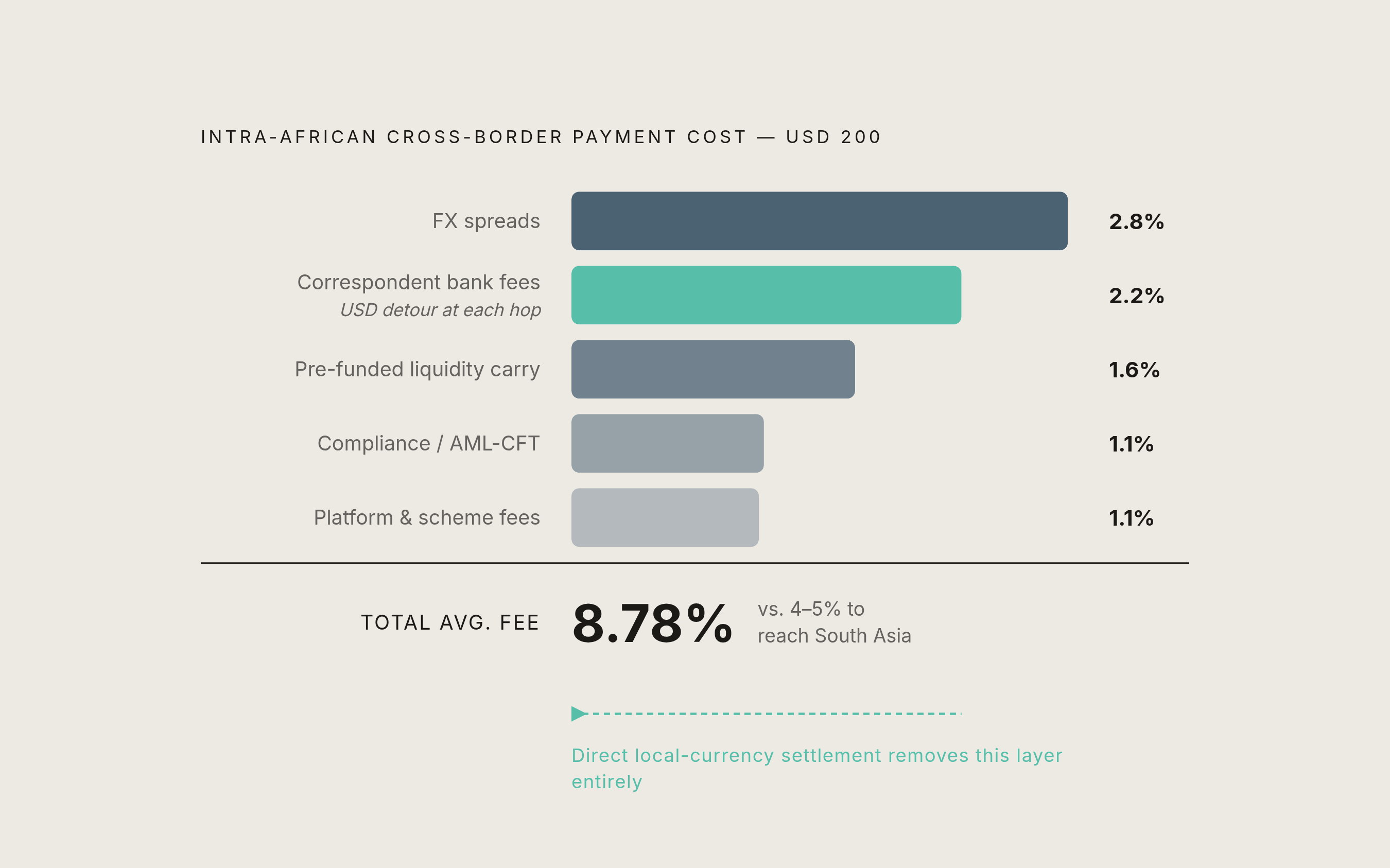
Sub-Saharan Africa is the most expensive place in the world to send remittances to. The average cost to send USD 200 runs 8.78%, nearly double what a sender pays to reach South Asia for the same amount, and that gap has nothing to do with distance or currency risk on its own.
That cost is not one fee. It's a stack of them, and the stack is the point. FX spreads get applied by banks and payment intermediaries along the route. Correspondent banks charge at each hop they touch. Compliance and AML/CFT checks add their own layer on top of that. Thin liquidity in local-currency pairs means capital has to sit pre-positioned, and holding that capital costs money in itself, before a single dollar moves. Platforms and schemes take a cut on top of all of it. In many bilateral corridors, there's simply not enough competition to push any of this down. That's the part regulators tend to underrate: they treat high fees as a market failure to monitor, not a structural one to fix, and that's backwards.
Duplo's research names a specific culprit inside that stack: the USD detour. Intra-African payments that route through USD or EUR clearance carry a cost premium that direct local-currency settlement would remove outright, no negotiation needed. The channel matters as much as the corridor, too. Mobile money remittances in West Africa run materially cheaper than bank-led channels, meaning the rail a payment travels on can matter more than which two countries sit on either end of it.
The World Bank's Remittance Prices Worldwide report (Issue 54, September 2025) counted 13 corridors globally with costs above 20%. Nine of those originate in Sub-Saharan Africa. Only two corridors from the entire region clear the UN's 3% Sustainable Development Goal target, against a far larger share of corridors worldwide meeting that bar. That gap is not a rounding error. It's a structural failure, and it's the one this piece spends the rest of its time explaining.
None of this cost is fixed or natural. It's a product of how a corridor gets built, which means it can be rebuilt.
Liquidity management as the hidden engine of corridor economics
Underneath every fee sits a liquidity problem, and it's the one most people evaluating these markets skip past. To guarantee same-day or near-instant settlement, an operator has to pre-fund wallets or nostro accounts in the destination market before the transaction even happens. That pre-funding costs money, and the size of the cost depends on how thin and erratic corridor volume runs, how volatile the currency is, how long the settlement cycle stretches, and how many intermediaries sit in the chain, since each one needs its own liquidity position.
MicroSave Consulting puts a number on the damage: roughly USD 5 billion a year lost to FX liquidity issues in African cross-border payments. Scale decides who absorbs that cost and who profits from it, and this is where the market splits in two. Large operators like M-Pesa and MTN MoMo, running high-volume bilateral corridors, can pool liquidity and net their positions, which brings the per-transaction cost of pre-funding down. Smaller operators, or anyone entering a new corridor, can't pool at that scale, so they pay more per unit and pass the difference on to users.
Interoperability hubs like Onafriq exist to solve exactly this, aggregating volume across many operators so that netting becomes possible in a way no single bilateral pair could ever manage alone. Value capture follows the same logic. Operators running their own FX books earn margin on conversion instead of paying an outside rate for it. Hubs and aggregators take a spread on whatever volume they route. Correspondent banks, wherever they're still in the chain, get paid for holding and releasing liquidity, and they've been pulling back from African corridors for years now, pushing central banks and fintechs to build their own liquidity mechanisms instead of leaning on Western banks that no longer want the exposure. Liquidity management, not fee negotiation, is the lever that actually decides whether a corridor works commercially, and at what price to the person sending the money.
The platform layer: how major operators have built cross-border infrastructure on domestic rails
M-Pesa moves more than USD 1 billion a day across Africa. In Kenya alone it processes more transactions than the entire banking sector combined, which makes it less a wallet product than a natural anchor point for corridor traffic that has nowhere else to route through.
MTN MoMo tells a similar story at a different scale. Its annualized transaction value crossed USD 260 billion in 2024, and MTN has since spun it off as a distinct fintech business unit, with analysts pricing a standalone valuation somewhere between USD 5 billion and USD 7 billion. MoMo has expanded into merchant acquiring, cross-border corridors, and API-based banking-as-a-service, positioning itself as regulated financial infrastructure across the region rather than a consumer app. That gap between the wallet's public image and the infrastructure valuation underneath it says something on its own: investors are pricing the settlement layer as the real asset, not the app icon sitting on top of it.
Onafriq, formerly MFS Africa, runs a different model entirely: the interoperability hub, or "network of networks," connecting more than 500 million mobile money wallets and over 200 million bank accounts across more than 40 markets. Founded by Dare Okoudjou in 2009, the hub model solves the bilateral liquidity problem directly, aggregating volume that would otherwise sit fragmented across dozens of separate corridor relationships. In 2026 alone, Onafriq launched the first wallet-based corridor between Nigeria and Ghana in partnership with PAPSS, rolled out Visa Pay in the DRC in September 2025, and adopted stablecoin settlement. Three distinct infrastructure moves inside a single year is not incremental progress. It's a company betting its whole model on the local-currency shift happening on schedule.
Flutterwave was valued at roughly USD 3.3 billion in a June 2026 Series E round that drew equity investment from Ripple, a clear sign that the line between payments infrastructure and stablecoin settlement has become a commercial question, not an experimental one anymore. Five African companies, Flutterwave, M-Pesa, MTN's MoMo, Mukuru, and Onafriq, made the 2026 FXC Intelligence Cross-Border Payments 100 list, sitting alongside Visa and PayPal.
The pattern across all of them holds without exception: build scale on domestic rails first, then extend across borders. Domestic depth is a prerequisite for corridor credibility, not something bolted on afterward, and any new entrant trying to skip straight to cross-border scale is building on sand. Platforms with both domestic depth and cross-border reach can offer partners net settlement instead of gross pre-funding, a real cost advantage that smaller entrants have no way to replicate on a bilateral basis. That's the moat, and it's why the next wave of consolidation in this market will happen around who controls liquidity, not who has the prettiest app.
What corridor improvement looks like in practice: the London-Lagos example
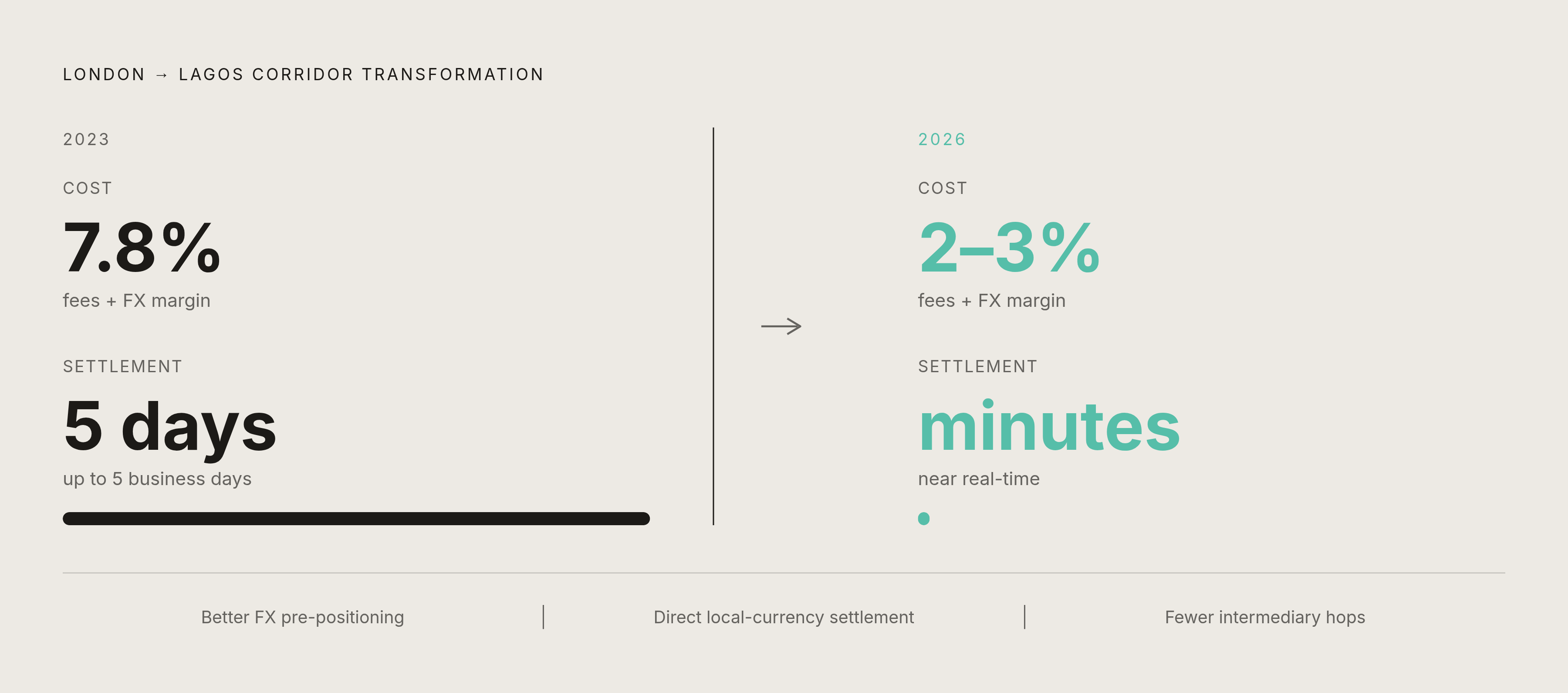
The London-Lagos corridor shows what corridor compression looks like once it actually happens. In 2023, sending NGN 100,000 from London to Lagos cost an average of 7.8% in combined fees and FX margins, and settlement could take up to five business days. By 2026, the same transfer runs at 2-3% through diaspora-focused apps like Lemfi and Sendwave, and settlement happens in minutes, not days.
No single technology drove that shift. It came from better FX pre-positioning, more direct local-currency settlement routes, and fewer intermediary hops, each one chipping away at a different layer of the cost stack described above. Remittance inflows to Sub-Saharan Africa run into the tens of billions of dollars annually, with Nigeria accounting for a significant share of regional flows. London-Lagos isn't a case study picked for convenience. It sits at the economic center of the region's whole remittance picture.
But the improvement is uneven, and that unevenness deserves more weight than it usually gets. London-Lagos compressed largely because of volume, since high volume is what makes efficient pre-funding possible in the first place. Thinner corridors, serving smaller diaspora populations or poorer sending communities, haven't seen anything close to the same shift, and they won't, not through competition alone. Corridor economics reward scale, which means the corridors that need cost relief the most are structurally the last in line to get it. Fixing that will take shared infrastructure, not another round of operators fighting over the corridors that already work.
PAPSS and the shift to local-currency settlement infrastructure
PAPSS, the Pan-African Payment and Settlement System, launched by Afreximbank and the African Union in 2022, is the clearest attempt so far at building that shared infrastructure. By early 2025 it was operating across 17 countries, connecting 14 national switches and more than 150 commercial banks. It is designed to remove the intermediary currency altogether: no USD, no EUR, direct settlement in African currencies. MicroSave Consulting puts the payoff at up to a 50% reduction in transaction costs, with settlement times dropping from days to seconds.
In mid-2025, PAPSS launched the African Currency Marketplace, letting settlement happen directly between African currencies without the dollar ever entering the transaction. The point is to open up trade corridors that currently don't function at all, simply because no direct currency pair exists between the two markets involved. In early 2026, Onafriq and PAPSS launched the first wallet-based outbound payment pilot from Nigeria to Ghana, with more PAPSS-linked corridors expected across ECOWAS.
Finextra frames PAPSS's significance in institutional terms, not just efficiency terms: it's part of the architecture supporting intra-African trade under AfCFTA, and local-currency settlement is a shift in financial sovereignty as much as a shift in transaction cost. Practically, PAPSS changes settlement economics three ways. It removes the USD clearing hop, cutting out one of the most persistent cost layers in the whole stack. It connects national switches to each other directly, cutting dependence on correspondent banks that have been pulling back from African corridors anyway. And netting across the PAPSS network reduces the pre-funding burden that each bilateral corridor would otherwise have to carry alone.
The limitations are real, though, and worth stating plainly instead of waving away. Regulation across member states remains fragmented, licensing regimes are inconsistent from one market to the next, and approval timelines for fintechs seeking cross-border scale can stretch out to three years. The infrastructure is live. The regulatory harmonization needed to actually use it is still years behind, and that gap, not the technology, is the real bottleneck.
Instant payment systems as a parallel cross-border layer
Africa now runs 36 live instant payment systems, and 11 of them support cross-border transactions, up from just 6 in 2024, according to AfricaNenda's 2025 SIIPS report.
Instant payment system (IPS) linkages solve a different problem than PAPSS does. A single IPS connection gives a participating payment service provider access to every counterparty in a linked market at once, which beats negotiating bilateral agreements with individual aggregators one at a time. Harmonized scheme rules across linked markets also cut down on operational and compliance overhead. Settlement through these systems is instant and irrevocable too, which solves a problem raised earlier: working capital trapped inside slow settlement cycles, a real burden for the small and mid-size businesses that depend on these corridors to get paid on time.
A few regional IPS efforts are already in motion. BCEAO's PI-SPI gives the Central Bank of West African States' member economies a regional instant payment rail built specifically for the WAEMU bloc. Other regional systems, including TCIB, are extending similar cross-border instant settlement into their own parts of the continent, running alongside PAPSS rather than replacing it.
Between the two, a settlement architecture built for Africa's own currencies and its own trade patterns is starting to take shape. It's not finished. It's under construction, and the corridors that adopt it early are the ones that will set the price for everyone else.