Payment corridor economics: why the same $50,000 transfer costs wildly different amounts depending on the route it takes
Corridor economics determine why the same transfer costs vastly different amounts.

The global payments industry has a truth it rarely volunteers: two transfers for the same amount of money are not the same transfer. Send fifty thousand dollars from New York to London and the experience is nearly frictionless. Send the same amount to Lagos, Karachi, or rural Guatemala, and you are suddenly operating inside a completely different financial universe, one with steeper fees, slower settlement, and layers of intermediary banks each quietly extracting their share. That discrepancy is not an inefficiency waiting to be fixed. It is the intentional architecture of how global payment corridors are built and priced.
What a Corridor Actually Is
A payment corridor is the pathway money travels between two countries. New York to London is a corridor. Nairobi to Toronto is a corridor. Each one has its own infrastructure, its own regulatory environment, its own network of correspondent banks, and its own economics. Those things do not transfer from one route to another.
Well-traveled corridors between wealthy, financially integrated economies are deeply competitive. Banks, fintechs, and payment networks all fight for share of that flow, and competition compresses margins. The sender benefits, mostly without knowing why.
Corridors connecting emerging markets, frontier economies, or countries with limited banking infrastructure work differently. Volume is lower, compliance costs are higher, fewer institutions are willing to participate, and the sender picks up the tab. Not because anyone decided to penalize them specifically. Because the underlying economics leave little room for anything else.
The Correspondent Banking Problem
Most people assume that when they wire money internationally, their bank sends it directly to the recipient's bank. That is almost never what actually happens.
What happens is a chain. Your bank instructs its correspondent bank, which instructs another correspondent, which eventually reaches the destination institution. Each link charges a fee. Those fees are frequently opaque at the point of initiation, so the sender agrees to a transaction without a complete picture of what it will actually cost, a detail that surfaces only when the recipient calls to say the amount was short.
On the transatlantic route, correspondent relationships are mature. Banks have maintained direct lines with each other for decades. The chain is short.
On a corridor running into a country with limited correspondent banking relationships, that chain gets long fast. Compliance risk, currency illiquidity, and regulatory unpredictability make banks reluctant to hold direct relationships with institutions in those markets. So the money hops. Each hop adds time and cost, and by the time funds arrive, the recipient has received less than either party anticipated. The wire went exactly as planned. It just took everyone else's plan into account too.
Currency Liquidity as a Hidden Tax
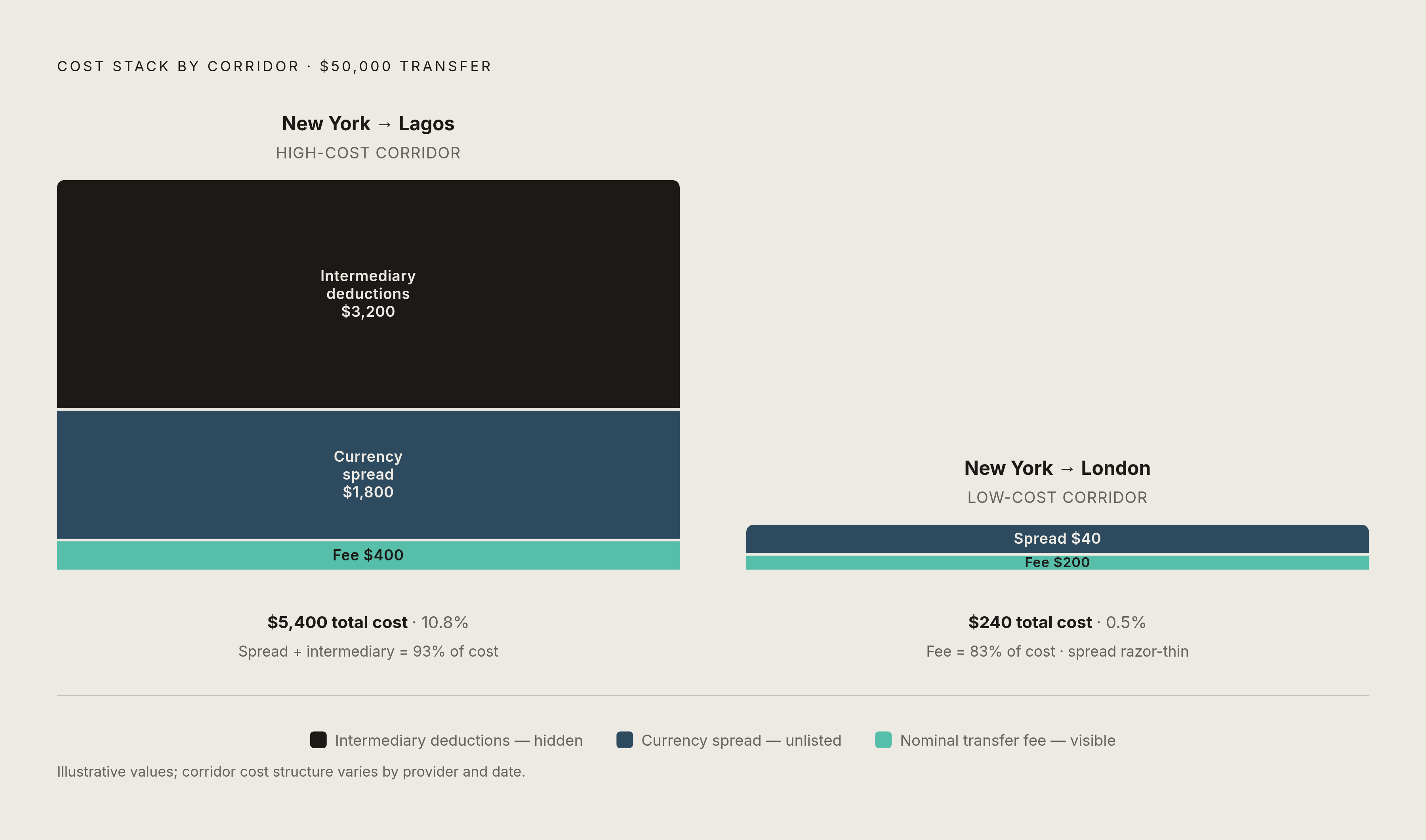
Transfer fees are visible. Exchange rate spreads are not, and that asymmetry is where a significant portion of the real cost actually lives.
Major currency pairs, dollars to euros, pounds to yen, are traded in enormous volumes around the clock. The spread between buy and sell prices on those conversions is razor thin because the market for them is deep and liquid. Converting into a thinly traded currency is a different proposition entirely. The institution handling that conversion is absorbing genuine currency risk, and they price that risk into the rate they offer. The nominal fee looks modest on the confirmation screen. The spread is frequently the larger number, and it is baked into the conversion rather than listed as a line item.
This is why corridor economics cannot be evaluated on fees alone. The total cost is the fee plus the spread plus any intermediary deductions that were never quoted at initiation, measured against what the recipient actually receives. Assembling that complete picture before a transaction clears is harder than it should be.
Regulatory Compliance as a Cost Driver
Compliance is not free, and its cost varies dramatically by corridor. Sending money into a country with stringent anti-money-laundering requirements, currency controls, or sanctions adjacency requires real investment in due diligence, documentation, and monitoring. That cost gets passed through, because no institution absorbs meaningful compliance overhead out of charity.
The harder reality is who this affects most. The people who most depend on affordable, reliable international transfers, migrant workers sending remittances back to families in less financially developed countries, are frequently operating in the most expensive corridors precisely because those destinations carry the highest compliance burden. The populations with the greatest need for accessible cross-border payments are often paying the highest price for access to them. That is not a coincidence. It is a structural outcome of how compliance costs are allocated.
Volume Holds the Whole Thing in Place
Volume is the quiet variable that determines whether a corridor attracts genuine competition. When enough money flows between two points, institutions invest in the infrastructure to move it efficiently. Technology gets built, relationships get established, pricing falls.
Low-volume corridors attract minimal investment. Fixed costs of compliance, technology integration, and correspondent relationship management spread across far fewer transactions, so per-transfer economics deteriorate. Fewer providers enter the market, competitive pressure stays weak, pricing holds high, and elevated pricing discourages some senders, which keeps volume low, which keeps the corridor unattractive to new entrants. The cycle holds itself in place without anyone actively maintaining it.
What Newer Entrants Are Actually Changing
Several fintechs and non-bank payment companies have made genuine progress on specific corridors by doing something structurally different. Rather than routing through correspondent banking networks, they have built local banking relationships at both ends of a corridor, holding balances in multiple currencies and netting transfers internally. The money never actually crosses a border in the traditional sense. Dollars go in one side, local currency comes out the other, settled through local rails.
This model cuts the correspondent chain problem significantly where it has been deployed. It works best where volume is sufficient to justify maintaining local relationships and currency positions. On high-volume corridors, it has been genuinely disruptive to legacy pricing. On low-volume corridors, the unit economics often do not support it, and the traditional correspondent model persists, largely unchanged. The innovation is real. Its reach, for now, is selective.
The Fifty Thousand Dollar Lesson
A large transfer does not automatically get cheaper on a relative basis. On a low-cost corridor, a fifty-thousand-dollar wire is fast, transparent, and inexpensive in relative terms. On a high-cost corridor, that same wire triggers additional compliance scrutiny, larger absolute fees, and meaningful exchange rate exposure that was never disclosed upfront.
Flat fees become less relevant at larger amounts, but spread-based costs scale directly with the principal. A half-percent spread on fifty thousand dollars is two hundred and fifty dollars, and that is before intermediary deductions that were never quoted at initiation.
The corridor matters more than the amount. Before initiating a significant international transfer, understanding the specific economics of that route, its typical chain length, its currency spread dynamics, its regulatory overhead, is not optional diligence. It is the whole job, and most people skip it entirely until the recipient tells them the funds came up short.