Payment Corridor Risk Pricing for Frontier Markets
Correspondent banking exits and compliance costs drive frontier market pricing more than FX spreads.

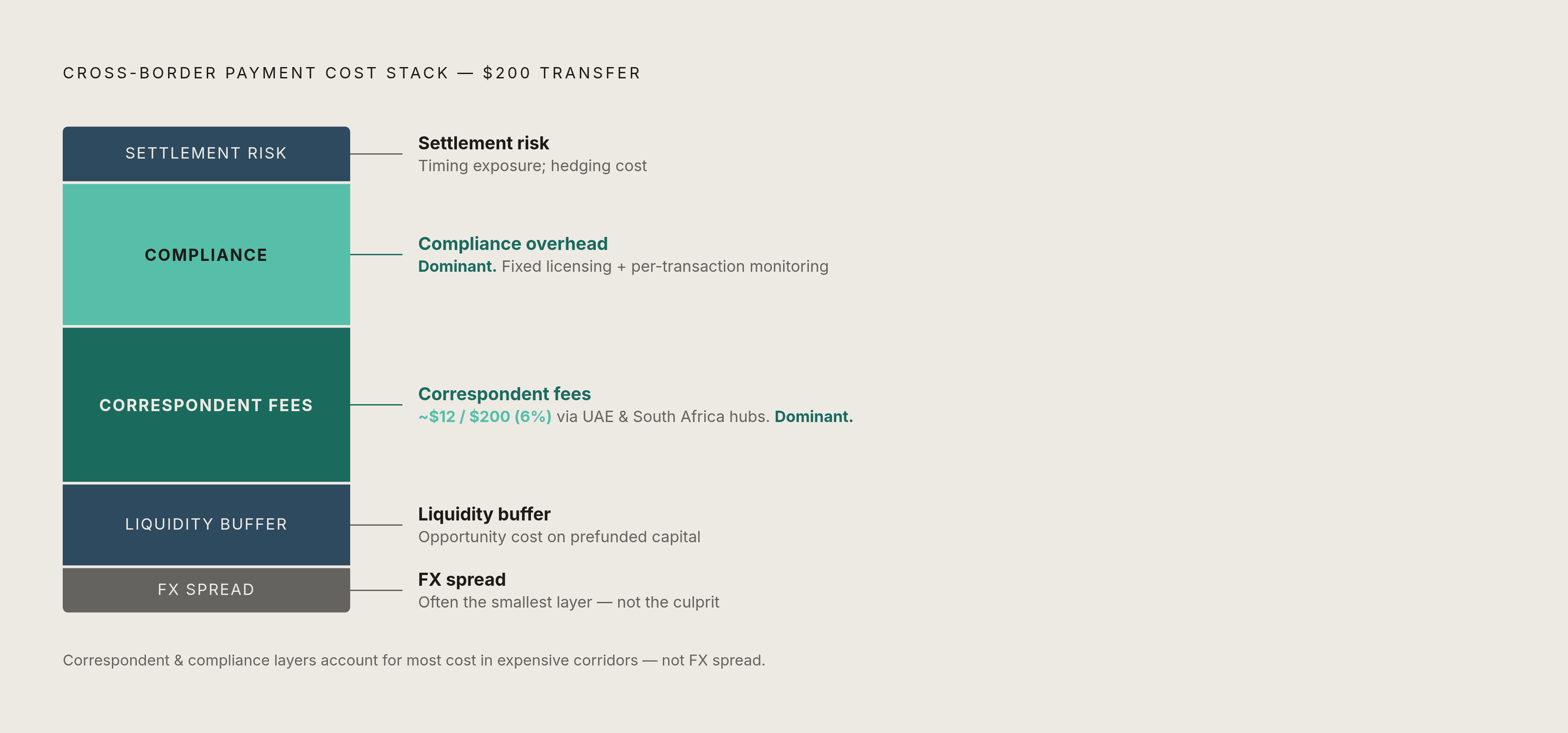
Payment corridor pricing in frontier markets is a stack: FX spread, liquidity buffer, correspondent fees, compliance overhead, and settlement risk, each moving on its own schedule for its own reasons. Global remittances reached an estimated hundreds of billions of dollars in 2024, with most destination countries in emerging markets, and most of that money lands in places where the plumbing hasn't kept up with the volume. Operators who treat the whole thing as one "risk premium" overpay for costs that are actually separable, and in some cases, negotiable. Here's the part that surprises people: correspondent banking withdrawal and compliance overhead do most of the damage in the corridors that look expensive, and FX spread, the layer everyone blames first, is usually a smaller line on the invoice than assumed.
Start with what frontier markets lack, because the absence is the whole story. Thin interbank depth means there aren't enough market-makers to absorb large orders without moving the price. Managed or restricted FX regimes mean the official rate and the real rate can diverge, sometimes by a lot. Limited foreign investor access keeps capital thin on the ground, and a lot of these corridors still don't have payment-versus-payment settlement, the mechanism that lets both legs of an FX trade clear at the same instant so neither party sits exposed. Strip those four things out of a currency market and the pricing behavior below follows almost mechanically: wide, jumpy, hard to predict.
The base FX spread and how it is constructed on exotic pairs
On a pair like EUR/USD, market-makers quote tight spreads because they can hedge all day, continuously, in a market with close to bottomless depth. A frontier pair works differently: that hedge either doesn't exist or costs too much to run constantly, so the market-maker prices the spread to cover the risk of sitting on inventory it can't offload right away.
The mechanics are plain once laid out. Fewer market-makers means each one carries more directional risk per quote, since nobody else is around to take the position off their hands. Some frontier currencies don't trade around the clock either, so the spread has to price in overnight gap risk, the chance something moves while the market sleeps and the rate jumps against the position. Then there's the parallel market problem: capital controls create a second, unofficial exchange rate running alongside the formal one, and the quoted spread has to straddle both somehow. The Argentine peso is the textbook case, with spreads that can move meaningfully within a single trading day depending on which rate the market actually trusts at that moment.
Most providers don't put FX markup on its own line. It gets folded into the exchange rate itself, which makes this the murkiest layer in the stack for anyone trying to shop corridors on price. An operator negotiating this layer down has two real options: run a matched book internally so flow offsets flow, or bring enough volume to a liquidity provider that tighter quotes become worth the provider's while.
How liquidity depth and capital controls add a premium on top of the spread
Prefunding is the quiet cost nobody puts on the invoice. To guarantee settlement in a frontier currency, an operator has to hold a balance in that currency before the transaction even starts. That money sits there earning nothing and can't go anywhere else in the meantime, dead capital with a very live opportunity cost.
The more frontier the market, the bigger that buffer has to be, because thin liquidity means even a moderate transaction can move the local rate on its own. Liquidity providers respond by demanding more margin or collateral to cover that risk. Capital controls stack another cost on top: some currencies restrict repatriation outright, trapping working capital inside the country the moment it's earned. Others require pre-approval above certain transaction thresholds, and the resulting delay is a real cost even when nobody sends an invoice for it. Any currency outside a PvP arrangement also carries explicit settlement lag risk, the gap between when one leg clears and the other does, and that gap has to be priced somewhere.
Prefunding cost behaves like an interest-rate-and-duration problem more than a flat fee. A corridor with a two-day settlement cycle ties up capital for two days of opportunity cost; cut that to same-day and the buffer cost falls even if the quoted spread never moves. That's a structural advantage rather than a one-time discount, and it's one of the few places in the whole stack where an operator's own infrastructure choices, rather than corridor conditions, decide the outcome.
What correspondent banking de-risking actually does to corridor costs
Correspondent banking relationships dropped materially worldwide in the years leading up to 2025, and the losses concentrated hardest in Africa, South Asia, and the Middle East. Every time a global bank walks away from a correspondent relationship, whoever's left in the chain inherits something close to a monopoly on that route, and prices like one.
Major global banks reduced or exited African banking operations in recent years, citing compliance cost and reputational exposure. It's an entire class of bank deciding the juice isn't worth the squeeze. Traffic that used to move directly now reroutes through hubs in the UAE and South Africa, adding up to 48 hours and around $12 onto a $200 transfer, according to Mordor Intelligence.
The math from the bank's side is rational even when the outcome looks absurd. Compliance departments know the cost of one missed enforcement action dwarfs whatever revenue a small frontier correspondent account brings in, so the safe move is to leave before the exposure ever materializes. The knock-on effect for corridor operators: fewer intermediary options, less competitive pressure on hop fees, and higher per-transaction cost that somebody has to absorb or pass along. This layer behaves less like a spread that tightens with a good pitch and more like a fixed cost set by market structure. The only lever that moves it is volume, aggregated enough to matter to whoever's left standing in the chain.
The compliance cost layer and how it differs by corridor
Compliance cost is a different bill in every jurisdiction, not one number repeated across markets. AML and CFT reporting rules, beneficial ownership requirements, transaction monitoring thresholds: what's cheap to satisfy in Kenya can cost several times as much in Nigeria or Pakistan, purely because the paperwork and the reporting cadence differ.
The shape of that cost matters as much as its size. Licensing fees are fixed, so they hit hardest at low volume and shrink in relative terms as volume grows. Transaction monitoring and suspicious activity report filing scale roughly with how many transactions run through the pipe. Fines and enforcement actions sit off to the side as the tail risk: low probability, brutal magnitude when they land. That asymmetry is exactly why compliance teams stay conservative even when the expected-value math says they don't need to.
This layer also stacks on top of the correspondent layer rather than sitting beside it. Global banks charge a risk-adjusted correspondent fee that already has their own compliance cost baked in, so an operator routing through one of those banks pays compliance twice: once for its own overhead, once inside the bank's markup. As of Q1 2025, World Bank RPW Issue 53 showed twenty-two corridors globally with no low-cost qualifying service available at all, and in most of those cases the missing competition traces straight back to compliance cost as the wall keeping smaller providers out. Operators who build reusable compliance infrastructure, shared KYC tools, reporting pipelines that work across multiple corridors, spread that cost over more transactions. Everyone else pays it fresh, as a fixed cost, every time they enter a new market.
How the corridor cost stack looks in practice: regional benchmarks
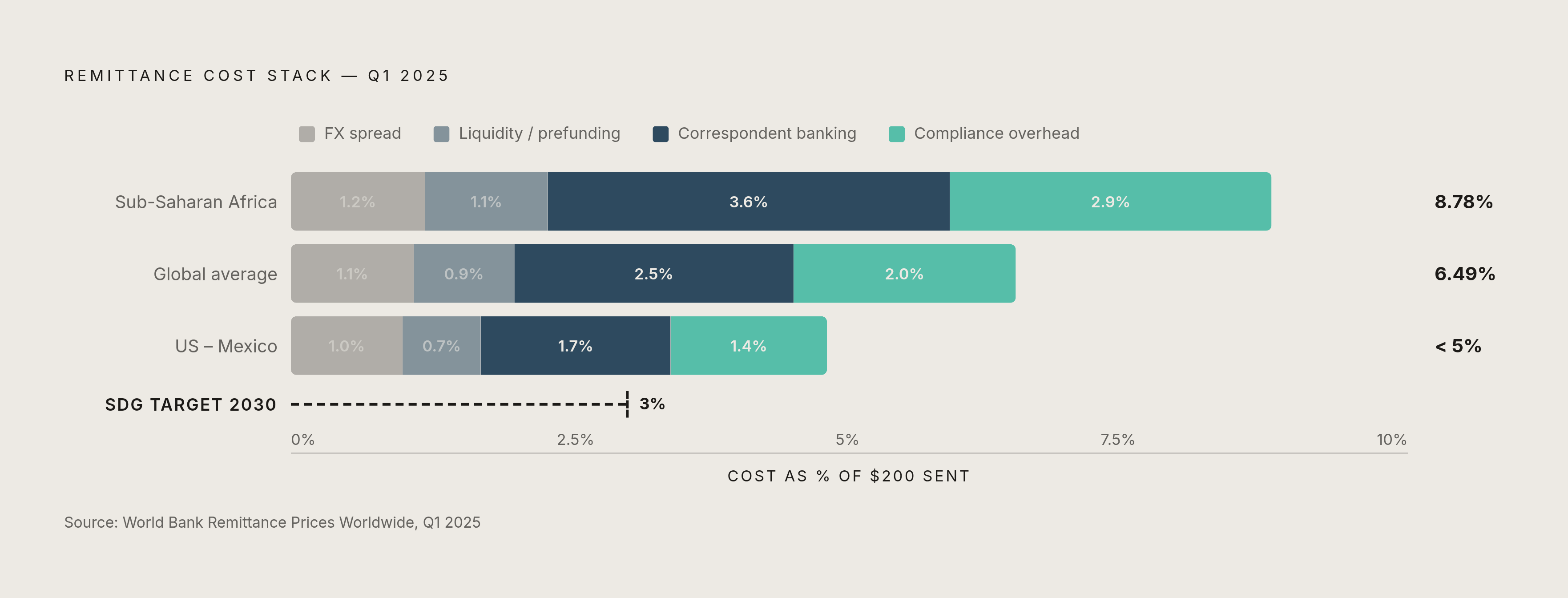
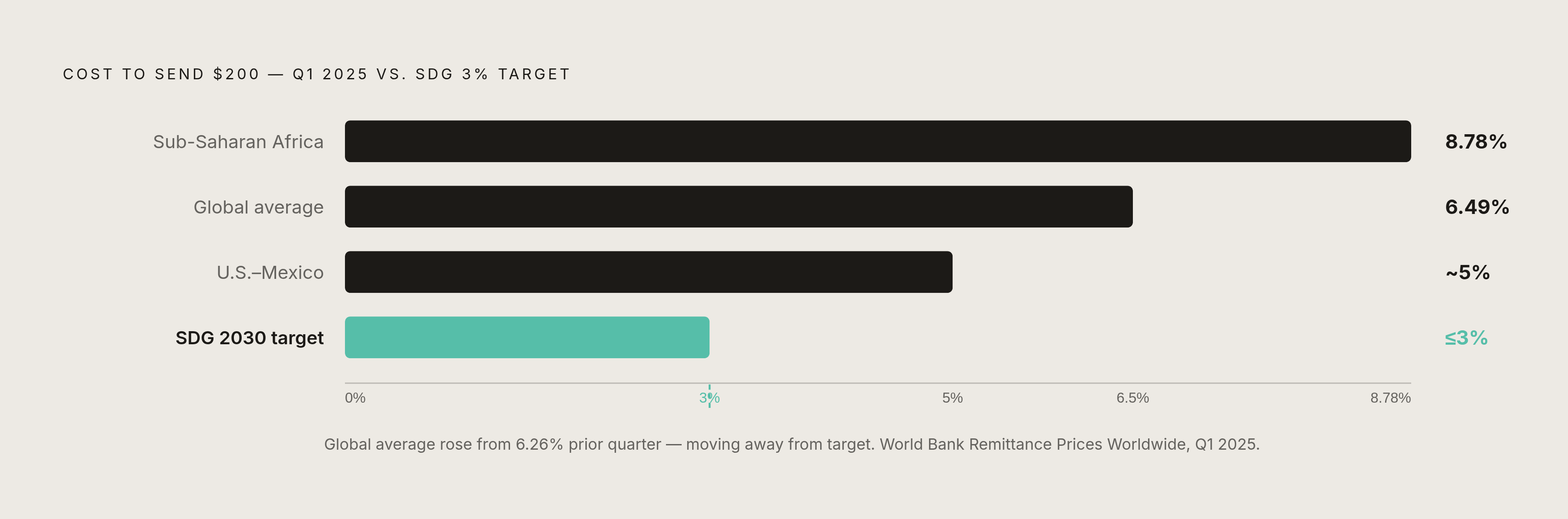
Here's where all four layers show up in one number. The global average cost of sending $200 sat at 6.49% of the amount sent as of Q1 2025, per the World Bank's Remittance Prices Worldwide report, up from 6.26% the quarter before. That's moving the wrong direction against the UN's Sustainable Development Goal target of 3% or below by 2030.
Sub-Saharan Africa is the stack at full weight. Sending $200 averaged 8.78% in Q1 2025, and many individual corridors inside the region ran considerably higher. Southern African intra-regional transfers sit toward the top of that range, which tracks once you remember they're carrying thin liquidity, correspondent withdrawal, and fragmented compliance regimes all at once, none of it cancelling out the others.
Contrast that with U.S.-Mexico, a corridor with none of the infrastructure gaps but plenty of volume: average fee just under 5% for a $200 transfer in Q1 2025, according to the Federal Reserve Bank of Dallas and the World Bank. Volume alone did the compressing there, without any rebuilding of the underlying pipes. South Asia comes in as one of the cheaper receiving regions overall in the same period, driven by remittance volume, a denser field of competing providers, and mobile money infrastructure that matured faster than in most frontier markets.
Provider type is the variable that should worry a pricing team more than geography does. Digital money transfer operators charged substantially less than banks in Q1 2025, with banks averaging significantly higher costs on retail remittances than digital providers on the identical corridor. Same corridor, same underlying stack, wildly different bill. That alone says the stack sets a range, and where a given transfer lands inside that range is a pricing decision, not a geographic sentence.
Where alternative rails — stablecoins and regional systems — actually reduce the stack
Stablecoin rails cut out the correspondent hop entirely, in corridors where on-chain liquidity runs deep enough to support it. On US-Mexico, that's brought remittance fees down from the traditional mid-single-digit range to under 1% in some provider setups. Stablecoin transfers have run meaningfully cheaper than traditional remittance channels on average in corridors where they operate — a real saving, but nowhere close to free.
The catch is the off-ramp, and it deserves to be taken seriously rather than filed as a footnote. Global stablecoin liquidity concentrates heavily in a handful of major trading pairs, and converting into Nigerian naira, Indonesian rupiah, Pakistani rupee, or Bangladeshi taka means dealing with thinner on-chain markets and wider conversion spreads. Those spreads claw back a chunk of whatever got saved by skipping the correspondent hop in the first place. Where only one or two providers can actually run that conversion, they hold the same kind of pricing power a monopoly correspondent used to hold, just wearing a different outfit.
Regional infrastructure takes a different swing at the same problem. Regional infrastructure like the Pan-African Payment and Settlement System aims to connect African countries through a shared continental settlement layer, cutting reliance on USD-intermediated hubs for transfers that never actually need to leave the continent. An operator routing intra-African payments through PAPSS can skip one or two correspondent hops entirely, which lines up directly against that $12-per-transfer hub routing cost mentioned earlier. Regulatory clarity has helped push institutional adoption of these rails too, as frameworks in multiple major jurisdictions have cut down the uncertainty that used to keep treasury teams parked safely on traditional rails.
The stack doesn't disappear here, though it does reroute pieces of it. FX spread and off-ramp liquidity stay wherever they were regardless of which rail carries the payment; what changes is whether the correspondent hop and some settlement lag get skipped along the way. The savings show up biggest where both ends of the corridor have a competitive local conversion market, and vanish fast where one end doesn't.
The levers operators actually control when building a competitive corridor price
Volume aggregation is the lever that touches every layer at once, which is why it's the first one worth reaching for. More flow earns tighter FX quotes from liquidity providers, and it spreads compliance and licensing overhead across more transactions, shrinking the per-unit hit. Where correspondent relationships still exist, enough volume can qualify for tiered pricing that a smaller operator never gets offered.
Rail selection is the second lever, and it only works if the operator has actually mapped which layer dominates cost on a given corridor before picking a rail. Correspondent-heavy routes, much of Africa and parts of MENA, are where stablecoin or PAPSS routing removes the biggest single cost line. FX-spread-heavy corridors running managed exchange regimes don't respond the same way; there, liquidity sourcing strategy matters more than which rail carries the payment.
Settlement cycle compression is a quieter lever but a real one. Shorter cycles mean shorter prefunding duration, which cuts the capital buffer cost directly without touching the quoted rate at all: a saving that never shows up on the invoice but shows up squarely on the balance sheet.
Compliance infrastructure amortization rounds out the set. Shared KYC tools and standardized AML pipelines turn what would be a fixed cost per corridor into something closer to a marginal cost per transaction, and this is the one layer where an operator running at platform scale holds a genuinely structural edge over someone running a single corridor as a specialist shop.
None of these levers touch the base FX spread on genuinely illiquid pairs, capital controls that block repatriation outright, or compliance costs a local regulator simply requires by law. Those set the floor, and knowing exactly where that floor sits is what keeps an operator from mispricing a corridor, or worse, undercutting a quote below what the stack actually costs to run. What actually separates efficient corridor operators from everyone else paying the structural premium: tracking each layer separately, noticing which one is actually moving when a corridor gets more expensive, and renegotiating that specific piece instead of repricing the whole thing from scratch every time something shifts.