China Cross-Border Payment Restrictions for Foreign Companies
Beijing tightens controls on foreign company payments while easing inbound investment rules.

China runs foreign exchange the way a bouncer runs a velvet rope: nothing gets through unless it's on the list, and "not explicitly forbidden" doesn't mean "allowed in." That's the operating principle behind China's cross-border payment regime, and it trips up foreign companies who assume commercial law works the same way it does in New York or London, where anything not banned is fair game.
Two regulators split the job. The State Administration of Foreign Exchange (SAFE) governs cross-border payments in foreign currency. The People's Bank of China (PBOC) governs cross-border RMB payments. Getting a business license doesn't clear you for either lane: companies still need separate filings with SAFE or PBOC, plus registration steps at the local business bureau, the telecom regulator (if the business touches payment infrastructure), and the Payment & Clearing Association of China. Layer anti-money-laundering rules, counter-terrorism financing checks, and data protection requirements on top, and the picture that emerges is less "regulated market" and more "permission structure with regulated exceptions."
The line that matters most goes back to 1996. That's when China's Foreign Exchange Control Regulations made current account transactions, trade payments, service fees, and the like, essentially fully convertible. Capital account transactions, investment flows, loans, equity transfers, stayed restricted and still are. Every rule discussed below sits on one side of that divide or the other. Gaps in the rules aren't gray areas to route money through. They're closed doors until Beijing writes a key.
The September 2025 SAFE reforms: what actually changed for inbound investment and FIE reinvestment
On September 15, 2025, SAFE issued the Notice on Matters Concerning the Deepening of Reform of Foreign Exchange Administration for Cross-Border Investment and Financing, paired with Operational Guidelines issued alongside it. The Notice touches three areas: FX management for foreign direct investment, cross-border financing, and how companies use capital account income once it's inside China.
For inbound FDI, the changes are mostly about cutting a step out of the process rather than opening a new door. Foreign investors can now open an upfront expense account and remit pre-establishment funds directly through a bank, no prior registration at the local foreign exchange bureau required. Foreign-invested enterprises (FIEs) reinvesting domestically no longer need to register the receiving entity first, funds move straight into the relevant accounts as long as the investment complies with existing access rules and is genuine (not a shell for something else). FIEs can also reinvest foreign exchange profits domestically, with funds transferred into the capital account of the invested enterprise or into the equity transferor's settlement account.
The financing side got a real expansion, not just a procedural trim. A pilot program launched in 2018 for high-tech companies went nationwide in 2023, letting eligible firms borrow from abroad more easily. The September 2025 Notice widens the eligible pool to include "specialized and innovative" enterprises and technology-based SMEs generally. Every eligible company now gets a foreign debt quota up to several million US dollars (or the equivalent in other currency), and select enterprises can qualify for double that ceiling.
Worth sitting with for a second: none of this touches the substantive question of whether a given foreign investment is allowed in the first place. SAFE has been explicit that these are procedural changes, banks' verification duties get streamlined, not eliminated. Non-enterprise scientific research institutions receiving foreign capital now follow standard FDI procedures too, an expansion of a pilot called "Science and Technology Exchange" that used to be geographically limited. The pattern across the whole Notice is consistent: friction goes down at the point of entry, but the rules about who's allowed in and what they're allowed to do once inside stay put. Faster compliance. Not lighter compliance. That distinction sounds pedantic until a legal team confuses the two and gets a filing rejected.
The October 2025 KYC and AML tightening: stricter rules running in parallel with liberalisation
Six weeks after loosening the front door, Beijing tightened the back one. On October 31, 2025, the PBOC, together with banking and securities regulators, rolled out stricter know-your-customer and anti-money-laundering rules for cross-border transfers.
Two changes matter most. Banks must now hold transaction records for 10 years, extending the paper trail regulators can pull if something looks off years later. And identity verification kicks in at a lower threshold: anyone sending more than RMB 5,000 or USD 1,000 abroad now has to be verified. That's not a high bar. A mid-sized invoice payment or a routine payroll transfer clears it without trying.
On the capital side, capital account foreign currency movements remain subject to SAFE oversight, a supervisory role that stays in the regulator's hand even when it's not actively exercised. Once converted, that RMB comes with strings: companies can't dump it into risky financial products or lend it out to unrelated firms unless that activity sits inside their approved business scope. A manufacturing FIE can't quietly become a shadow bank with its own working capital.
For foreign companies on the ground, the practical effect is more paperwork on transfers that used to clear without much friction. Routine intercompany transfers that sailed through a year ago might now sit in a compliance queue while a bank collects documentation it wasn't asking for before.
None of this contradicts the September reforms, even though the two moves point in opposite directions. Liberalizing inbound investment while tightening outbound capital controls isn't a policy contradiction so much as two levers on the same dashboard: Beijing wants foreign capital coming in fast and clean, and wants existing capital staying put. Coherent, if a little schizophrenic to live inside of.
One partial offset: cross-border data transfer rules issued by the Cyberspace Administration of China on March 22, 2024, carved out certain exemption scenarios relevant to cross-border business operations. So while documentation burdens rose on the payments side, some of the data-compliance overhead that would otherwise stack on top of it got relief. Small mercy, but a real one for multinationals juggling both payment and data compliance teams.
Moving profits out: the four-gate compliance sequence for dividend repatriation
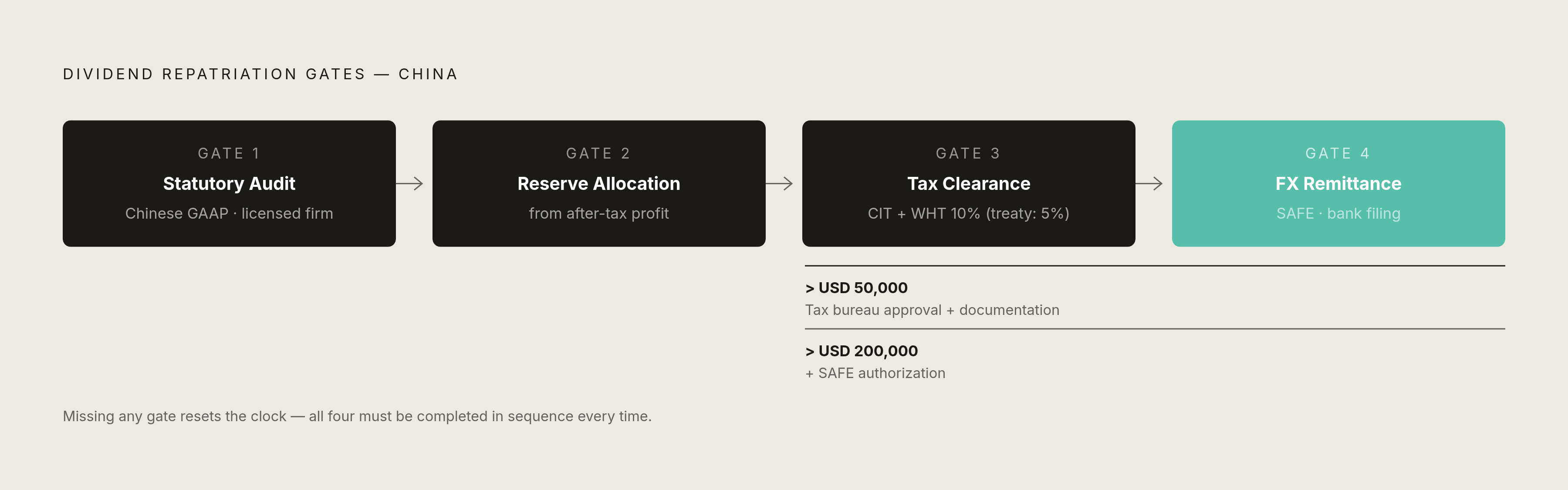
Getting a dividend out of China isn't a wire transfer. It's a relay race with four separate judges, each holding a stopwatch and a clipboard, and missing a handoff means starting the leg over.
Gate one is the statutory audit of annual accounts, a Chinese GAAP audit by a licensed local firm, not something a foreign parent's auditor can wave through. Gate two requires allocating a portion of after-tax profit to mandatory statutory reserves before a single yuan can be earmarked for distribution. Gate three is corporate income tax settlement and withholding tax clearance. Gate four is SAFE or bank-level foreign exchange remittance filing, the actual mechanics of turning approved RMB profit into an outbound payment.
The withholding tax rate on dividends sits at a statutory 10%, but shareholders in qualifying treaty jurisdictions can bring that down to 5%. That reduction isn't automatic. It requires a formal tax treaty benefit filing, and skipping that step means paying the higher rate by default even if the treaty technically entitles the company to less.
Transaction size determines how deep the paperwork goes. Profits above USD 50,000 need tax bureau approval plus supporting documentation. Cross USD 200,000 and SAFE authorization gets added to the stack. The full document list for a dividend remittance typically runs to a business license, an audit report on paid-in capital, an external auditor's report, a tax filing certificate, a tax payment receipt, and a board resolution approving the profit distribution. Assembling all of it correctly still means working through a multi-step approval process before the remittance clears. Assemble it incorrectly and the clock resets.
Two changes landing in 2026 raise the stakes further. Cross-border capital settlement rules effective April 1, 2026, require, "in principle," that funds raised from overseas listings get repatriated, and mandate dedicated capital accounts for all cross-border fund settlements, no more routing through general-purpose accounts. High-value transfers continue to draw heightened scrutiny as part of SAFE's broader oversight framework.
Companies looking to sidestep some of the tax burden sometimes route value out through service fees, royalties, or intercompany loans instead of dividends. Each of those channels has its own conditions and its own audit trail, and all of them draw close transfer pricing scrutiny from Chinese tax authorities. A royalty payment without a substantive underlying licensing agreement won't survive an audit; it just looks like a dividend wearing a costume.
The 2025–2028 reinvestment tax incentive and why it changes the repatriation calculus
Between January 1, 2025, and December 31, 2028, qualified foreign investors can claim a 10% corporate income tax credit against direct domestic investments funded by dividends from Chinese resident companies. Credits that go unused in a given year carry forward rather than expiring, which gives companies some flexibility in timing.
Eligible uses are defined and specific, limited to particular forms of direct domestic capital investment. The incentive applies to qualified direct domestic investments, not as a blanket benefit available to any reinvestment regardless of conditions. Put profits into a sector Beijing wants more capital in, and the credit applies. Put it somewhere else, and it doesn't.
The September 2025 SAFE Notice complements this directly: FIEs and foreign investors can now reinvest foreign exchange profits domestically under simplified procedures introduced by the September 2025 SAFE Notice. Combine the SAFE Notice with the tax credit and the message becomes fairly explicit: recycling profit back into China is now cheaper and faster than pulling it out.
That's worth pausing on, because it changes the actual math a finance team runs when profits show up on the books. The 10% CIT credit isn't a rounding error, it's a real input into a build-versus-repatriate decision, especially for companies already planning to expand their Chinese operations anyway. Does this eliminate the four-gate repatriation sequence from the section above? No. Companies that still want to send dividends home go through all four gates regardless. What the incentive does is add a conditional off-ramp for companies willing to stay invested instead, a fork in the road that didn't exist with this much financial weight behind it before.
The December 2025 integrated cash pooling reform and what it means for multinational treasury operations
On December 26, 2025, PBOC and SAFE jointly issued Yinfa [2025] No. 251, the Notice on Matters Relating to the Integrated Domestic and Foreign Currency Cash Pooling Business of Multinational Corporations. Buried in that title is a genuinely significant change: the end of a dual-track system that's been a headache for corporate treasurers for years.
Under the old setup, multinationals ran two separate cash pooling structures side by side, a cross-border two-way RMB pool regulated by PBOC, and a foreign exchange centralized operation system regulated by SAFE. Two account frameworks, two sets of compliance obligations, two reporting cycles. A treasury team managing both was effectively running parallel operations that happened to serve the same company.
The new Notice lets eligible multinationals unify domestic and foreign currency funds into a single "domestic master account," treated as one multi-currency account nationwide. Group treasurers get to collect and allocate both currency types across member entities from one unified position instead of juggling two. The quota framework stays defined, with leverage ratios and macro-prudential adjustment parameters set out in the Notice governing how much companies can borrow externally or lend overseas. The old constraints around "full aggregation" or fixed quotas are gone, replaced by a flexible centralization ratio that gives treasury teams more room to move funds according to actual need rather than a rigid formula.
Two additions showed up in the final version that weren't in the April 2025 draft. The transition period got extended from six months to a full year, companies with existing cash pooling arrangements now have twelve months from approval to migrate funds and close out legacy accounts. And the final text explicitly added foreign exchange receipt and payment facilitation policies that the draft hadn't spelled out.
The one-year window matters more than it sounds. This isn't a flip-of-a-switch changeover where old accounts vanish on day one and new ones appear on day two. It's a migration project, the kind that needs a plan, a timeline, and probably a project manager who's done this before. DLA Piper's January 2026 analysis of the reform described the extended transition period as reflecting "regulatory goodwill" and a "commitment to maintaining market stability throughout the reform process," language that, translated out of law-firm-speak, means Beijing knows this kind of infrastructure change takes time and isn't trying to force it through overnight.
CIPS, SWIFT, and RMB settlement: the infrastructure layer foreign companies actually transact through
Every rule discussed above eventually has to travel through actual wires and actual clearing systems, and here the picture gets more interesting than the "RMB is a minor currency" headline usually suggests.
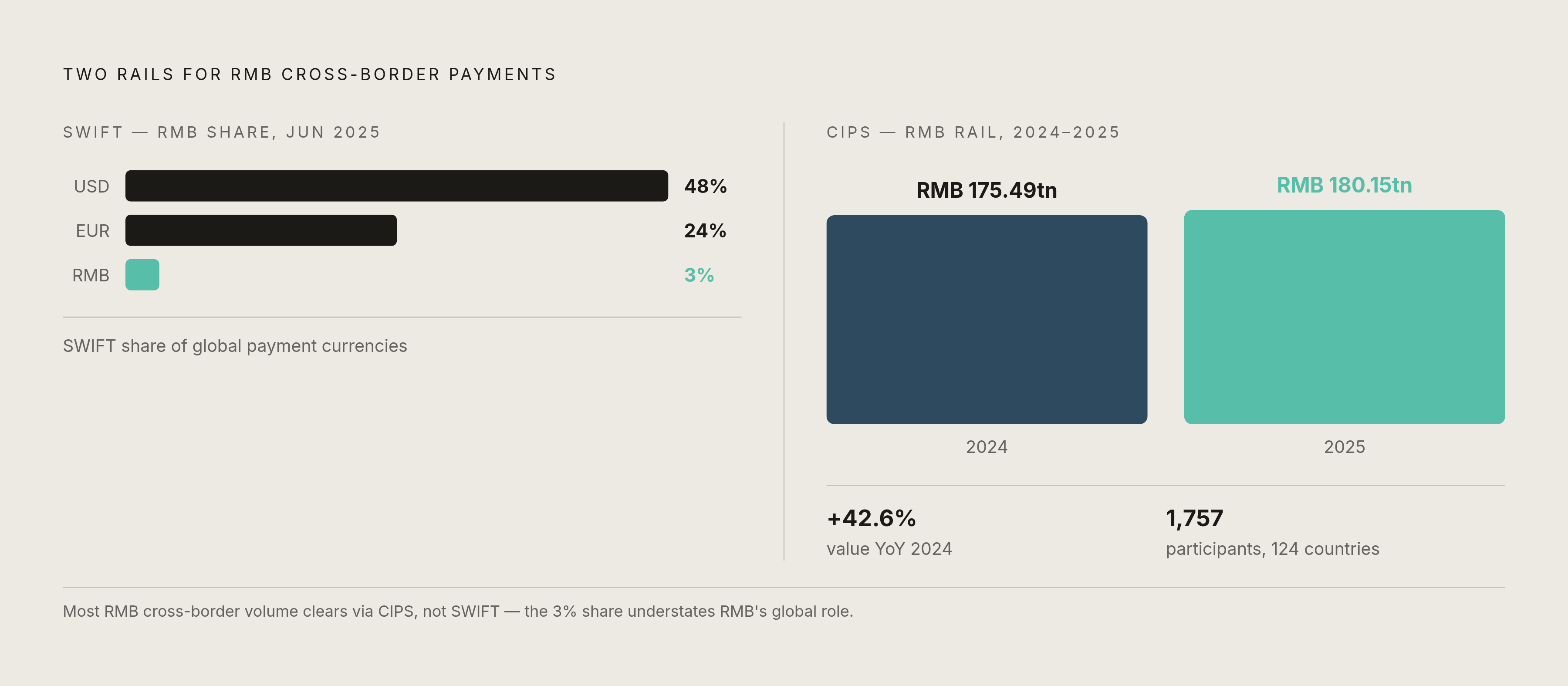
SWIFT is the dominant global messaging network, the one that shows up in sanctions headlines because getting cut off from it is treated as financial exile. As of June 2025, the yuan accounted for just 3% of global SWIFT payment currencies, dwarfed by the US dollar's 48% and the euro's 24%. Read that number alone and RMB internationalization looks like it's stalled.
But that 3% figure measures the wrong thing if the goal is understanding actual RMB usage, because it only counts transactions that route through SWIFT. China built its own clearing system, the Cross-Border Interbank Payment System (CIPS), back in 2015, operating under PBOC authorization, specifically so that RMB transactions wouldn't need to touch SWIFT at all. And CIPS has scaled fast: in 2024, it processed 8.2169 million transactions totaling RMB 175.49 trillion (about USD 24.47 trillion), up 24.25% in transaction count and 42.60% in value year-on-year, a daily average of 30,500 transactions worth roughly RMB 652.39 billion. In 2025, volume kept climbing, 8.4419 million transactions totaling RMB 180.15 trillion, though growth slowed to 1.02% year-on-year. By November 2025, CIPS counted 190 direct participants and 1,567 indirect participants spread across 124 countries and regions.
RMB's role in cross-border transactions has grown considerably in recent years, a figure that sits awkwardly next to that 3% SWIFT statistic until the mechanism becomes clear: a large share of RMB volume simply never touches SWIFT's messaging rails in the first place. It's less that RMB is invisible internationally and more that it's using a different road system entirely.
Foreign companies transacting in RMB also need to keep straight which RMB they're dealing with. CNY is the onshore yuan, subject to SAFE's full set of controls. CNH is the offshore-traded version, with its own liquidity conditions and pricing that can diverge from CNY depending on market sentiment. Contracts and settlement instructions that don't specify which one applies are contracts waiting to generate a dispute.
The scale of the broader payments market gives some sense of where this is headed: China's payments market is projected to grow from USD 40.27 trillion in 2024 to USD 60.24 trillion by 2029, a compound annual growth rate of 8.39%. Cross-border RMB payments specifically grew 21.1% year-on-year in the first eight months of 2024, reaching roughly 41.6 trillion yuan, around USD 5.94 trillion. For foreign companies without direct CIPS access, fintech intermediaries have become a meaningful routing option, especially for smaller transactions where a traditional correspondent banking chain is slow, expensive, or both. Given that transactions above USD 50,000 already trigger the extra SAFE documentation covered earlier, knowing whether a given payment is routing through CIPS or through SWIFT correspondent banking isn't a technical curiosity. It changes what a receiving bank expects to see and how long the whole thing takes.
China's anti-sanctions legal framework and the compliance dilemma it creates for foreign companies
Every section above deals with rules that make cross-border payment slower or faster, cheaper or costlier. This last piece is different in kind: it's about rules that can make compliance with one country's law an act of non-compliance with another's.
Over the past several years, Beijing has built out a counter-sanctions legal architecture, piece by piece: the Export Control Law in 2020, the Unreliable Entity List the same year, the Anti-Foreign Sanctions Law (AFSL) in 2021, and the Blocking Rules also in 2021. That architecture got two more additions on April 13, 2026, when the State Council issued Regulations on Countering Unlawful Extraterritorial Jurisdiction Measures alongside Provisions on the Security of Industrial and Supply Chains.
The theory underlying all of it is straightforward even if the practice is messy: Beijing wants Chinese companies, and increasingly foreign companies operating in China, protected from having to comply with foreign (mainly US) sanctions that China considers to be an overreach of extraterritorial jurisdiction. The Blocking Rules, in particular, can require Chinese entities and foreign entities operating inside China to report foreign sanctions compliance requests to Chinese authorities, and can prohibit compliance with certain foreign sanctions outright.
That theory turned into an actual order on May 2, 2026, when China's Ministry of Commerce (MOFCOM) issued its first formal blocking order under this framework, prohibiting recognition, enforcement, and compliance with US sanctions imposed on five Chinese petrochemical companies. First use of the instrument, which makes it a genuine precedent rather than a hypothetical clause sitting unused in a statute book.
What does a foreign company do when it's caught between a US sanctions list and a Chinese blocking order telling it not to comply with that same list? There's no clean answer sitting in a filing cabinet somewhere. A multinational with US shareholders, US bank relationships, and Chinese subsidiaries can find itself legally obligated in two directions at once, obligations that don't just create friction, they can actively conflict. That collision sits outside the scope of the payment mechanics covered in the sections above, SAFE filings and CIPS routing don't help when the underlying legal obligation itself is contested. But it's the backdrop against which every one of those payment rules now operates, and companies moving money through China without accounting for it are navigating with half the map.
Sources
- Official Release of the 2025 Cross-Border Cash Pooling Regulations: Strategic Transition from “Dual Track” to “Integrated” and Practical Guidance | DLA Piper
- China's FX Rules in 2025: New Measures Ease Cross-Border Investment
- Payment Options and Foreign Exchange Control in China: 2025 Update | EU SME Centre: China Market Research, Training, Advice | Get Ready for China
- Ultimate guide to bank payments to China
- China is Tightening Foreign Exchange Control from 1 January 2026 - Chinese Lawyer in Shanghai, Shenzhen, Guangzhou and Beijing:
- msadvisory.com
- en.wikipedia.org
- statrys.com