USD to MXN Corridor Pricing Benchmarks
How fees and exchange markups stack up across digital, bank, and cash providers.

Mexico pulled in $64.7 billion in remittances in 2024, with the US supplying $62.5 billion of that total. This piece is about what happens to that money between a sender's bank app and a recipient's pocket, a story about fees, spreads, and a peso that spent 2025 acting like it couldn't decide what it wanted to be. Roughly 12 million Mexican families depend on this flow, so the difference between a good transfer and a bad one isn't academic. It's groceries.
Banxico puts remittances at around 3.5% of the country's circulating money supply, which means this corridor works less like discretionary income and more like plumbing. At an average transfer size of $394, the gap between a 5% fee and a 3% fee stops being abstract math and starts being an actual line item in someone's budget.
What the corridor actually costs on average and where that sits relative to global targets
Start with the number everyone quotes: the World Bank's Remittance Prices Worldwide survey put the average cost of sending $200 through this corridor at just under 5% in Q1 2025. Bump the transfer to $500 and the average drops to 3.03%. A flat $10 charge is 5% of $200 and only 2% of $500, so the percentage shrinks as the transfer grows even when the provider's actual cost structure hasn't moved an inch.
The UN's Sustainable Development Goal target asks for average remittance fees under 3% globally by 2030. On the $500 transfer, this corridor is close, but the $200 transfer, the size far more households actually send given that $394 average ticket, sits well above target. That's the size that matters, because it's the one people use.
Here's the part that decides how you read every number in this piece: an average is a statistical construct that no single transfer experiences. For banks, that average sits close to their best case; for the leading digital operators, it's closer to their worst case. Knowing the average tells you the shape of the distribution, not where any given transfer lands on it. The rest of this piece is about finding that spot.
How fees and exchange rate markups combine to form the real cost of a transfer
Every transfer carries two costs stapled together, and providers have gotten good at making sure senders only notice one. There's the stated fee, flat or percentage-based, and there's the FX spread: the gap between the mid-market rate (the real, interbank, Reuters-quoted USD/MXN rate) and whatever rate the provider actually hands over.
Traditional operators lean hard on the second lever, and this is where most senders get taken without ever seeing it happen. Embed 2-4% into the exchange rate itself, and the stated fee can look like zero, sometimes get advertised as zero, while the real cost hides in a number most senders never think to check. Nothing on the receipt looks expensive, yet the total still adds up the same.
Wise runs a different setup: an FX spread of roughly 0.45% to 0.65% plus a disclosed fee around 0.5% to 0.7%, both visible before the transfer, both adding on top of each other rather than hiding inside one another. Western Union's cash-in-to-SPEI delivery, by contrast, runs 5-7% once the rate markup and fee are combined, a chunk of which a sender comparing "fees" alone would never see coming. Transparency here is the actual mechanism behind getting a fair rate.
Funding method matters too. ACH funding sidesteps the card surcharge that credit and debit funding often carries, and some providers charge no stated fee on this corridor when the transfer is ACH-funded. In that case the FX spread is the only number left to check, which makes the sender's job a lot easier.
The real formula is stated fee plus FX spread above mid-market. Any provider comparison quoting only one of those two numbers is incomplete at best, and at worst is doing exactly what it was built to do.
Provider-by-provider pricing: what digital MTOs, banks, and cash operators actually charge
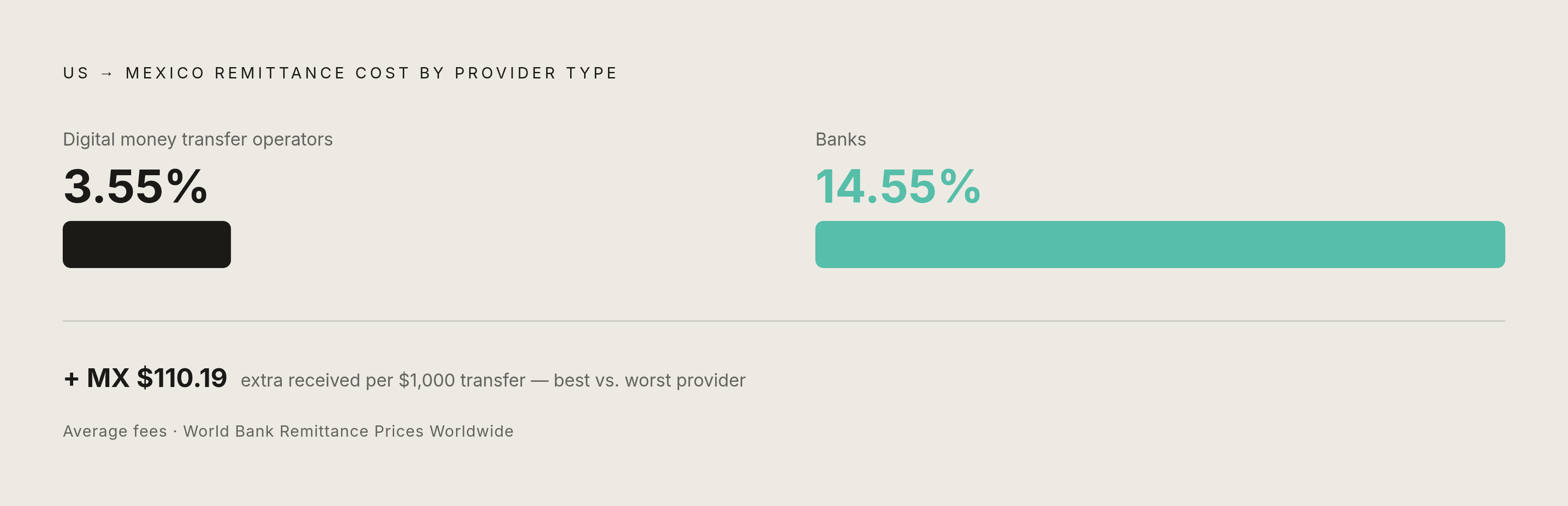
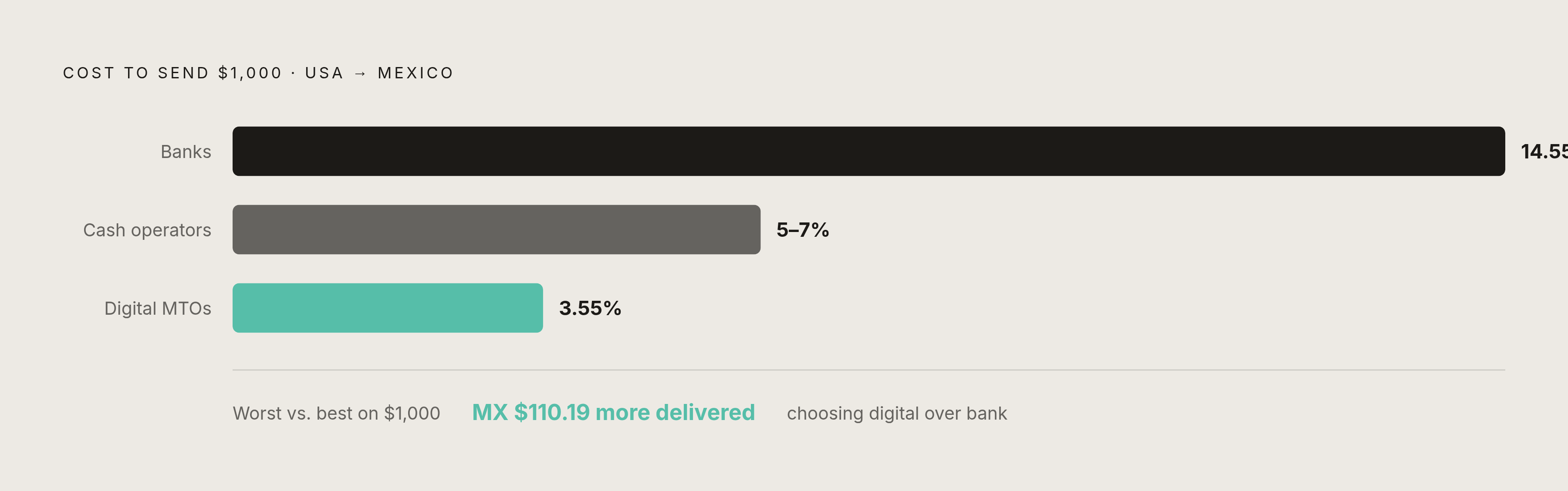
The starkest number in this corridor: Remitbee's 2025 analysis found digital-only money transfer operators charging 3.55% on average against 14.55% for banks. Banks cost roughly four times more for what is, at the infrastructure level, largely the same electronic transfer. Nothing about wire infrastructure justifies that gap, so what's actually going on? Banks built their international transfer pricing in an era before instant peso-denominated rails existed, and most haven't been forced to compete on it since. When a customer base isn't rate-shopping, nobody's auditing the pricing model, so nobody fixes it. If there's one plain takeaway from this whole corridor, it's this: sending through a bank is the single costliest habit a regular remitter can keep, and it survives mostly because nobody checks the alternative.
On the digital side, Wise offers the mid-market rate plus that transparent 0.5%-0.7% fee, making it one of the more cost-effective options for bank-to-bank delivery. Remitly frequently runs zero-fee promotions and improved rates for first-time senders, worth $3 to $10 on an initial transfer, with regular pricing landing below 3% for bank delivery once the promo ends. Xoom, running on PayPal's pre-funded infrastructure, offers competitive rates with express SPEI delivery. Western Union's combined cash-in-to-SPEI cost sits at that 5-7% figure; the tradeoff there is ubiquity and cash pickup access, and for a meaningful slice of recipients without a bank account, that's a real tradeoff, not a bad decision.
On a $1,000 transfer, picking the best-priced provider over the worst nets the recipient an extra MX$110.19. That's grocery money, not a rounding error, and it's the concrete version of the point above: shopping around on this corridor is worth triple digits in pesos on a single transfer.
Worth sitting with: no provider holds the "cheapest" title permanently, since rates shift throughout the day as FX markets move. A provider that wins the comparison Tuesday morning might lose it by Tuesday afternoon.
How the peso's 2025 volatility changed the value recipients actually received
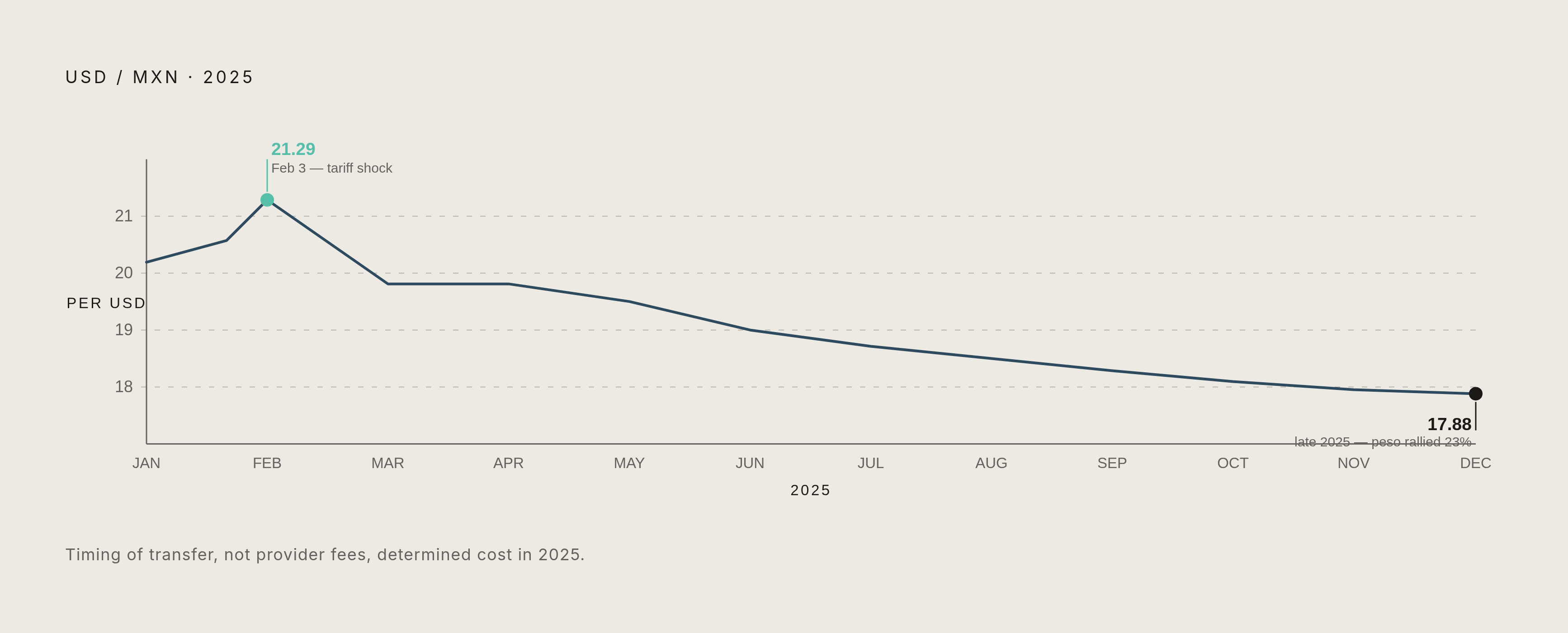
Zoom out from provider fees for a second, because 2025 handed the peso a wild ride that makes fee comparisons look almost quaint. USD/MXN peaked at 21.29 on February 3, 2025, the peso's weakest point since March 2022, right after the announcement of steep US tariffs on Mexico. Currency markets don't love tariff uncertainty, and the peso reflected that without much subtlety.
Then it reversed, hard, and by late 2025, USD/MXN had fallen to 17.88, a level last seen back in July 2024. That's the peso rallying roughly 23% over the year, one of the strongest performances among emerging-market currencies anywhere in 2025. Some of that move traces back to the dollar's broader decline against a basket of currencies that year, so part of the peso's strength was really dollar weakness showing up on the other side of the pair.
Put that 23% swing next to anything in the provider section above and the fee comparison starts to look small. A sender using the identical provider in February versus December would have seen the December transfer deliver noticeably more pesos per dollar, purely from exchange rate movement, with zero change in provider, fee, or method. Chasing the cheapest provider in February while ignoring timing entirely still would have left money on the table compared to just waiting. Timing beat shopping that year, and not by a little.
By early September 2026, USD/MXN had settled into a range between roughly 16.91 and 17.33 over the prior 30 days, with daily volatility around 0.20%. Calm, and structurally stronger than the corridor saw for most of the preceding two years. Calm now doesn't mean calm always, though: MXN/USD has shown it can swing 5-10% over a matter of months. For someone sending money every payday rather than once, rate-timing, waiting for a weak-peso window, setting rate alerts, saves more than switching providers ever will. It just takes actually watching the number, which most people don't bother doing.
Why delivery method — SPEI, cash pickup, or stablecoin rail — affects both speed and cost
By 2025, 99.1% of remittances into Mexico traveled electronically, per Banxico, with cash transfers and money orders combined making up less than 1%. The sending side has gone almost entirely digital, even if the receiving side still has real cash-dependent segments worth understanding rather than dismissing.
SPEI, Mexico's real-time interbank payment system, is the dominant delivery rail. When a provider holds pre-funded peso accounts inside Mexico, an ACH-funded transfer can land in a recipient's account within minutes to hours. Some providers still route through SWIFT instead, which tacks on one to three days and, more often than not, a higher price tag, since SWIFT correspondent banking means more intermediaries taking a cut along the way.
Cash pickup hasn't disappeared, and calling it a legacy behavior on its way out would be a mistake. OXXO's network, tens of thousands of locations strong, plus correspondent networks run by Western Union and MoneyGram, serve recipients who don't have bank accounts, still a meaningful population. A MoneyGram survey from June 2024 found a substantial share of remittance customers said they collect money at a walk-in location, rising to nearly half among Hispanic recipients specifically. A pure digital-rail strategy simply fails that slice of the market, no matter how clean the SPEI numbers look on a slide deck.
Then there's the newer entrant: stablecoin rails, and this is the part of the corridor most senders don't know they're already touching. Bitso's model converts dollars to USDC or USDT on-chain, moves them to Bitso's US entity in seconds, then converts to pesos via SPEI, with the cross-border leg settling in under a minute. Bitso processed billions of dollars in remittances in 2024, more than 10% of total corridor volume, running through crypto rails most senders never think about. Bitso's internal benchmarks put the FX spread on the USDC-to-MXN leg under 10 basis points, with the full loop closing in 7-10 minutes against the roughly 48-hour average of legacy SWIFT transfers. Felix Pago has processed over a billion dollars using a similar USDC-to-SPEI model, operated through WhatsApp, at fees well below traditional cash operators.
Worth sitting with before getting too excited about the crypto angle: the regulatory picture is still being drawn in pencil, not ink. Stablecoin-rail transfers require both US money transmission licensing and CNBV registration in Mexico, and FinCEN and CNBV both claim jurisdiction over different segments of the same flow. A rail that works today under rules still being written carries a different level of risk than one that's been stress-tested by a regulator for a decade.
What a fair transfer actually costs in 2025 and how to use these benchmarks to evaluate any provider
Pull this together and a workable benchmark emerges. For a smaller transfer, a fair total cost, fee plus FX spread combined, sits at or below 3-3.5%. That matches what the best digital MTOs already charge and points toward the UN's 3% SDG target. For larger transfers, the top digital providers routinely land below 3% total cost; anything above 4% at that size deserves a second look, not blind trust.
Bank pricing at 14.55% on average has no infrastructure-based justification left standing once you've seen what digital operators charge for the same wire. That gap reflects a lack of competitive pressure, not the real cost of moving money. If a single number in this piece should change someone's behavior, it's that one: a bank is very likely the wrong place to send this money from, and the four-fold gap is the whole argument.
So how does anyone evaluate a provider without becoming a full-time FX analyst? A short set of questions does most of the work. What's the FX rate offered against the live mid-market rate right now, since the spread is usually the biggest cost lever? What's the stated fee, and does it change with funding method, given ACH typically comes in cheapest? Which delivery rail is actually being used, SPEI, SWIFT, or cash pickup, and does the speed difference matter for this particular transfer? Answering those three questions resolves most of the guesswork.
The World Bank's Remittance Prices Worldwide database, along with various real-time comparison tools, offers live rate checks, which matters given how much rates move within a single day. A rate checked at 9 a.m. isn't guaranteed to hold at 3 p.m.
For businesses or finance teams managing corridor exposure at volume, rather than individual senders moving a few hundred dollars home, the stablecoin rail's sub-10-basis-point spread and minute-level settlement represent a real structural cost floor the traditional MTO model hasn't matched, promotional rates aside.
None of this sits still. The 2025 peso's 23% swing and stablecoin adoption climbing past 10% of corridor volume both mean the benchmark keeps moving under its own feet. Treating a cost comparison from two years ago as current is a common and expensive mistake. Knowing the number is step one. Building an actual policy around it, which rail, which funding method, whether to set rate alerts, is what turns a benchmark into savings that show up in someone's pocket.