SWIFT vs Local Rail Routing Cost Comparison
SWIFT's hidden fees often exceed cheaper local payment options for recurring transfers.

Cross-border payments hit $212.55 billion in market value in 2024, headed toward $320.73 billion by 2030. Most of the teams moving that money picked a routing method years ago, usually SWIFT, and never checked whether it still made sense. B2B payments claim 72.8% of that market's revenue, with bank transfers as the dominant channel at 42.4%, so the exposure sits mostly with corporate finance and operations teams, not with retail consumers wiring birthday money to relatives.
Here's the position this piece takes, and then spends the rest of its length defending: SWIFT is the wrong default for most recurring, mid-size, corridor-specific payments. The only reason it survives as the default is habit, not math. Every payment has its own answer, but the habit of treating SWIFT as the automatic choice instead of the fallback it should be deserves a second look.
What SWIFT actually is and why its architecture creates the costs it does
SWIFT moves messages about money. That distinction sounds picky until it explains the whole fee structure downstream. Founded in 1973, SWIFT now connects more than 11,000 financial institutions across upwards of 200 countries and handles the equivalent of $530 billion in payment instructions per day. That scale is exactly why it stays the default even in corridors where cheaper options exist now: everyone's already plugged in, so nobody checks whether there's a shorter way home.
The funds themselves travel through correspondent banking. Picture a chain of banks, each one holding an account with the next, passing value along like a relay where every runner also takes a cut of the baton before handing it off. If a bank in Ohio wants to pay a bank in Jakarta and the two have no direct relationship, the payment may pass through two or three intermediary banks before it lands. Each intermediary is a place where a fee gets pulled out, and where the payment can sit for a while before moving on. SWIFT handles the instructions; correspondent banks handle the settlement. The fees stack up at both, and nobody sends one itemized bill for the full trip.
The full cost stack of a single SWIFT transfer
Most people see one number on a receipt. The real transfer runs through four or five separate cost layers, and most of them never show up on any single statement at all.
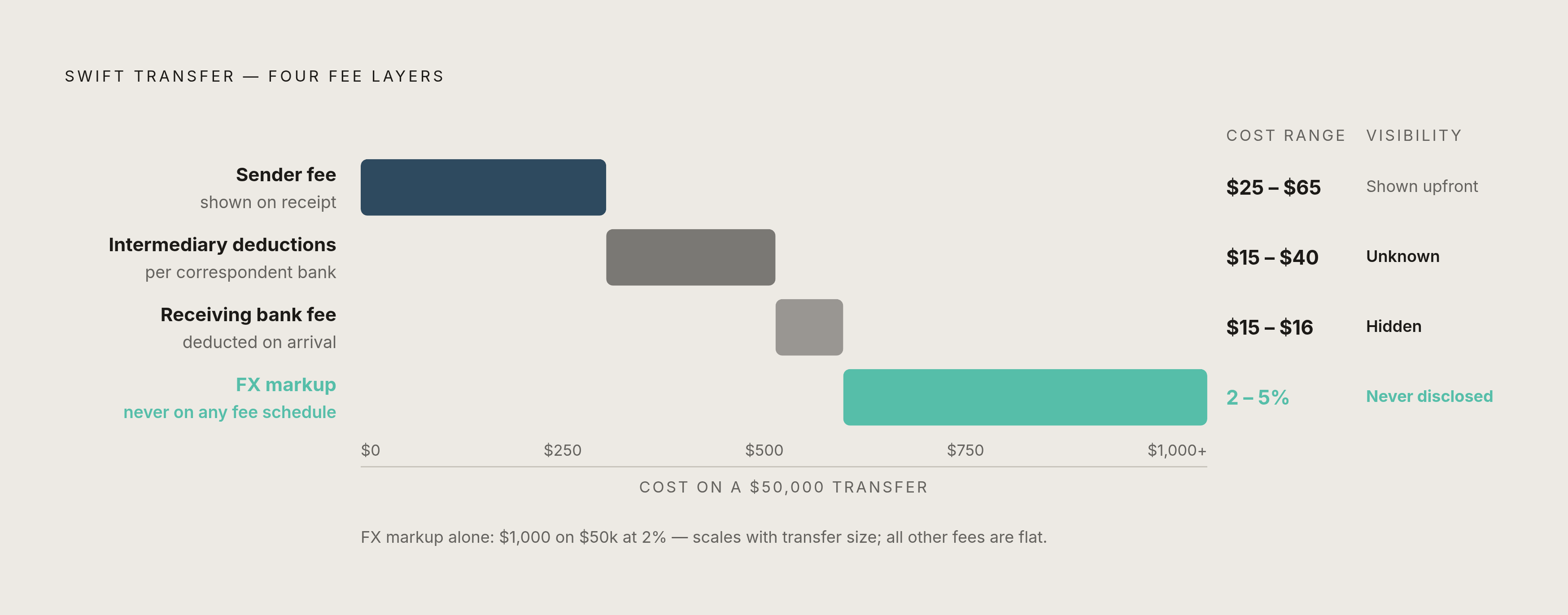
Start with the sender fee, the only layer most people ever see coming. Major US banks charge somewhere between $25 and $65 for an outgoing SWIFT transfer; Chase charges $40 online or $50 in a branch.
Layer two is intermediary deductions. Each correspondent bank in the chain can pull $15 to $40 out of the transfer before passing it along, and the sender has no way of knowing in advance how many intermediaries the payment will touch. That money isn't coming back once it's gone.
Layer three is the receiving bank fee, where the beneficiary's bank deducts its own incoming wire charge, typically $15 to $16, straight out of the arriving funds. Layer four does the real damage: the foreign exchange markup. Banks apply their own rate instead of the interbank mid-market rate, and that markup runs 2 to 5% above the real number. Chase applies 4 to 5%; Bank of America runs 2 to 4%. This layer shows up on no fee schedule anywhere, and it scales with transfer size, so the bigger the payment, the bigger the silent cut. Send $50,000 and a 2% markup quietly drains $1,000 before the money reaches anyone. That's the layer worth watching, since it's the one nobody discloses up front and the one that grows the most as the payment grows.
Add it up: a $1,000 transfer can carry $70 to $100 in total cost, and larger transfers climb past $150 without much effort. That's the toll for SWIFT's reach.
What SWIFT actually delivers in speed, and where SWIFT gpi changes the picture
Standard SWIFT transfers take 1 to 5 business days start to finish. The message itself moves fast: 75% of SWIFT messages reach the destination bank within 10 minutes, so the delay isn't the network. The gap sits in everything downstream of it. Time between message arrival and money actually landing averages around 27 hours, stretching to 4.6 days when currency conversion enters the picture.
Why the gap? Batch processing at the receiving bank, capital controls in certain jurisdictions, and limited operating hours at banks in lower-income countries. A message can sit in a queue overnight because the receiving bank only runs settlement batches twice a day. The network was built for reach more than for speed, and those turn out to be different problems with different fixes.
SWIFT gpi, the tracking and speed layer bolted onto the base network, changes a real amount of this. Median processing time under gpi drops below two hours, and on the fastest, best-connected corridors that median falls under five minutes. On the slowest corridors it can still stretch past two days, so gpi narrows the gap without closing it everywhere at once. SWIFT gpi significantly accelerates delivery times for a large share of payments, with most reaching end beneficiaries well within 24 hours on well-connected corridors.
Here's the catch that matters more than any of those numbers: gpi still runs on the same correspondent banking network underneath. Speed goes up, but the fee layers from the last section don't go anywhere. The ISO 20022 messaging migration adds richer structured data to SWIFT messages, which helps compliance screening and cuts the manual holdups that cause delays. It doesn't touch correspondent fees either. So gpi closes the speed gap in well-adopted corridors, and the cost gap sits exactly where it was. That's the more durable reason local rails stay in the conversation, and it's the reason speed and cost need to be judged as two separate questions rather than one.
How local rails work and what their cost structure actually looks like
Local rails skip the correspondent chain entirely. Convert the currency once, drop the payment into the recipient country's domestic infrastructure, done. Fewer intermediary banks sit in the way, fewer deductions happen along the route, and fewer surprise fees show up days later.
In the US, ACH runs a fraction of a dollar per transaction. A $500 SaaS subscription charged through ACH costs a small fraction of a dollar to process; run the same charge through a card network and the processing cost is substantially higher, a gap wide enough that it should make any finance team ask why cards are still the default for recurring billing. RTP, run by The Clearing House, operates as a real-time rail with per-transaction fees that are a small fraction of a typical SWIFT sender fee. FedNow, the Fed's real-time rail, also operates at near-zero per-transaction fees and settles in real time.
Europe's SEPA network covers a broad set of countries across the continent. Standard SEPA Credit Transfers settle within a short number of business days; SEPA Instant settles in near-real time at low per-transaction fees. Recent EU regulation pushes eurozone banks to offer SEPA Instant around the clock and to align its pricing with standard transfer fees. In the UK, Faster Payments operates as a real-time rail with low to no fees for most account holders. CHAPS, the same-day high-value sterling system, carries per-transaction fees that are modest relative to the payment sizes it handles.
The pattern repeats across every one of these rails: fixed or near-zero fees, a shorter path between sender and recipient, and little to no markup baked into the rail itself. What's left is the FX conversion, done once at the point of entry, at a rate that's visible or negotiable rather than buried inside a bank's own exchange desk.
Where the cost comparison actually plays out: corridors, payment size, and use case
So when does the local rail win, plainly? Almost always, once three conditions line up: mature domestic infrastructure in the destination country, small to mid-size payments where SWIFT's fixed fees eat a bigger share of the total, and a recurring relationship (payroll, supplier payments, SaaS billing) where the savings compound with every cycle. Most corporate cross-border payments meet all three, which is exactly why the default deserves more scrutiny than it gets.
SWIFT still wins, or becomes the only option, when no local rail exists in the destination market, when the payment is urgent enough that the global fallback network is the sole realistic path, when compliance rules demand the full SWIFT message record, or when the counterparty relationship is a one-off in a jurisdiction where the sender has no local banking infrastructure to route through at all. Those are real cases, worth naming, even if they cover a minority of the volume.
Size changes the math mechanically, not vaguely. On a $1,000 transfer, a $70 to $100 all-in SWIFT cost runs a significant share of the value moved, steep by any measure. On a $100,000 transfer, the fixed fees barely register, but the FX markup takes over as the dominant cost; even a modest spread on that amount drains thousands of dollars before the money reaches anyone, regardless of what the sender fee happened to be. Corridor maturity matters too. SWIFT gpi's fastest routes, the ones with median transfer times under five minutes, already match local rails on speed, so cost becomes the tiebreaker. On SWIFT's slowest routes, where transfer times can stretch past two days, the corridor loses on both fronts at once.
Frequency might be the most underrated variable in the whole comparison. A team running weekly supplier payments to eurozone vendors pays the full SWIFT stack 52 times a year. Route the same payments through SEPA and each one costs a small fraction of the SWIFT equivalent. Multiply that gap across a full year of payroll or supplier cycles and it becomes a budget line worth catching earlier rather than later. Treasury teams making this decision corridor by corridor are doing the real work here; a single blanket policy applied to every cross-border payment, regardless of destination or size, leaves money on the table every cycle it runs.
What finance and operations teams need to do before choosing a routing method
Start by mapping every payment corridor by destination country, frequency, and average transaction size. Those three variables determine where the cost gap is widest and where it barely matters at all.
Ask banking partners for a full fee breakdown: sender fee, estimated intermediary charges, receiving bank fee, and the FX rate applied against the mid-market benchmark. Many banks won't volunteer this on their own. It has to be requested directly, and even then the intermediary estimate is just that, an estimate, since the correspondent chain isn't fixed from transfer to transfer.
For high-volume corridors, model the annualized cost of SWIFT against a local rail alternative instead of eyeballing one transaction in isolation. The difference between a $45 SWIFT fee and a 4.5-cent RTP fee looks trivial by itself; multiplied across a full year of weekly payments, it becomes the number that actually moves a budget conversation. Where local rail access means setting up a local banking partner or a payment platform with in-country infrastructure, that setup is a one-time cost, and in corridors with enough recurring volume, the savings usually cover it fast.
The tooling question matters here too, and it's the one most teams skip. A routing setup that pairs corridor-by-corridor logic with actual in-country rail access should surface the cheaper path on its own, instead of forcing someone to recalculate by hand every time a payment goes out. The policy itself also has to keep pace with the market: SEPA Instant's regulatory expansion and the build-out of RTP and FedNow in the US both changed the math for corridors that had no viable local alternative a few years back. Save SWIFT for payments where its reach actually earns the premium, and send everything else through whatever local rail already does the job for less money and less waiting.