Automated Reconciliation for Multi-Currency Payment Flows
Structured data and AI matching engines shrink reconciliation exceptions in multi-currency flows.

Structured data is the answer to fragmentation, and ISO 20022 is the clearest example of what that looks like in practice. A major central bank required ISO 20022 compliance for all TARGET transactions, and correspondent banks across that region have been working to meet that standard. That's a fast curve for something as slow-moving as bank infrastructure usually is.
What changes when data gets structured this way? Payments start carrying richer, standardized reference fields, so a matching engine can line up records across systems without a person cross-referencing invoice numbers against bank memos by hand. Compliance screening runs against structured fields instead of free text, which cuts down on the repair loops that used to stall settlement and generate reconciliation gaps downstream. The same outcome emerges from a different angle: better interoperability between banks, fewer repairs, cleaner sanctions screening, all of which shrinks the number of exceptions that ever reach a reconciliation team in the first place.
Settlement speed matters here too. SWIFT gpi settles a large share of cross-border payments within thirty minutes now, a pace that would have been unthinkable a decade ago when a wire could sit in a correspondent bank's queue for days. Faster settlement narrows the timing-difference window that creates open, unmatched items sitting on someone's desk.
Stablecoins deserve a mention as an emerging piece of this picture, though not as a current substitute for SWIFT or ACH rails, and treating them as one right now would be a mistake. Stablecoin volume figures include activity well beyond payments, and the portion attributable to actual payment flows is a subset of the headline number. The GENIUS Act passed in the US in July 2025, alongside separately developed stablecoin frameworks in Japan, the EU, Singapore, and the UAE, and together these signal that stablecoin rails are shifting from experimental territory into regulated infrastructure. For reconciliation specifically, on-chain settlement produces an immutable, timestamped record that collapses the timing-difference problem almost by design. Worth watching for a finance team thinking a few years out. Not something to build a 2026 reconciliation stack around.
Standardization at the data layer is infrastructure a reconciliation platform depends on, not a feature it sells you. It decides how much work the matching engine downstream actually has left to do, and teams that skip this layer end up asking software to fix a data problem no algorithm can fully patch over.
What automated matching engines actually do with multi-currency transactions
Traditional rule-based matching assumes an exact amount, an identical reference number, and same-day settlement. In multi-currency flows, none of those three assumptions hold reliably, which is why rule-based systems choke on this work specifically. A system built for domestic ACH reconciliation could not survive contact with FX.
AI-driven matching engines add three things rule-based systems don't have. Dynamic FX and fee adjustment calculates the real-time currency difference and fee variation instead of demanding an exact-amount match, so a rounding difference or a hidden spread doesn't get buried and forgotten. Fuzzy and contextual matching lets the system reconcile records even when timing is off, references are incomplete, or a single bank deposit actually represents ten separate customer payments bundled together. Continuous learning means match rates climb as the model accumulates corrections and approved exceptions over time, so a newly deployed system starts lower and gets better the longer it runs.
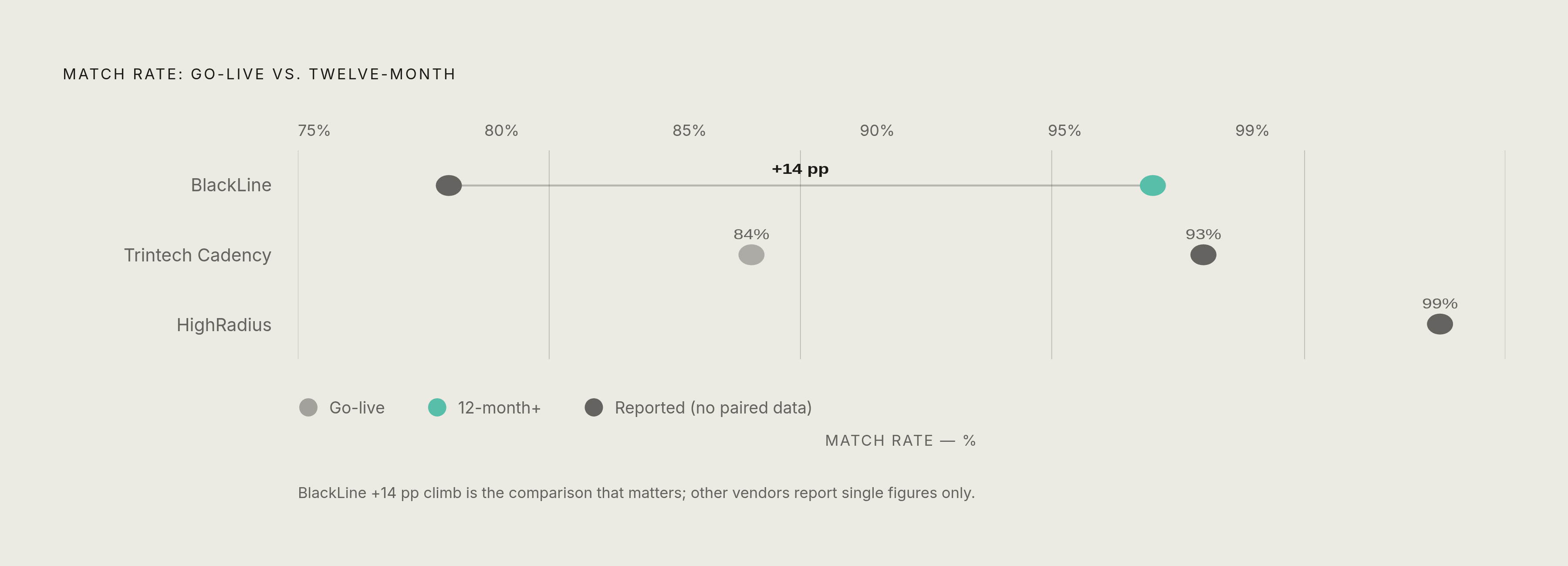
The vendors' own numbers make the pattern clear. BlackLine reports auto-match rates in the low 90s once a deployment has been live more than a year, but fresh deployments under six months old land closer to the high 70s. The company's own honest expectation is 60 to 80% of routine reconciliations auto-certified, with the rest needing a human. Trintech's Cadency platform reports 93% auto-match on high-volume accounts, defined as more than 500 transactions a month, and 84% on lower-volume accounts, though named enterprise customers have reported hitting 99% in their own success data. HighRadius claims 99% reconciliation accuracy with its AI-driven resolution and targets a 90%-plus auto-match rate on payment-to-invoice and general ledger matching through its agentic AI tools.
That gap between new deployments and mature ones is the number most vendors would rather you not dwell on, and it matters more than any single headline figure. A finance team comparing platforms should weight the twelve-month number over the go-live claim, because the go-live number describes a system that hasn't learned the account yet. Anyone selling you on the go-live number alone is selling you the wrong number, full stop.
There's a structural lever here too, separate from the AI itself. SWIFT gpi's instant FX feature converts currency at the moment a payment is initiated, rather than at every correspondent bank hop along the way, which trims the spread baked into the transaction before it ever reaches a ledger. Fewer FX discrepancies in the underlying data means fewer exceptions land on the matching engine's desk to begin with.
How platforms handle exceptions, the reconciliation work that automation cannot fully eliminate
Even at a 91 to 93% auto-match rate, a high-volume operation still throws off a real number of unmatched items every single day. Exceptions exist, full stop, and no vendor pitch should suggest otherwise. What separates a good platform from a mediocre one is whether those exceptions get routed, owned, and resolved as a system, or whether they pile up in a shared inbox waiting for someone to have a free afternoon.
Good exception handling in a multi-currency context looks specific. Predictive exception handling means the AI ranks anomalies by risk, flagging large FX discrepancies, aged open items, and duplicate indicators first, and routes each one to the right person automatically instead of dumping everything into one queue. Structured ownership means each exception carries its own context, including the source data, the matching logic the system tried, and why it didn't auto-certify, so the reviewer resolves the thing instead of re-investigating from zero. Resolution workflows need an audit trail built in, with approvals, comments, and supporting documents attached directly to the exception record rather than filed somewhere else entirely.
Named platforms handle this differently, and the differences aren't cosmetic. Ledge runs AI agents that reconcile across systems even when timing is off, references are incomplete, FX is involved, or transactions are grouped, and it surfaces exceptions inside the close workspace before close even starts, with ownership and dependencies already assigned, so the team reviews rather than rebuilds from scratch. BlackLine's Verity suite includes Verity Match, which studies historical patterns to improve match rates on the hardest reconciliations, and Verity Prepare, which drafts reconciliations end-to-end with every step traceable. HighRadius flags unreconciled transactions instantly and builds audit-ready documentation at close. It's strongest in structured accounts-receivable, invoice-to-cash workflows specifically, and its fit narrows outside that domain. Trintech's Cadency includes Beacon, an in-app AI assistant offering step-by-step guidance through close workflows, and applies risk-rated automation, meaning higher-risk accounts get routed to a human by design, not as a fallback when the system fails.
Fully automated exception resolution is a ceiling, not a near-term goal, and the platforms themselves say so. BlackLine's own stated realistic expectation is 60 to 80% auto-certification on routine reconciliations. The real dividing line among these products lies elsewhere entirely. It's whether the remaining exceptions land on someone's desk with full context attached, or as a raw pile of unmatched line items they have to reconstruct by hand.
Continuous processing changes this calculus in a different way than the match rate does. Ledge processes reconciliations continuously through the month, so exceptions surface well before close instead of getting discovered during the close crunch itself. That shifts staffing and timeline planning, not just the accuracy number.
Where each platform in the current market fits a specific reconciliation profile
For multi-currency flows specifically, the criteria that matter aren't the generic ones. Does the platform handle FX and fee variation natively inside its matching logic, or does someone have to write manual tolerance rules to paper over it? Does ERP sync run two ways and respect closed accounting periods, so nothing back-posts into a month that's already locked? Does the platform connect directly to external banks and payment processors, or does it need a centralized data model built first before it can do anything useful? And is close management unified with reconciliation, or are they two separate tools someone has to stitch together?
Airwallex fits best where multi-currency spend and card reconciliation dominate the workload. It combines payment execution with real-time, pre-normalized ledger syncing natively, syncs hourly with NetSuite, QuickBooks Online, Xero, Sage Intacct, and Microsoft Dynamics 365, and uses AI and OCR to extract receipt data and match it at the point of spend. An Expense Policy Agent checks spend against policy across entities, currencies, and languages. It supports more than 60 currencies at interbank FX rates. Its limits show up outside its own rails: transactions from external sources may need a separate bank feed or API connection, and it doesn't offer close checklists or flux analysis.
BlackLine fits best for balance sheet reconciliation at enterprise scale, with the Verity AI suite adding named agents for end-to-end prep and complex matching. It has deep integrations with SAP, NetSuite, Oracle, Microsoft Dynamics, Acumatica, and Sage, plus SOX-grade audit trails. Deployment takes months rather than weeks at enterprise scale and requires significant IT involvement as part of the rollout.
FloQast fits best as a close checklist manager, with live syncing to Excel and a spreadsheet platform, a no-code AI agent builder, and integrations with NetSuite, SAP, Workday, Microsoft, Sage Intacct, and Xero. It's positioned as a close management layer, not a deep transaction-matching engine, and that distinction matters when weighing it against the others here. Don't buy FloQast expecting it to do what BlackLine does.
Trintech's Cadency fits best for risk-based account review in financial services specifically, purpose-built for banks, credit unions, insurers, capital markets firms, and non-bank financial institutions. Its Beacon assistant and risk-rated automation integrate with Microsoft Dynamics, NetSuite, Oracle, SAP, ServiceNow, and Workday, and it posts 93% auto-match on high-volume accounts against 84% on lower-volume ones.
HighRadius fits best for accounts receivable reconciliation and invoice-to-cash automation, with agentic AI targeting a 90%-plus match rate and a 99% reconciliation accuracy claim. It integrates with SAP S/4HANA, Oracle Fusion, Microsoft Dynamics 365, and NetSuite. It's weaker on complex, multi-system payment reconciliation and on messy clearing accounts or FX and fee edge cases, per public customer feedback, and changes to its configuration are not typically self-serve.
Ledge fits best for finance teams juggling complex, multi-system payment flows, since its AI agents reconcile across ERP, banks, payment processors, and billing systems without needing a centralized data model built first. It handles FX differences, fees, timing gaps, partial references, and aggregated deposits, and runs reconciliation inside the close workspace itself, with ownership, dependencies, approvals, and audit trail defined from the start. Processing is continuous rather than a month-end scramble, and it prepares and posts journal entries directly with a human approving before anything finalizes. It isn't built as a point solution for invoice matching, AR automation, or as an ERP replacement, and a team looking for one of those should look elsewhere.
Numeric fits best for flux analysis, with transaction monitors and AI cash matching, integrating with NetSuite, Sage Intacct, QuickBooks Online, and Xero. Xelix fits best for accounts payable reconciliation, with AI duplicate and overpayment detection running before the pay run goes out, and it's ERP-agnostic through a daily file feed.
Xero, QuickBooks, and Sage have all shipped AI-powered bank feed matching as a standard feature, and their combined user base runs into the tens of millions. A large share of small businesses already have some automated reconciliation available to them without buying anything additional, and that's worth checking before anyone signs a contract for a dedicated platform they may not need.
The split between enterprise and SME tooling reflects deeper differences in workflow complexity and support needs, beyond price alone. It's baked into the design. BlackLine, Trintech, and HighRadius all expect implementation resources and IT involvement as part of the deal. Ledge, Airwallex, and Numeric are positioned for lean teams without large implementation resources. A ten-person finance team evaluating BlackLine against Ledge is really asking whether it has the headcount to spare on a multi-month deployment, not just which product matches more transactions.
What a phased implementation actually looks like for a finance team starting from manual processes
Match rates climb as an AI model accumulates corrections on a specific account's patterns, and that fact alone should dictate the rollout order. A finance team that tries to automate every currency corridor and every exception type on day one will see a lower initial match rate across the board, and low numbers early on erode trust in the system before it's had time to stabilize. Trying to automate everything at once is the single most common mistake finance teams make here, and it's an avoidable one.
The more defensible path starts narrow. Pick the highest-volume, most standardized currency corridor first, the one with the cleanest reference data and the fewest partial-payment or aggregated-deposit patterns, and let the matching engine run on that corridor alone for a stretch of months. That's roughly the same curve BlackLine's own benchmarks describe: a new deployment starting in the high 70s and climbing toward the low 90s as it matures past the twelve-month mark. Trying to skip that curve by automating everything at once doesn't compress the timeline. It just means the whole reconciliation function inherits a low match rate everywhere simultaneously, and the exception queue balloons past what any team can review with real context attached.
Once the first corridor stabilizes, in other words once the auto-match rate holds steady and the exception patterns become predictable, the second corridor can layer in. Each addition benefits from lessons already coded into the matching logic, whether that's a reference-format quirk from a specific processor or a fee structure a certain bank applies inconsistently. Exception handling should scale the same way: routing rules and ownership assignments built for the first corridor extend to the second rather than getting rebuilt from scratch.
This is slower than a single flip-the-switch rollout, and it's supposed to be. The whole argument for automated reconciliation rests on the system getting smarter with volume and time, and a team that respects that curve gets a tool that keeps improving. A team that skips it gets a system stuck permanently at its go-live numbers, and a stack of unresolved exceptions nobody trusts enough to act on.