Bank Account Rationalization for Global Treasury Teams
Structured account rationalization unlocks cash and reduces costs across global operations.

Bank account rationalization sounds like housekeeping, but treated properly it's the single highest-leverage project a global treasury team can run. Done as a structured program, working through account proliferation, banking relationships, cash visibility, and change management in a deliberate order, it becomes the foundation everything else in treasury gets built on. Done as an occasional cleanup sprint, it just grows back.
What rationalization means, and what it does not
Rationalization is a deliberate rebuild of the banking landscape so it matches the operating model the organization actually wants to run, not the one it backed into over a decade of regional deals and quiet exceptions. It's a deliberate rebuild of the banking landscape so it matches the operating model the organization actually wants to run, not the one it backed into over a decade of regional deals and quiet exceptions.
Two things are getting rationalized, and they're not the same thing. Account rationalization means cutting the number of physical accounts, killing the redundant ones, and making sure every account left standing has a documented reason to exist. Banking relationship rationalization is a separate question: which banks have earned their place. A wallet distribution approach, where fees paid get weighed against credit extended and services delivered, is the standard way to sort that out and build a small set of core relationships worth keeping for the long haul.
None of this means moving to a single house bank. Zanders argues that counterparty risk and diversification rules make a single-bank model a non-starter for any organization of real size. The target is a lean, deliberately chosen panel, not a monopoly with one bank holding all the cards.
One account per country per banking partner wherever that's operationally enough, payments run centrally instead of through accounts payable scattered across every project site, and electronic or mobile payment rails stand in for cash and cheque wherever the business will tolerate it. HSBC's Treasury Pulse Survey, which pulled in more than 500 companies across 33 countries, found 53% of treasury teams naming operational cost reduction as their top 2026 goal. But cost cutting is the shallow read. The deeper case is that rationalization is what makes the rest of the 2026 agenda, lower financing costs, new technology, real cash visibility, possible.
Taking stock: the account census and relationship audit that must come first
No account gets closed and no bank gets fired until someone knows, in full, what the organization is actually holding. Most teams skip this step or badly underestimate how long it takes, and it shows later.
The account census means building one register: entity, country, bank, account type, currency, average balance, annual fee, date of last transaction, and whatever business purpose is on file. That register then has to get checked against the ERP, the TMS, and the actual bank statements, because proprietary bank portals hold data that never made it into any internal system. Anything dormant, anything duplicated, anything with no purpose anyone can name gets flagged first. Those are the easy closures.
The relationship audit runs in parallel. Fee flows get mapped against credit commitments for each bank using that wallet distribution lens, so it's clear which partners are getting paid more than they're contributing and which strategic partners are underpaid relative to what they bring. The next question worth asking early is which relationships only work through a bank's own proprietary portal, and which run on SWIFT or a standard file format. That answer decides how fast a bank can be exited if the relationship stops making sense.
Before designing any solution, World Vision International's due diligence process included sending banks out to visit local offices to see how accounts were actually being used, rather than trusting what the register said on paper. The account ledger and the operational reality are rarely the same document, and the gap between them is exactly where surprises live. The output of this whole phase is a prioritized map, close this, merge that, renegotiate this bank, keep that one, and every later step in the program runs off that map. Bank fee analysis and rationalization work eats real time and bandwidth, but for large global companies the savings on maintenance, service, and account fees, plus lower technology and transaction costs, are typically big enough to justify it.
Structural options for a rationalized account landscape: physical consolidation, virtual accounts, and in-house banks
These three approaches aren't competing choices. Most treasuries that have actually gotten this right use some blend of all three.
Physical consolidation is the baseline move: close accounts, pull balances together, cut the banking panel down to a small core. Paired with a central payment platform, it opens the door to standardizing process, not just trimming account count. BCG's transformation work gives a clean example of what that looks like in practice: standardizing payment cycles and consolidating global payment terms down to a small set of core standards. That's consolidation changing how money moves, not just where it sits.
Virtual account management works differently. A virtual account is a sub-ledger account tied to one physical demand deposit account, each with its own unique identifier, as one bank describes it. Morgan, so it can be assigned to a subsidiary, a customer, a department, or a project for clean tracking and reconciliation without opening a new bank account for each one. Technology now lets a company drop physical bank accounts without losing visibility into any of them, because funding stays efficient through one consolidated cash position sitting behind a single bank relationship. VAM earns its keep for organizations that need reporting down at the entity or project level but don't want the operational weight of a separate physical account for every one of them. It's not a universal swap-in, though. J.P. Morgan's own evaluation checklist flags legal entity structure, technology readiness, and available staff time as things to check before committing.
In-house banks and payment factories are the third leg. PwC's 2025 Global Treasury Survey, covering 350 treasurers globally, found that among large organizations with revenue above $10 billion, 67% run an in-house bank, 60% run a payment factory, and 50% use payments-on-behalf-of structures. Roughly 40% of all respondents in that survey, notably, aren't using any in-house banking or centralization model yet. That's a lot of unclaimed upside sitting on the table. IHBs and POBO setups pull cash flows together, tighten control, free up cash that would otherwise sit trapped locally, and cut the number of external accounts the enterprise needs to run day to day. Receipts-on-behalf-of models are showing up more often too, lining up cash coming in with the business activity that actually generated it.
Whichever structure gets chosen, bank-agnostic connectivity through SWIFT or standardized file formats makes it more durable. Bank-agnostic connectivity means a bank can be swapped out without tearing apart the internal processes built around it.
Automating account management with eBAM, and understanding its limits
Electronic Bank Account Management is the electronic handling of bank account data, accounts, mandates, signatories, supporting documents, through standardized ISO 20022 XML messages sent over SWIFT, EBICS, or host-to-host connections. It's the tooling layer that keeps a rationalized structure from quietly growing back into the mess it replaced.
Inside a rationalized landscape, eBAM lets accounts get opened, changed, or closed without a paper trail chasing signatures across time zones. Signatory management gets centralized across the whole panel instead of tracked bank by bank. It plugs into the TMS and ERP for automation end to end without a major systems overhaul, and as the account count comes down and the data gets cleaner, cash forecasting accuracy improves alongside it.
A hard compliance date drives all this. SWIFT mandated a full transition to ISO 20022 for cross-border payments and reporting messages, making ISO 20022-capable eBAM the baseline going forward. ISO 20022-capable eBAM is the baseline now. It's the baseline.
The friction is real and deserves to be named. eBAM setup tends to be bank-specific, since each bank's own security requirements can force a separate build for each relationship, which is a big reason adoption still lags behind what the technology can actually do. ISO 20022 is the standard, but how its data fields get interpreted still varies bank to bank, corporate to corporate, vendor to vendor, so the integration is rarely a plug-and-play affair no matter what a sales deck implies. It also takes real money and time up front, and any treasury team weighing eBAM should size that cost against the expected payoff before signing anything. For teams that can't staff a full build themselves, managed services can offer a faster route to eBAM maturity alongside broader treasury centralization efforts. Past 100 accounts, an organization needs a real framework for managing them; without eBAM or something like it, the rationalized structure drifts back toward proliferation on its own.
The sequencing and change management that determines whether the program lands
Rationalization is a change management project wearing a banking costume. World Vision International's own account of its process makes that explicit: the work was built around collaboration and communication with every impacted office, every global partner bank, and the global treasury team, because the changes were understood from the start as disruptive to how finance actually operated day to day.
Other organizations can take a cue from WVI's structured approach to vetting a solution: running proposals through multiple review stages, from the global treasury team out to regional and local finance directors, so the design gets tested against real operational requirements before anything rolls out. Each stage tests the design against real operational requirements before anything rolls out, so the decision gets built from the bottom up as much as from the top down.
The site visits mentioned earlier deserve a second mention here, because they're really a change management tool as much as a data-gathering one: seeing how accounts got used in practice kept assumptions from driving the design. Skipping that discovery step is a common reason rationalization projects stall once they hit real operations.
A workable sequence for a global program runs like this. Finish the census and the relationship audit before any bank conversation starts. Settle on the target model, physical consolidation, VAM, in-house bank, or some mix, before any formal vendor solicitation goes out. Pilot in one region or one entity first, and use what that pilot teaches to adjust the change management plan before going global. Then phase the closures: dormant and duplicate accounts first, operational account consolidation second, banking panel restructuring last.
Stakeholder alignment isn't optional. Local finance directors, tax, legal, and accounts payable teams all have legitimate reasons to care about account structure, and cutting them out just teaches them to build workarounds, which quietly recreates the same proliferation the program was meant to fix. Regular updates need to reach every impacted office, not just the global treasury desk. WVI described its own project as a team effort rather than a top-down mandate, and that framing shaped how well people actually adopted the new structure. On timeline: this kind of project runs long at global scale, and WVI's own retrospective was that the benefits clearly outweighed the time and energy spent, but setting that expectation early is what protects the program when momentum sags halfway through.
How rationalization fits the broader 2026 treasury agenda
The urgency here isn't abstract. HSBC's Treasury Pulse Survey, again across more than 500 companies in 33 countries, found 53% naming operational cost reduction as the top 2026 goal, 50% naming lower financing costs, and 48% wanting to adopt new technology. Rationalization is the one project that moves all three at once.
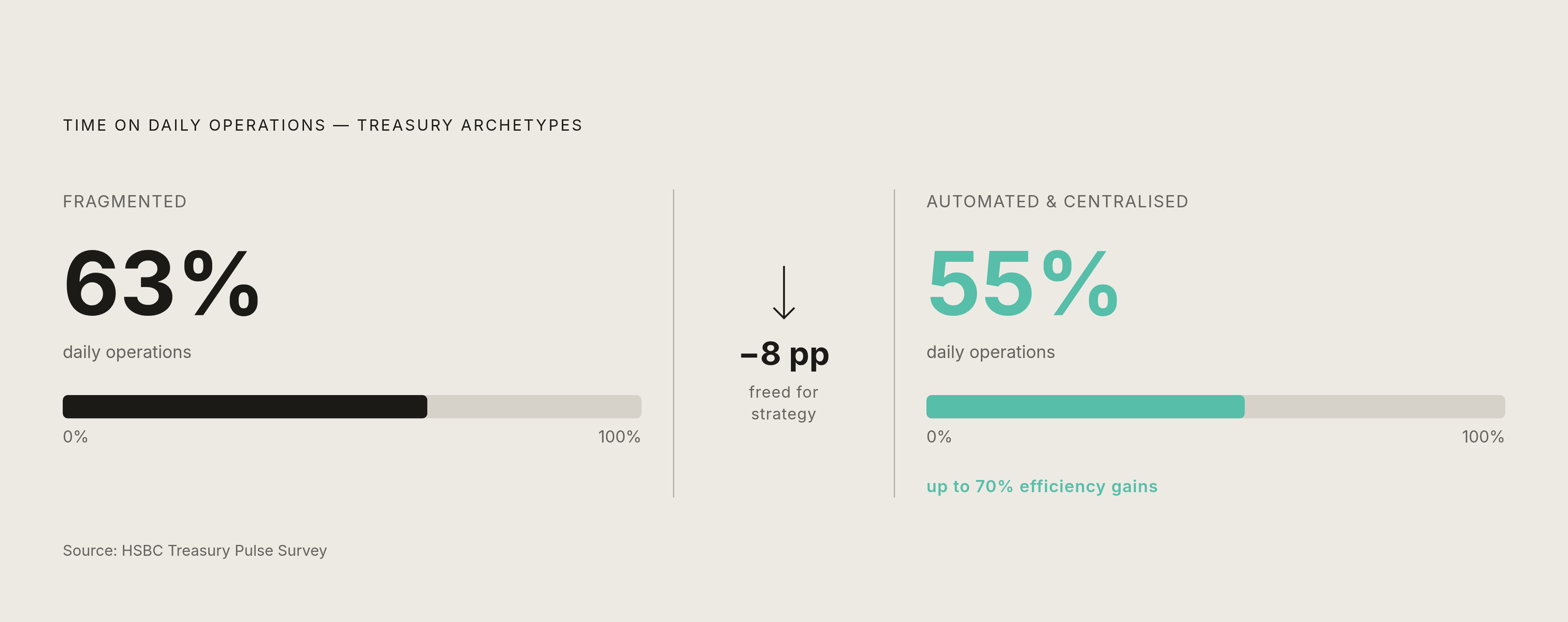
The efficiency gap between rationalized and fragmented treasuries is measurable. That same survey found treasuries with high automation and centralization hitting efficiency gains up to 70%, spending around 55% of their time on daily operations versus 63% for peers stuck with fragmented systems. That gap is real time freed up for forecasting, risk work, and investment decisions instead of chasing down account statements.
Rationalization is also the precondition for AI actually earning its keep in forecasting. PwC's 2025 survey found 74% of respondents are either expanding AI use or actively using it already, but AI and machine learning tools need clean, consolidated cash data to work with. Fragmented account structures produce the poor data quality that 76% of PwC's respondents named as their biggest forecasting obstacle. Garbage in, garbage out still applies, no matter how good the model is.
Further out, Gartner's Top Strategic Technology Trends for 2025 was cited by a major banking provider. Morgan, projects that by 2028, a third of enterprise software applications will include agentic AI. Treasuries running rationalized, automated structures will be positioned to actually use that. Treasuries still managing hundreds of disconnected accounts by hand won't be. The EuroFinance International Treasury Management conference, set for Barcelona in September 2026, put cash intelligence first in its program and gave technology transformation its own dedicated stage, which says something about where practitioners think the real work is right now. The World Bank Group's move to fold IBRD, IDA, and IFC into one integrated platform, spanning treasury, controller, risk, and environmental and social functions, starting January 1, 2026, is a striking public example of even the most complicated multi-institutional treasury setups choosing consolidation over letting complexity keep piling up.
A rationalized account landscape, fewer accounts, a leaner bank panel, eBAM handling the administration, payments running through centralized flows, is a foundation to keep building on, not a finish line to defend once it's built. It's the base a treasury team stands on to stop being a transactional custodian and start acting as a strategic architect of value, which is exactly the shift PwC's 2025 Global Treasury Survey points to as where the function is headed next.
Sources
- 2026 International Treasury Agenda | Barcelona, Sept 16-18
- Bank account rationalisation | Treasury Today
- 2025 Global Treasury Survey: PwC
- Virtual Account Management (VAM) Considerations | J.P. Morgan
- 2026 Economic Outlook: Impact on Treasury - Euromoney
- Rationalization revisited: An integrated solution to manage global liquidity
- en.wikipedia.org
- BCG Treasury Benchmarking Survey: Activating the Balance Sheet