Rolling Hedge Programs for Recurring FX Exposures
How companies can protect recurring currency exposures through continuous rolling hedges.

That ranking alone should settle any lingering idea that currency risk is a side issue handled once a quarter by whoever happens to be free. The number says something sharper: FX has become the top operational risk facing corporate treasury, full stop.
The math that produces that ranking is concrete rather than abstract. A 5% swing in EUR/USD is routine, and for an exporter running tight margins, that swing can erase millions in operating profit before anyone in the finance department has a chance to react. A market trading $9.6 trillion a day, as of April 2025, means there is no shortage of liquidity to hedge with, but there is also no shortage of volatility to absorb if a business fails to hedge at all.
Here is the pattern that keeps recurring exposures unprotected. A finance team notices a large payment coming due, perhaps a supplier invoice or an intercompany transfer, and places a hedge to cover it. The payment clears, the hedge rolls off, and coverage lapses until the next big number appears on someone's radar. Payroll in a foreign subsidiary, recurring supplier payments, forecast revenue streams, none of these appear as a single dramatic event, so they slip through a hedging process built around events rather than exposure.
The fix is structural. A rolling hedge program treats FX management as an ongoing operational discipline rather than a series of one-off decisions triggered by whatever invoice happens to be largest this month. That shift, from reacting to a transaction to managing a stream, is the difference this article sets out to explain.
What a rolling hedge program is
A rolling hedge program hedges on a continuous basis. As existing hedges mature, new ones extend coverage forward, so the leading edge of protection is a consistent tenor instead of collapsing to zero every time a contract expires. That is the entire mechanical idea, and everything downstream in this article builds from it.
The distinguishing feature is replacement. A hedge is never simply set and forgotten; when it matures, a new hedge for the same forward tenor takes its place, so the horizon of coverage keeps moving forward in step with the calendar. Two effects fall out of this naturally. First, the business maintains something close to a constant hedge ratio through time, rather than a ratio that spikes around known payment dates and evaporates in between. Second, volatility gets smoothed by a blended, averaged forward rate instead of whatever single rate happened to be available on the day someone remembered to place a hedge.
Compare that to a static hedge, which is placed once against a fixed, known exposure, like a single large equipment purchase. A rolling program does the opposite: it is placed repeatedly against an exposure that keeps regenerating itself. A static hedge protects an event, while a rolling program protects a stream of activity that has no natural end date, which is exactly the situation most operating companies actually... It is about philosophy. A static hedge protects an event. A rolling program protects a stream of activity that has no natural end date, which is exactly the situation most operating companies actually face.
A balance sheet dimension figures in even at this early stage, though the deeper mechanics come later. Rolling hedges can net out exposures already sitting on the balance sheet, hedging a specific tenor, then adjusting and rolling that position at expiry to protect against FX gains and losses on items already recorded. That is a distinct job from hedging forecast cash flows, and the next section draws that line more precisely.
The prerequisites: what you must know before placing the first hedge
Most rolling programs that fail, fail before the first hedge ever gets placed. The reason is almost always the same: nobody did the exposure mapping properly, so ratios get set against a guess rather than a number.
Two lanes need separating from the start. Cash flow hedging covers future cash movements that are expected to happen but have not yet occurred: forecast purchases, forecast revenues, planned overseas payroll. If FX moves against the business, the cash plan itself changes. Balance sheet hedging is a different animal entirely; it addresses revaluation risk on items already recorded, foreign-currency receivables and payables, intercompany balances, loans already on the books. Treating these two lanes as one undifferentiated pile of "FX risk" is how programs end up over-hedged in one place and exposed in another.
Within the cash flow lane, firm commitments (signed contracts, purchase orders) need to be distinguished from forecast exposures (pipeline revenue, budget estimates), because that distinction drives both hedge ratios and eligibility for hedge accounting treatment. A signed contract is a known quantity. A budget estimate is a belief about the future, and belief deserves a lower hedge ratio than certainty, a point the next section develops in detail.
For any company running multiple business units or subsidiaries, netting comes before hedging. One division may be long a currency while another is short the same currency, and hedging each in isolation means paying for coverage the company does not actually need on a net basis. Fifth Third Bank's guidance on this point is blunt: hedge the net, not the gross.
All of this exists to defend one number: the budget rate, the assumed exchange rate baked into financial planning and pricing at the start of the year. Pricing strategy, margin targets, and cost assumptions get built around that rate, and if actual currency moves diverge from it materially, the damage does not stay contained to a single line item. It ripples through the entire P&Lc11. A rolling program's real job, stripped of jargon, is defending that budget rate for as long as the underlying forecast stays reliable.
None of this works without a written hedging policy. The policy defines risk appetite, approved instruments, and who has authority to act, and it exists precisely to stop good intentions from decaying into ad hoc decisions the moment a market moves sharply. It also does quieter work: it keeps business units consistent with each other and gives boards, auditors, and investors something concrete to evaluate rather than trusting that treasury is "on top of it."
Two metrics make all of this legible in numbers rather than intuition. Value at Risk estimates potential loss over a given horizon at a defined confidence level, essentially answering how bad things could get under normal market conditions. Cash Flow at Risk translates that same uncertainty into cash-flow terms, how much actual cash flows could deviate from plan. For most operating businesses, CFaR is the more honest measure, because missed budgets and margin surprises are how leadership actually experiences FX risk, not abstract statistical loss distributions. If actual rates diverge materially, the consequences ripple through every line of the P&L, and the rolling program's job is to defend this rate for as long as forecast reliability allows.
Setting hedge ratios and tenors across a rolling horizon
The governing principle is simple to state and easy to violate: hedge ratios should fall as the time horizon extends. Forecast accuracy degrades the further out a business tries to look, and over-hedging an exposure that may never materialize creates a new risk in the act of trying to eliminate an old one.
The Association of Corporate Treasurers finds that near-term practice among corporates tends to cluster around a hedge ratio of roughly 80% of forecasted exposure, typically using forward-based instruments, over a three- to nine-month window, since exposures inside nine months are known with enough confidence to justify heavy coverage. That figure is not arbitrary. It reflects a judgment that exposures inside nine months are known with enough confidence to justify heavy coverage, while exposures further out carry too much forecast risk to hedge at the same intensity.
One illustrative structure is a six/twelve/eighteen-month layered structure at 80%, 50%, and 20% respectively. Another is an 80/60/40/20 rolling structure, with 80% of the immediate quarter firmly hedged and coverage scaling down to 20% for exposures roughly a year out. Neither is a universal formula. Both are illustrations of the same underlying logic: certainty commands coverage, uncertainty earns caution.
Tenor length in practice runs wider than either example suggests on its own. Fifth Third Bank notes that the optimal tenor for many FX options programs falls between 12 and 36 months, with the right endpoint depending heavily on how far out a company's forecasts stay reliable. Businesses with unusually stable, long-dated exposures, recurring supply contracts or long-term customer agreements, sometimes run layered hedging out to 18 or even 36 months. Ericsson offers a real anchor point here: its recurring hedge program for highly probable forecasted USD sales and purchases runs 7 to 18 months out, refreshed monthly. That is not a theoretical range pulled from a textbook. It is a functioning program at a company with genuinely recurring, forecastable currency flows, which is exactly the profile a rolling program is built to serve. The declining-ratio structure across a full horizon draws on two illustrative benchmarks from the sources.
Layering turns a hedge ratio policy into continuous coverage
Ratios and tenors are policy. Layering is what makes the policy real, and it is worth walking through mechanically because the logic, once seen, is hard to unsee.
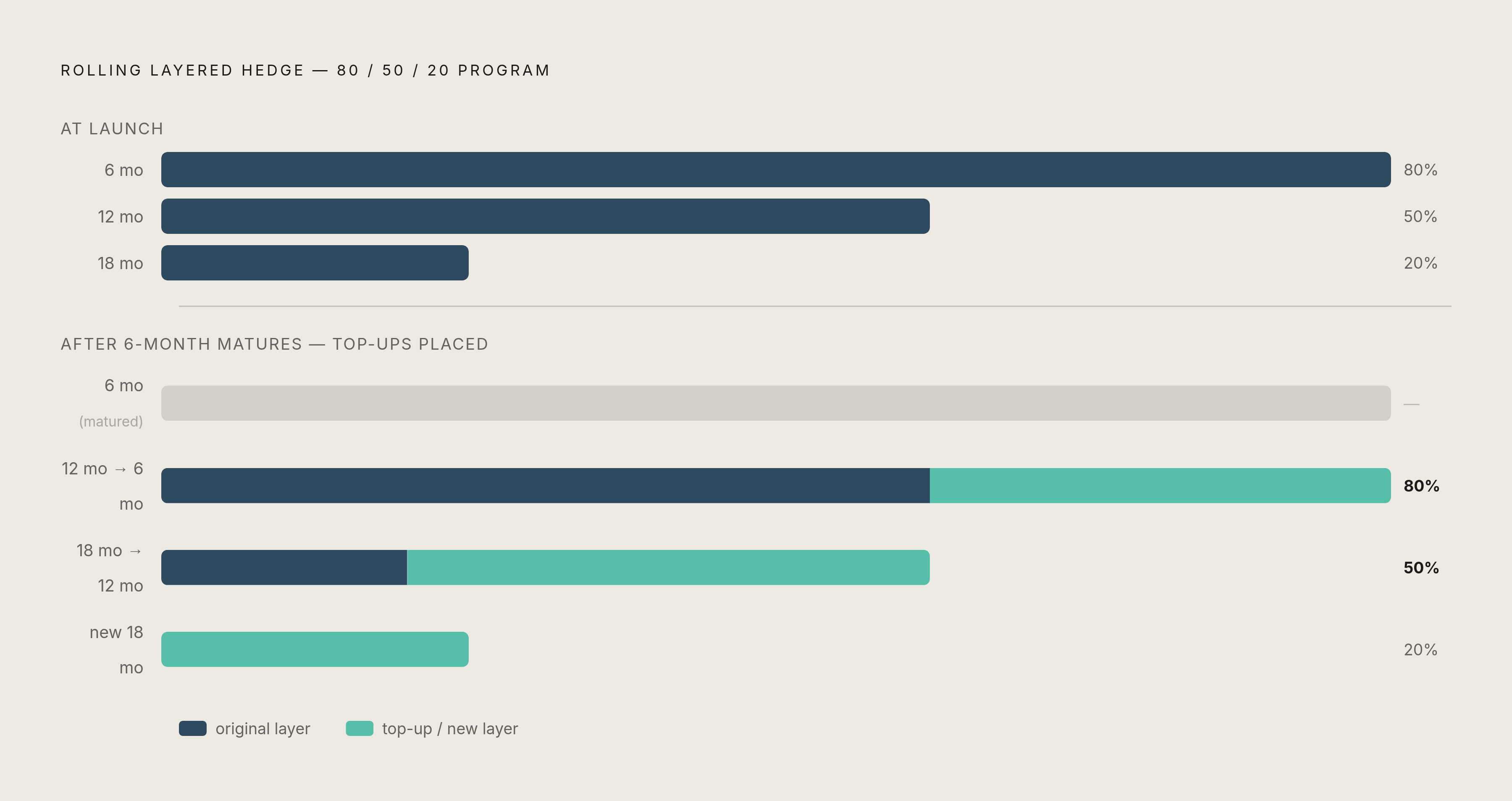
Take the 80/50/20 example from the Association of Corporate Treasurers. At launch, three hedges go on simultaneously: a six-month hedge covering 80% of exposure, a twelve-month hedge covering 50%, and an eighteen-month hedge covering 20%. Nothing unusual yet, just three positions at three tenors and three ratios, consistent with the declining-ratio principle from the previous section.
The interesting part happens when the six-month hedge, part of a structure layered at 80%, 50%, and 20% at six, twelve, and eighteen months respectively, matures. At that point, the original twelve-month hedge now has only six months left to run, so it gets topped up from 50% to 80% with a new 30% hedge layered on. The original eighteen-month hedge, now with twelve months left, gets topped up from 20% to 50% with another new 30% hedge. And a fresh eighteen-month hedge goes on to capture the next 20% slice of exposure, restarting the far end of the horizon. The process then repeats at the next maturity. The program never restarts from zero; it simply rolls forward, layer by layer, with each maturity triggering a top-up rather than a fresh beginning.
A monthly variant of the same idea exists too. Hedging one-twelfth of annual exposure every month creates what Kantox calls a smooth hedge, since successive layers get executed at different market rates and blend, over time, into something closer to an averaged forward rate than any single day's print.
What does this actually buy a treasury team, compared to just rolling a single hedge forward on a fixed date? Volatility in the hedged rate drops, because the blended rate dampens the effect of any one entry point landing badly. Mark-to-market swings shrink in both frequency and size, since positions are layered smaller and at varying rates rather than concentrated in one large bet. Coverage never collapses to zero while a new hedge gets arranged, which is the structural failure mode that transaction-by-transaction hedging is prone to.
Instruments available for building a rolling program
Forward contracts remain the workhorse of most rolling programs, and for good reason: they lock in a future exchange rate cleanly, and spreading them across time through a rolling structure reduces the risk of mistiming any single hedge while smoothing cash-flow volatility overall. Micron Technology runs exactly this kind of program, using a rolling hedge strategy for its primary currency exposures built on forward contracts that generally mature within three months. Ericsson, meanwhile, uses forward contracts designated as hedging instruments under formal hedge accounting rules, applying the approach to both its multi-year contract program and its monthly rolling forecast program.
FX options serve a different purpose. Where a forward locks in a rate outright, an option creates a floor while leaving room to benefit if the market moves favorably instead. That asymmetry has real demand behind it: the BIS Triennial Central Bank Survey shows that options turnover more than doubled between 2022 and 2025, showing that treasury teams increasingly want downside protection without giving up all upside. Options can also be built with specific terms, particular price triggers, notional sizes, contract lengths, and come in one style, exercisable any time before maturity, or another style, exercisable only at expiration. The tradeoff is cost: option premiums and time value can affect short-term results under both IFRS 9 and ASC 815, a real consideration for any program running formal hedge accounting.
Strip hedges solve a more specific problem: matching instruments to a predictable payment calendar, whether that means monthly, quarterly, or tied to a particular payment cycle. Companies with regular import payables, recurring supplier payments, or known capital expenditures in a foreign currency tend to find strip hedges a natural fit, since the exposure timing is already known well in advance.
Cross-currency swaps address a longer horizon altogether, and they matter most for multinationals carrying large foreign investments or cross-border loans, where the exposure is structural rather than transactional. Swaps complement the shorter-dated forward and option layers described above, extending protection over years rather than months for companies whose exposure genuinely runs that long.
None of these instruments crowds out the others in practice. Airbus runs a hedging policy that combines forwards, options, and swaps while covering roughly 70 to 80% of future cash flows, which says something important: large, sophisticated programs tend to blend instruments to match the shape of their exposure rather than betting everything on one tool.
Maintaining the program: rebalancing, monitoring, and governance discipline
A hedge ratio set in January is a guess about the future, and guesses age badly. Forecast volumes shift, contracts get won or lost, currencies move on their own schedule, and a program without a defined rebalancing trigger simply drifts away from its own policy without anyone quite noticing when it happened.
Three things typically force a rebalancing review: a material change in forecast exposure, whether in volume or currency mix; a hedge approaching or breaching its effectiveness threshold under hedge accounting rules; or a market move sharp enough to re-price the cost of rolling forward the next layer. That last trigger has been unusually active lately. Ripple Treasury reports that EUR/USD implied volatility spiked sharply after US tariff announcements in early 2025, and the spread between short- and long-dated options widened in ways that made forward-based hedging meaningfully more expensive. When hedging costs rise faster than the exposure they are meant to protect, the economics of the hedge itself start to erode, and rebalancing cadence has to adapt in response rather than stay on autopilot.
Supply chain fragmentation compounds the problem. When currency moves reprice supplier contracts inside a single quarter, treasury and procurement need a connected process, not siloed ones.
Governance is where the written policy from earlier in the program's life either proves its worth or reveals itself as decorative. A real policy specifies review frequency, names who has authority to adjust ratios or instruments, and states what documentation each decision requires. LVMH's approach is instructive here: a central treasury based in Paris oversees currency risk across roughly 75 brands worldwide, which prevents policy drift that occurs when individual business units are left to make their own calls. Consistency of execution turns out to matter almost as much as the initial design of the program, since ad hoc decisions made outside the agreed policy quietly erode the smoothing benefit that layering was built to deliver.
The companies that choose not to run a program at all deserve acknowledgment too. Risk.net reported that Amazon and Tesla decline to hedge their day-to-day FX exposures, citing cost, oversight burden, and a preference to preserve upside; Meta, by contrast, has since begun using currency forwards. For businesses with strong natural hedges or genuinely diversified global revenue, that stance is defensible. It is a legitimate strategic choice. It is not, however, a rolling hedge program, and it should not be confused with one: the absence of hedging is a decision about risk appetite, not a substitute for the operational discipline this article has laid out.
Sources
- Examining Options for FX Hedging | Fifth Third Bank
- ERICSSON LM TELEPHONE CO - Form 20-F - FY2025
- How Geopolitical Fragmentation is Breaking Traditional FX Hedging and What Comes Next | Ripple Treasury
- MICRON TECHNOLOGY INC - Form 10-K - FY2025
- Layering Hedges and Extending the Hedge Horizon Through Rolling Hedge Programs | Treasury Management International
- Harness your hedges | The Association of Corporate Treasurers
- Global FX markets when hedging takes centre stage
- FX Hedging Programs: How to Manage Currency Risk - Kantox