FX Exposure Identification in Global Supply Chains
Most multinational companies ignore three distinct types of FX risk lurking in their supply chains.

Global FX trading volume hit $9.6 trillion a day in 2025. Despite that ocean of liquidity sitting around every cross-border payment, four in five businesses still took losses from unhedged currency risk that same year. That gap between how much FX activity exists and how badly companies manage their own exposure to it is the subject of this piece. The reason so many firms get caught out is that FX exposure isn't one problem. FX exposure is three separate problems. It's three, and each one appears at a different point in the supply chain, in a different form, visible only if you know which lens to use.
The stakes are higher right now than they've been in years. Major currencies strengthened hard against the dollar through 2025, and the dollar never really recovered, even as geopolitical tension built. At the same time, tariff volatility started stacking on top of currency volatility, and the two now hit the same margin line at once: a cost increase from a tariff and an adverse currency move can land in the same quarter, on the same product line, and finance teams often can't tell which one did the damage. J.S. Held puts the annual cost of supply chain disruption at roughly $184 billion as of 2025, and FX sits inside that number as one of the drivers nobody labels correctly.
Transaction exposure: the FX risk created at the moment a contract is signed
Transaction exposure starts the second a company commits to a cross-border deal in a foreign currency. A purchase order gets placed, a sales contract gets signed, and somewhere between that moment and the day cash actually moves, the exchange rate can shift under the deal. The amount owed is fixed. The date is usually fixed too. What isn't fixed is what that amount will be worth in the company's own currency by the time payment clears.
That's the detail that separates transaction exposure from the other two types: there's no doubt the payment will happen. The rate at settlement is the only open question.
It appears in a handful of predictable places. A domestic manufacturer buying components from an overseas supplier priced in a foreign currency carries it. So does an exporter who invoices a foreign buyer in the buyer's currency instead of its own, and so do subsidiaries transacting with each other across different functional currencies. Payment terms stretch the exposure window further: Net 30 is a month of rate risk, Net 60 doubles it, and longer terms just keep extending the runway during which the rate can move against you.
Rolls-Royce is the case worth knowing here. After the Brexit vote, sterling collapsed, and the company's existing hedge book on its GBP/USD exposure took a £4.4 billion non-cash charge, driving a £4.6 billion headline pre-tax loss. Nothing about the underlying contracts changed. The amounts owed were the same amounts as before the vote. What moved was the rate, and the hedges written against a different sterling reality turned from protection into liability almost overnight.
Translation exposure: the FX risk that appears only at consolidation time
Translation exposure doesn't touch cash at all, at least not directly. It occurs when a parent company rolls up the financial statements of subsidiaries that operate in other currencies. The subsidiary's revenue, assets, and liabilities are all denominated in its local currency, and when the parent converts those figures back into its own reporting currency at consolidation, the exchange rate on that date decides what gets reported, even if nothing in the actual business changed.
Call it a non-cash event if you want, but don't call it harmless. Balance sheet values shift. Leverage ratios shift with them. Reported earnings move up or down for reasons that have nothing to do with operating performance, and that affects how credit rating agencies view the company, debt covenant compliance, and how investors read the quarter.
Manufacturing subsidiaries sitting in lower-cost currency regions, Southeast Asia or Eastern Europe for instance, carry this constantly, because their asset base is denominated in a currency that isn't the parent's. Inventory sitting in a foreign warehouse is a clean example: the unit count doesn't change, the physical goods don't change, but the value shown in the parent's consolidated books moves with the exchange rate. Intercompany loans carry the same exposure from both directions at once, a liability on one side of the ledger and an asset on the other, both subject to restatement at the same rate. Retained earnings built up over years inside a subsidiary get restated at spot rate every time the books close. Years of accumulated local-currency profit can look different in dollar terms purely because of where the rate happens to sit on reporting day.
That last point is what makes translation exposure hard to manage day to day. It lives on the balance sheet and it only becomes visible at reporting dates, so it behaves less like an ongoing signal and more like a quarterly jolt that finance teams have to explain after the fact.
Economic exposure: the FX risk that reshapes competitive position over years
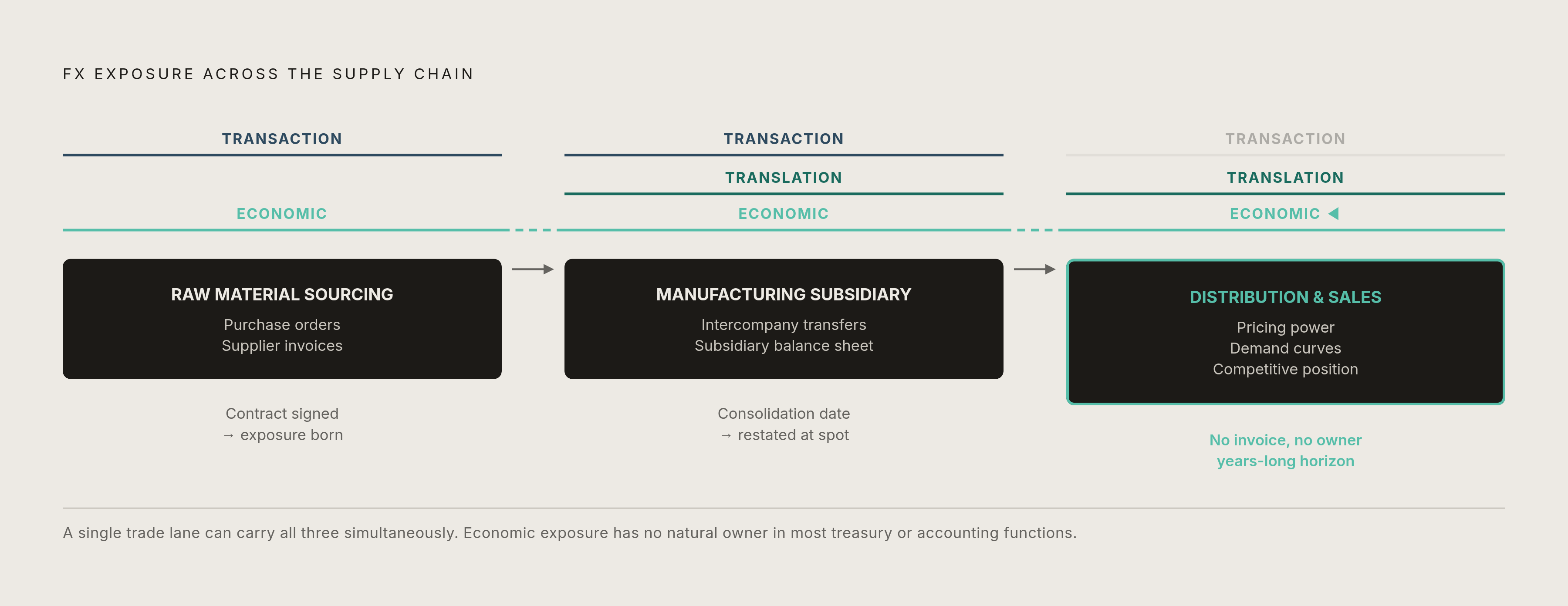
Economic exposure is the hardest of the three to pin down, because it lives outside any contract or consolidation schedule. It's the effect that unexpected currency moves have on a company's cash flows, its competitive standing, and its market value over the long run. Transaction exposure deals in known amounts and known dates. Translation exposure is an accounting restatement. Economic exposure lives somewhere else entirely: in demand curves, in pricing power, in what competitors decide to do next.
That's also why it's the type most companies fail to identify. It depends on how exchange rates, input costs, customer demand, and competitor pricing all move together, and those dynamics play out over years, not the weeks or months a transaction exposure runs on. You won't find it by reviewing accounts payable or a consolidation schedule. It takes an actual look at strategy and market position to see it.
The part most supply chain risk mapping misses entirely is indirect exposure. A domestic manufacturer with zero foreign suppliers and zero export sales can still carry real economic exposure, if its domestic competitors source inputs from a country whose currency is weakening. Those competitors get a cost advantage the domestic firm has no contract, no hedge, and no line item to counter. Importers face the mirror version: input costs climb if the payment currency appreciates, and exporters watch revenue shrink if the currency they get paid in depreciates. Both are economic exposure at work, and both first raise margin compression, well before anything about them appears in a contract or an invoice.
Sub-tier supplier exposure is the sneakiest version. A Tier 1 supplier might invoice a customer in USD, which looks clean and currency-neutral on paper. But if that supplier's own input costs are in a currency that's moving, the exposure doesn't disappear, it just hides for a while. Eventually it comes out in a price renegotiation, and by then it's landed on the buyer's income statement as a cost increase with no currency label attached.
How the three exposure types interact along a supply chain
None of this happens in isolation. A single trade lane, one supplier, one product line, can carry all three exposure types running at the same time. There's transaction exposure sitting in the open purchase orders with that supplier right now. There's translation exposure in whatever inventory or receivables sit on a subsidiary's balance sheet in that supplier's country. And there's economic exposure hanging over the long-run economics of the relationship if that supplier's currency shifts on a structural basis rather than bouncing around short term.
Each stage of the supply chain tends to generate its own mix. Raw materials and component sourcing mostly produces transaction exposure, from invoices priced in the supplier's currency, layered with economic exposure from the cost structures of competitors sourcing elsewhere. Manufacturing subsidiaries mostly generate translation exposure through asset and liability restatement, plus transaction exposure from intercompany transfers moving between entities. Distribution and sales operations in foreign markets carry transaction exposure on their invoices and economic exposure in how much pricing power they actually have against local competition.
The 2026 tariff picture makes all of this harder to read cleanly. The Thomson Reuters Global Trade Report found that 72% of trade professionals now name tariff volatility tied to one country's trade policy as the most disruptive regulatory shift they're dealing with, up from 41% the year before. Tariffs raise the cost of imported materials and components, and that cost increase lands on the same margin that currency moves are already squeezing, which makes it genuinely difficult to tell which force is doing the damage in any given quarter.
Ownership is part of the problem too. Transaction exposure usually belongs to Treasury. Translation exposure usually belongs to Finance or Accounting. Economic exposure, in most companies, doesn't clearly belong to anyone. No single function is looking at all three against the same supply chain map at the same time.
Currency mapping and time-horizon bucketing as the practical identification framework
A currency map is the starting point for actually getting a handle on this. It's a structured inventory of every currency a company touches, through revenue, cost, assets, liabilities, and intercompany flows, matched against the business activity that created the exposure and the function responsible for it. For any company operating across multiple countries, running meaningful import or export volume, or moving significant trade between entities inside its own group, this is required homework. It's the baseline document risk management has to start from.
A complete currency map records the currency and the counterparty involved, where the exposure came from (a supplier contract, an intercompany loan, a subsidiary's balance sheet, a revenue forecast), when payment or reporting is due, how certain that exposure actually is (a firm contractual commitment versus a forecast estimate), which internal function owns it, whether it's AP, Payroll, Procurement, or Treasury, and which of the three exposure types it falls under.
Time-horizon bucketing adds the second dimension, sorting exposures by how confident the company can be that they'll actually materialize. XE.com's treasury guidance lays out a useful structure: the 0 to 30 day window is near-certain and invoice-driven, mapping almost entirely to transaction exposure. The 31 to 90 day window mixes firm purchase orders with invoices, still transaction exposure but carrying more of a forecast component. From 91 to 180 days, the picture is forecast-heavy and policy-driven, starting to shade into economic exposure territory. Beyond 180 days, the map is dealing mostly with economic exposure, and that's generally something companies watch rather than hedge outright, since hedging a number that's still an estimate creates its own kind of risk.
The macro environment in 2025–2026 and the exposures it forces firms to identify
Dollar weakness is widening transaction and economic exposure at the same time, and that's not a coincidence. Major currencies pushed higher against the dollar through 2025, and the dollar didn't claw the ground back. Companies that locked in long-term supplier contracts in USD back when the dollar was strong are now looking at a different competitive landscape as those contracts come up for repricing, and the exposure they thought they'd settled has come back around from a different angle.
Tariffs have made identification harder still. Thomson Reuters found that 39% of trade professionals are now absorbing tariff costs, or actively weighing whether to, rather than passing them on to customers, up sharply from 13% the year before. And 76% believe the current tariff regime isn't a temporary phase, expecting it to hold for at least four years. That means the scope of FX identification now has to include tariff-adjusted cost scenarios alongside currency scenarios, not one or the other. When a tariff pushes input costs up in the same period a currency moves against a company, economic exposure and transaction exposure compound together, in the same reporting window, and the resulting margin hit is bigger than either factor would produce alone.
Supply chains are also shifting shape, and that shift is dragging new currencies into the picture. Companies pulling back from concentrated sourcing in favor of regional, multi-factory networks spread across Asia, Europe, and North America are, by definition, adding new currencies to their exposure registers. One emerging-market currency, another emerging-market currency, a third emerging-market currency: all of these are showing up now for companies that used to deal mainly in one dominant currency or another major currency. Geopolitical risk is the top concern for 19% of businesses, and geopolitical shocks that force a sudden change in sourcing can generate FX exposure that nobody flagged, because nobody had time to map it before the sourcing decision was already made.
The market for FX exposure analytics is growing to meet exactly this problem, expanding at a 12.4% compound annual rate from $2.21 billion in 2025. That growth says something on its own: identifying exposure has stopped being a periodic finance exercise and turned into something companies need to track continuously, across a currency map that keeps adding new entries faster than most treasury teams are used to.