FX Forward Contracts vs FX Options for Corporate Hedgers
Forwards lock in rates but sacrifice upside; options preserve it while charging for that protection.

Choosing between an FX forward and an FX option is not a question of which instrument wins. It comes down to matching the mechanics of each tool, its certainty, its flexibility, its cost structure, to the actual shape of the exposure sitting on a company's books. That distinction sounds simple, but treasury teams that get it wrong end up either overpaying for protection they didn't need or leaving real cash flow exposed to swings they could have priced away.
The volatility driving this decision isn't a temporary spike that will settle once markets calm down. Tariff shifts, central banks moving in different directions at different speeds, and disrupted trade routes have made it genuinely difficult to anchor a planning rate to anything stable. Global OTC FX turnover averaged $9.6 trillion a day in April 2025, up 28% from April 2022, and the ratio of FX trading volume to global GDP has climbed from 12 times in 1992 to 30 times today BIS Triennial FX Survey Deloitte Global Corporate Treasury Survey / Fifth Third Bank. That context matters because it means even routine, unglamorous corporate cash flows, a supplier invoice, a payroll run in a foreign subsidiary, now sit inside a market moving with far more force behind it than a decade ago.
The mechanism producing the pain is straightforward and unforgiving. A company prices its products or negotiates its input costs today, but the cash doesn't move until weeks or months later. If the exchange rate drifts against the business in that window, the margin baked into the original price simply evaporates, and in manufacturing, importing, and exporting, that erosion compounds fast.
Corporates have noticed. Of the companies still not hedging, more than half say they're reconsidering Bank of England London Foreign Exchange Joint Standing Committee MillTechFX MillTechFX 2025 Global Survey MillTech. Currency movements have hit the bottom line for 88% of firms globally, and 92% of North American firms specifically point to the strong dollar as the source of the pain MillTechFX. Inaction has a price tag too. Nearly half of UK corporates, 48%, took actual losses from FX volatility in 2025, even though 96% of them described their hedging strategy as well prepared going in MillTech. That gap between confidence and outcome is the cost of sitting on the sidelines, made visible in the results.
None of this argues for forwards over options or the reverse. It argues that the decision deserves real scrutiny rather than a default answer.
How FX forwards work
An FX forward is a binding agreement between a company and a financial institution to exchange a fixed amount of one currency for another, at an agreed rate, on a set future date. It's negotiated bilaterally, over the counter, not traded on an exchange. There's no premium paid upfront. Instead, the cost sits inside the forward points, which reflect the interest rate gap between the two currencies under covered interest parity, and a company can typically get tenors ranging from a single day out to several years.
The defining trait of a forward is that it removes rate uncertainty entirely, in both directions. If the currency moves against the company, the forward protects it. If the currency moves in the company's favor, the company doesn't get to keep that upside either. Consider a UK exporter that invoices customers in US dollars Bank of England London Foreign Exchange Joint Standing Committee MillTechFX MillTechFX 2025 Global Survey MillTech. If sterling strengthens, the exporter's dollar revenues are worth less the moment they convert back, and the hit lands directly on operating profit. A forward locked in ahead of time removes that swing from the equation completely.
Forwards are also fully customizable on the terms that matter to a treasury desk: amount, settlement date, and currency pair are all negotiable, unlike a standardized product traded on an exchange. In some cases, particularly for longer-dated contracts or when markets are choppy, the counterparty bank may ask the company to post a margin deposit as a performance guarantee. That deposit isn't a fee, it comes back at settlement. Structurally, the payoff on a forward is linear: whatever the underlying exposure gains or loses as the rate moves, the hedge moves in exact opposition, with no asymmetry built in anywhere. A UK exporter invoicing in USD faces immediate P&L impact when GBP strengthens, and a 5% adverse movement on £50m of USD revenues translates to a material reduction in operating profit (MillTech 2026), whereas a forward eliminates that uncertainty (MillTech).
How FX options work
An FX option gives the buyer the right to exchange currency at a strike price on a set expiration date, rather than the obligation to do so. The buyer can exercise it or let it lapse. That single word, right rather than obligation, is what separates an option from a forward at the structural level, and it changes everything downstream.
The payoff is asymmetric by design. Downside is capped at the strike price, while upside stays open if the market moves favorably, and the price for that asymmetry is the premium paid when the contract is written. That premium is priced off volatility, time to expiry, and how far the strike sits from the current spot rate, plus whatever margin the bank layers on top, and that margin is genuinely harder for a corporate to benchmark than a forward's cost, because there's no single quoted mid-rate to check it against.
Style matters here too. American-style options can be exercised any time before expiry, which gives maximum flexibility. European-style options can only be exercised at expiration, and they're simpler to price. That's why they show up more often in corporate hedging programs. Beyond style, options can be built bespoke: specific triggers, custom notional sizes, tailored contract lengths, all negotiated to fit a company's actual risk appetite rather than forcing the company to fit a standard product.
What makes the premium attractive from a risk standpoint is that it's a known ceiling. If the option expires unused, the company has lost what it paid upfront and nothing more, a sharp contrast with a forward, where an adverse move creates an open-ended opportunity cost with no natural cap. There's a secondary benefit that's easy to overlook: buying an option means owning an asset, and that reduces counterparty exposure relative to a forward, while also not eating into the credit lines a company would otherwise need to preserve for other hedges.
What the cost comparison looks like (and what it leaves out)
Calling a forward "free" because there's no premium is technically true and practically misleading. The cost is there; it's just embedded in the forward points rather than itemized as a line item. What matters is where that cost sits and whether anyone can actually see it, not which instrument costs money.
Options cut the other way on transparency. The premium is explicit, quoted upfront, and the buyer knows exactly the maximum they can lose on the hedge itself. But the margin buried inside that premium is genuinely opaque compared to a forward's pricing, since there's no simple benchmark rate to check it against. Volatility makes this worse in practice: when implied volatility across major sterling pairs climbed in 2025, option premiums climbed with it, which is part of why zero-cost structures like collars gained traction, since giving up some upside mattered less to many treasurers than controlling cost. The broader 2025 environment, tariff whipsaws, a falling dollar, elevated volatility, pushed up option premiums, widened bid-ask spreads on forwards, and made liquidity unpredictable exactly when companies needed it most.
Any straight cost comparison only holds up if the underlying exposure type stays constant. Stacking an option's premium against a forward's zero upfront cost for a cash flow that's fully certain makes the option look needlessly expensive. Comparing a forward against an option for an exposure that might not even happen removes the forward's real risk, the risk of hedging something that never materializes, from the picture. The two instruments aren't competing on a level playing field once the exposure profile changes, and pretending otherwise produces bad decisions. Opportunity cost belongs on that ledger too. Lock a forward and watch the home currency subsequently strengthen, and the foregone gain is a real cost even though no invoice or bank statement will ever show it.
Matching instrument to exposure type: the decision variables that matter
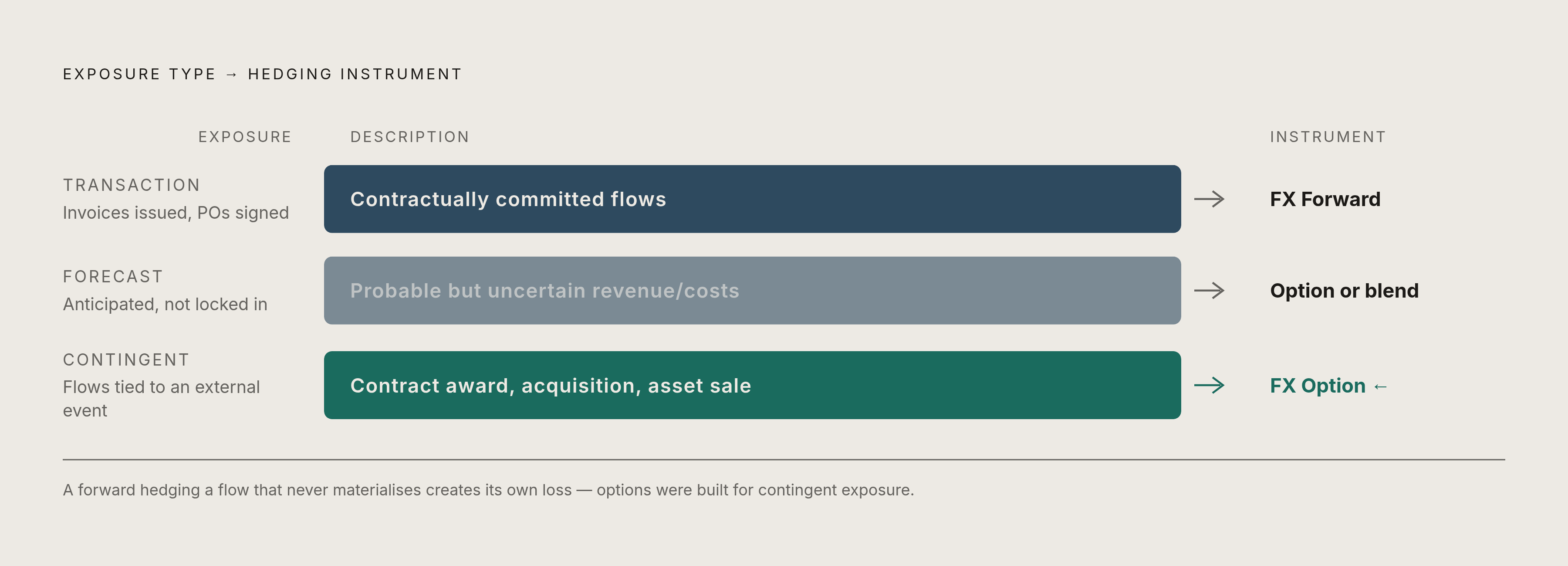
Everything comes back to one question first: is the underlying cash flow certain? A confirmed purchase order, a signed services contract, fixed payroll obligations in a foreign currency, these are all natural candidates for a forward. The amount is known, the date is known, so lock the rate and remove the variable. An uncertain or contingent flow is at the other end, a deal that might not close, year-end earnings that may or may not get repatriated, a bid on a competitive tender that might not win. That's the natural home for an option, since protection sits in place if the flow does materialize, and the premium is the only cost if it never does.
A cleaner way to sort this is by exposure type. Transaction exposure covers contractually committed cash flows, invoices already issued, purchase orders already signed, and that's typically where forwards fit best. Forecast or economic exposure covers anticipated revenue or costs that aren't locked in yet, and that uncertainty tends to favor options or some blend of the two. Contingent exposure covers cash flows tied to an external event entirely outside the company's control, a contract award, an acquisition closing, an asset sale, and that's precisely the case options were built for.
Timing adds a second wrinkle. A cash flow can be certain in amount but fuzzy on date, and that combination often calls for a window forward or a longer-dated option rather than a forward tied to one fixed settlement day. On tenor specifically, options programs tend to run 12 to 36 months, and many corporates layer in fresh tranches every quarter to keep the hedge horizon rolling forward consistently BIS Triennial FX Survey Deloitte Global Corporate Treasury Survey / Fifth Third Bank.
Supply chains are adding a wrinkle of their own. Tariff pressure has pushed 97% of UK corporates to shift sourcing or manufacturing in ways that directly changed their FX exposure, and these new exposures usually start out uncertain in both size and timing, which makes sorting exposures by type more urgent than it used to be MillTech. Before any of this gets hedged, it's worth checking for netting opportunities. A company with subsidiaries holding offsetting long and short positions in the same currency should hedge the net position rather than each leg on its own, cutting both derivative volume and cost no matter which instrument ends up chosen. Board-level risk tolerance sets how much residual exposure the business is willing to carry and shapes the hedge ratio and instrument mix well beyond exposure type alone.
When the two instruments work together rather than compete
In practice, most corporate hedging programs don't pick a side. They run forwards against known payables and receivables and options against exposures still uncertain in size, timing, or whether they'll happen at all. That's the same logic from the exposure classification carried through to execution, not indecision.
A common structure is the hedging strip: a spread of instruments across the year built to collectively support a target budget rate, with forwards locking in certainty for the bulk of known exposure and options acting as a buffer around the tranches that are still shifting. It gives a treasury team room to move as conditions change, which matters given that two out of three companies surveyed in 2025 said they planned to add to their hedges or extend them further out in response to geopolitical tension MillTechFX 2025 Global Survey MillTech.
Collars sit in the middle ground. A bought protective option pairs with a sold option running the opposite direction, and the premium collected on the sold leg offsets the cost of the bought one. The trade-off is straightforward: upside gets capped instead of staying open, but net premium cost drops to zero or close to it, which matters a great deal when volatility has pushed vanilla option premiums to levels that feel hard to justify.
Options also do something quieter but genuinely useful for a treasury desk managing multiple hedges at once. Because buying an option means owning an asset, it doesn't eat into the same credit lines a forward would, which preserves room to add further hedges later without running into internal credit constraints. That flexibility is likely part of why option volumes jumped so sharply in 2025. London's FX options volumes hit $350 billion in April 2025, up 52% from the October 2024 survey, and Tristan Wood, BNP Paribas's Global Co-Head of FX Options, said demand rose significantly as clients looked for ways to manage tariff risk and broader geopolitical uncertainty Bank of England London Foreign Exchange Joint Standing Committee MillTechFX MillTech. None of that surge replaced existing forward books. It layered on top of them.
Practical considerations that shape which instrument a corporate can use
Accounting treatment isn't a footnote here, it genuinely steers instrument choice. Under IFRS 9 and US GAAP ASC 815, option premiums and time value can move short-term results even when the hedge itself is doing what it's supposed to do economically, a complication forwards don't create in the same way. Qualifying for hedge accounting treatment at all means designating the instrument against a specific exposure and keeping documentation current, and for smaller finance teams, that overhead alone can tilt the decision.
Credit lines factor in too. Forwards carry a bilateral settlement obligation, so they draw down a company's credit facilities with its counterparty bank. Options bought outright don't draw on credit the same way, which matters for companies that want to keep building out a multi-tranche hedge program without running out of headroom.
Collateral risk appears mainly on the forward side. In stressed markets, counterparties can demand extra collateral on open forward positions, and failing to post it can trigger an automatic close-out of the position. An option buyer never faces that call. The most that position can lose is the premium already paid, full stop. Rolling a forward forward, extending it rather than settling, carries its own friction: wider spreads, thinner liquidity, more of both for the 55% of UK corporates now planning to extend hedge length and the 37% planning to raise hedge ratios MillTech. There's no central clearinghouse guaranteeing OTC settlement on the forward side, which creates counterparty risk and makes counterparty selection and credit assessment a real part of the job, not a formality. UK corporates are already leaning into longer hedges, mean hedge length grew from 4.04 months in 2023 to 5.52 months in 2025 MillTech. More firms now sit in the part of the curve where rollover and margin risk bite hardest MillTech.
Cost, the internal oversight burden, an assumption that the dollar behaves as a safe haven regardless, and a straightforward desire to keep upside on the table are reasons some firms opt out, including three of the "Magnificent Seven" tech giants. That last reason, wanting to keep the upside, is precisely the itch an FX option scratches, at a defined and known cost, rather than an unhedged bet with no ceiling on the downside at all.