FX Policy Design for Mid-Market Multinationals
A written FX policy turns currency swings into predictable costs instead of earnings surprises.

FX policy for a mid-market multinational isn't a compliance document filed away for the auditors. It's the mechanism that determines that currency volatility either appears on the income statement as a line item the CFO planned for or becomes a surprise the CFO has to explain live on an earnings call. Companies in this segment carry exposure too complicated to manage by gut feel, yet they don't have the budget to build the treasury infrastructure a much larger multinational takes for granted. A written policy, covering exposure identification, hedge ratios, approved instruments, and authorization rules, is the answer to that bind, and companies that skip it are betting on getting lucky twice.
The uncomfortable middle ground mid-market multinationals occupy on FX
The mid-market, generally companies between $20 million and $2 billion in annual revenue, is in a spot that neither extreme of the corporate world has to deal with. A Chubb and National Center for the Middle Market survey, drawn from roughly 1,000 executives, put total middle-market growth at 12.1% as of December 2024, with executives expecting another 8.9% in 2025. Growth like that doesn't stay domestic. It pushes companies into new countries, new suppliers, new customers billing in currencies the finance team never budgeted for last year. More cross-border activity means more currency exposure, not less, and there's no version of expansion that avoids this.
Confidence hasn't caught up to that reality. Eighty-five percent of mid-market leaders say they can adjust operations quickly when disruption hits, and 86% report having some kind of risk management plan on the books. Only 54% feel highly protected against threats, though. A 30-point gap between having a plan and trusting it isn't a rounding error, and closing it is exactly the job a purpose-built FX policy is supposed to do.
Large multinationals run dedicated treasury desks, staff FX specialists, and license enterprise treasury management systems built for this exact problem. Small businesses go the other direction and just absorb FX losses as a cost of doing business, the way a corner shop eats a bit of shrinkage every month and moves on. Mid-market firms can't do either. Their exposure is too large and too frequent to shrug off, but they don't have the headcount to stand up a full treasury operation. That's the uncomfortable middle, and it demands a level of discipline the company's size doesn't naturally come with.
The macro conditions that turned FX volatility from a periodic nuisance into a structural operating risk
2025 was a live lesson in why this matters. The dollar fell roughly 10% against a basket of currencies in early 2025, driven largely by tariff uncertainty. The Dollar Index alone slid 11.5% between January 1 and July 1, clawed back a modest 3.2% in July, then resumed its decline through year-end, closing out the dollar's weakest annual performance since 2017.
April's "Liberation Day" tariff announcements are the moment this stopped being background noise. They triggered what's been called a "triple decline," with currencies, equities, and bonds all falling together. Normally a weaker dollar gives exporters some cushion and sends investors toward the safety of bonds. When all three assets fall in tandem, that cushion disappears, and companies invoicing in dollars lose the offset they'd normally count on.
This isn't a one-off. MillTech's Global FX Report notes tariff dynamics resurfaced in 2026, unsettling capital markets for a second straight year and cementing what the report calls a "recurring feature" of the landscape rather than a disturbance investors can simply wait out. Central bank policy compounds it. J.P. Morgan's 2026 Market Outlook describes a shift from a synchronized easing cycle in 2025, when roughly 70% of central banks were cutting rates, to a synchronized hold in 2026 at levels still above pre-COVID norms. When major central banks stop moving together, currency spread risk widens, because divergence in policy is what currency markets price into every quote.
What unmanaged FX exposure cost corporates in 2025–2026
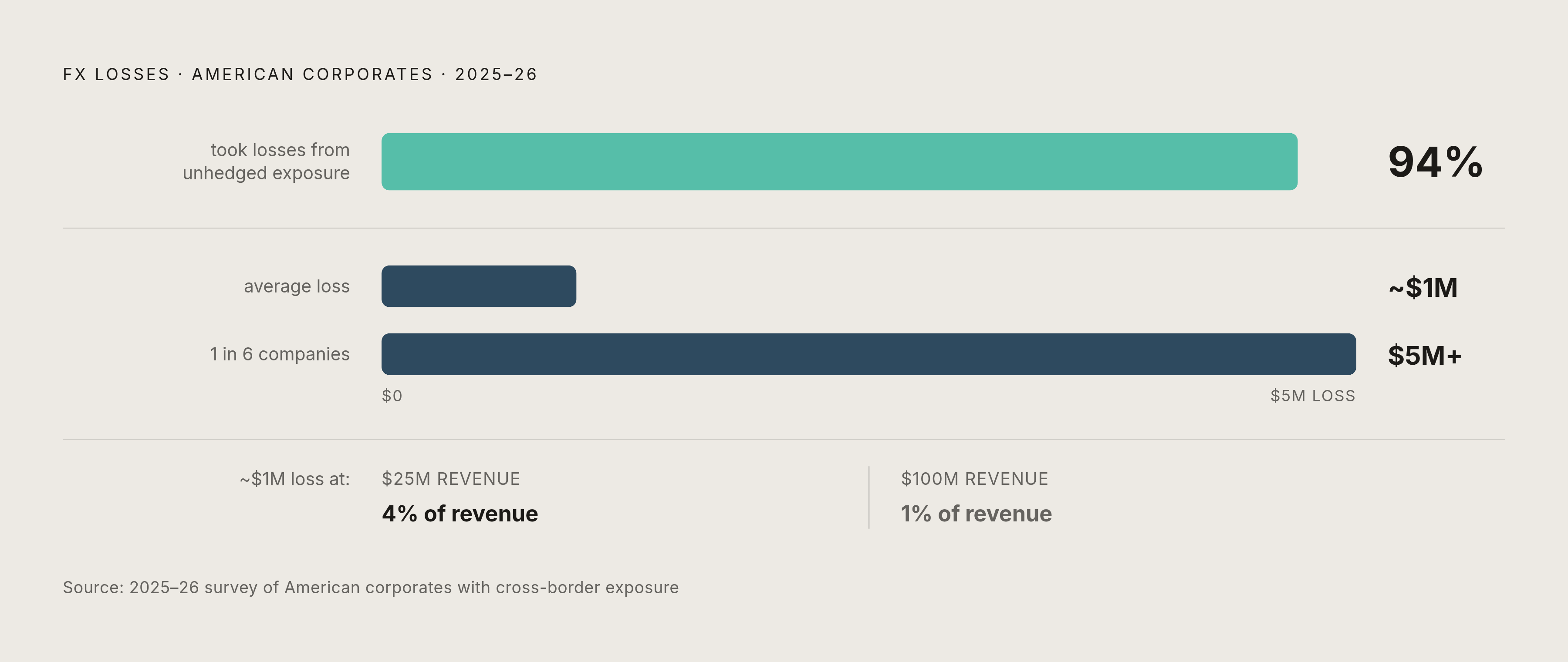
The number is stark on its own. Research covering 120 American CFOs, reported through a finance industry council, found 94% of American corporates took losses tied directly to unhedged FX exposure. The average loss came in just under $1 million, and one in six companies lost as much as $5 million.
Scaling that against a mid-market balance sheet changes the story depending on where a company sits. At $100 million in revenue, a loss just under $1 million is a real hit, the kind that appears in a board deck and needs an explanation, but it's survivable. At $25 million in revenue, the same dollar loss is a different category of problem entirely, closer to an existential one. Either way, nobody files this under acceptable rounding error.
The damage wasn't limited to a handful of unlucky firms. Sixty-two percent of corporates globally said tariff-driven currency volatility hurt their profitability or international competitiveness in 2025, with North American and European firms hit hardest at 69%. Fifty-eight percent pointed to their own FX strategy as the source of the losses. The hedging approach in place, or the absence of one, was often the problem, not the market.
Hedging got more expensive at the exact moment it got more necessary. The average cost of hedging rose 67% globally, and 72% of corporates saw interest rates or fees climb. The unhedged position lost money. The hedged position cost more to maintain. Both sides of the ledger got worse at once, and that's precisely the environment where a policy with defined hedge ratios and named instruments earns its keep instead of sitting in a drawer nobody opens until Q4.
The three types of FX exposure a mid-market policy must account for
Transaction exposure is the one finance teams feel first, because it's immediate. It's the risk that a future cash flow, an invoice payable in euros, a receivable in yen, changes value between the day the deal is struck and the day it settles. This hits EPS and EBITDA directly if left alone, and for mid-market firms with meaningful cross-border receivables and payables, it's the natural starting point for any hedging program.
Translation exposure behaves differently. It occurs when foreign-currency assets, liabilities, or income get restated into the parent company's reporting currency at period-end rates. Nothing about the underlying business changed, but the balance sheet looks different anyway. This matters most for firms with foreign subsidiaries or significant overseas assets on the books, since it shapes what shareholders and lenders see even when operating cash flow hasn't moved an inch.
Economic exposure, sometimes called operating exposure, is the broadest and the hardest to pin down. It's the risk that a company's underlying market value shifts because of structural, largely unavoidable currency exposure, shaped by geopolitical instability, regulation, and competitive dynamics that no single forward contract can fully offset. It lives in pricing power and cost structure, so it resists direct hedging the way transaction exposure doesn't.
Liquidity risk, which Kyriba flags as a dimension worth tracking on its own, is a fourth category that deserves equal weight even though it's often left off the list. An unmanaged transactional exposure hits EPS and EBITDA directly when the currency moves against you. But the hedging program meant to prevent that can create its own liquidity strain, particularly when the cost of maintaining hedges strains a mid-market firm's working capital at an already difficult moment.
The core structural elements every written FX policy must contain
A written policy is a starting point, not a finish line, and treating it as paperwork to file once a year is the mistake that undoes it. Establishing one to govern program parameters is best practice because it prepares a treasury team to act before the need becomes urgent, not after the dollar has already moved 10%.
Start with a risk appetite statement. It needs to define, in specific terms, how much currency-driven earnings volatility the business will tolerate before a hedge gets triggered, built around regular stress testing that measures how currency swings actually hit the numbers. This can't be a once-and-done exercise: 91% of middle-market leaders say they formally revisit financial plans and scenario models at least monthly or quarterly. A risk appetite statement is what turns that review cadence into a decision, rather than a meeting where people look at numbers and nod.
Next comes hedge ratio and tenor targets, and this is where most companies get the instinct backwards. The instinct is to hedge everything and sleep easier. Disciplined policy almost never aims for 100% coverage, because over-hedging locks up capital in collateral and margin that could otherwise fund the business, and it leaves no room to benefit if the currency moves in your favor. A more sensible target hedges 50% to 75% of highly certain cash flows on a rolling six-month horizon, protecting baseline profitability while keeping some flexibility in reserve. Some firms go longer: companies with long-cycle contracts or foreign-currency capital expenditures may extend hedge horizons further to blunt shocks from sustained market volatility. Opinion on direction is split rather than settled. Sixty-two percent of corporates plan to extend hedge lengths, but on ratios, 31% are increasing them while 34% are decreasing them. That split is a real trade-off between stability and flexibility, and a policy that doesn't pick a side on it isn't a policy.
Third: approved instruments, matched deliberately to the exposure each one is built for. FX swaps are the workhorse, hitting a record $4 trillion in daily turnover in April 2025, and they suit short-dated transaction exposure well. Options fit uncertain or contingent exposure, where a firm wants protection without locking in an obligation. Options volume more than doubled in the three years to April 2025, a sign of exactly that kind of demand for flexibility in a volatile market. Forwards fit known, committed cash flows. Futures fit standardized, liquid exposure. Swaps fit rollover and funding needs. A policy that doesn't match instrument to purpose isn't a policy, it's a list of products someone once heard about at a conference.
Emerging market currencies need their own line in the document. Renminbi turnover grew 56% in the three years to April 2025, and Brazilian real futures volume on the CME jumped 109% over the same stretch. Firms expanding into these markets need explicit guidance on which instruments actually cover the risk, because EM currency markets rarely offer the same depth a forward on euros or yen provides.
How governance and authorization rules make the policy executable
Governance keeps FX risk management pointed at the same target as the rest of the business, and it builds stakeholder trust that mid-market firms need to secure bank credit or convince investors that a currency swing won't blow up next quarter's numbers.
A sound FX policy template designates specific named roles authorized to enter FX contracts within the policy's guidelines, with a clear mechanism for expanding that list as the organization grows. Any exception requires written approval at a level above the authorizing role, documented before execution. No informal workarounds, no exceptions to the exception rule.
Most mid-market firms won't staff four distinct treasury titles. That hierarchy usually compresses down to two or three people, sometimes just a CFO and a controller wearing several hats at once. That's fine on its own, but the policy still has to say, in writing, who can act when the primary authorizer is out, and what dollar threshold triggers escalation to someone more senior.
Exception handling is where a policy either proves itself or falls apart. A policy with no exception mechanism gets ignored the first time an unusual deal comes through, or it turns into a roadblock people quietly route around. Written exception approval, with CFO sign-off required every time, builds an audit trail without freezing the business when something outside the norm occurs.
Review cadence closes the loop. At minimum, the policy needs a formal annual review, plus a triggered review whenever market conditions shift materially. The 2025 dollar decline is the reference case: a firm that waited for its next scheduled annual review to reassess hedge ratios missed nearly the entire period's volatility, which defeats the point of having a policy.
Technology's role in a mid-market FX program, and its limits
Nearly every firm surveyed in MillTech's Global FX Report is looking at some form of FX automation, and 99% are evaluating AI for FX operations specifically. That's close to universal interest, and the reasoning holds up: modern platforms flag exposure faster than a spreadsheet, execute hedges closer to real time, and run scenario analysis that used to take a treasury analyst days.
None of that works without a policy that governs it, and companies get this part backwards most often. Automating a process that's broken, or one that never existed in written form, just produces bad outcomes faster than a person would have made them. Technology executes what a risk appetite statement, a hedge ratio target, and an authorization matrix already define. It can't invent those decisions, and asking it to is a category error. For a mid-market multinational, the sequence matters: build the policy first, get governance and authorization right, then bring in tools that make execution faster. Reversing that order means the technology just gives the company a faster way to be wrong.
Sources
- What the 2025 BIS Data Says About 2026 Trends in FX Markets - OpenMarkets
- 2026 Market Outlook | J.P. Morgan Global Research
- Tariff-driven volatility is reshaping global FX strategy. Read our 2026 Global FX Report blog to see how corporates and fund managers are responding. | MillTech
- GW Platt Foreign Exchange Awards 2026
- Hedging Strategies for CFOs: Dynamic Techniques That Work — Kyriba
- forbes.com