In-House Bank Structures for Centralizing Cross-Border Payments
Centralizing payments, netting, FX, and cash in one internal bank.
- Written by
- Catalina Restrepo-Vidal
- Published
- November 19, 2026
- Reading time
- 8 min read
- Sources cited
- 5 sources ↓
What this covers
- Why cross-border payments inside a multinational are structurally different from domestic ones
- What an in-house bank actually is and what distinguishes it from a payment factory
- How POBO and COBO replace the web of subsidiary bank accounts
- How intercompany netting reduces the volume of actual cross-border cash movements
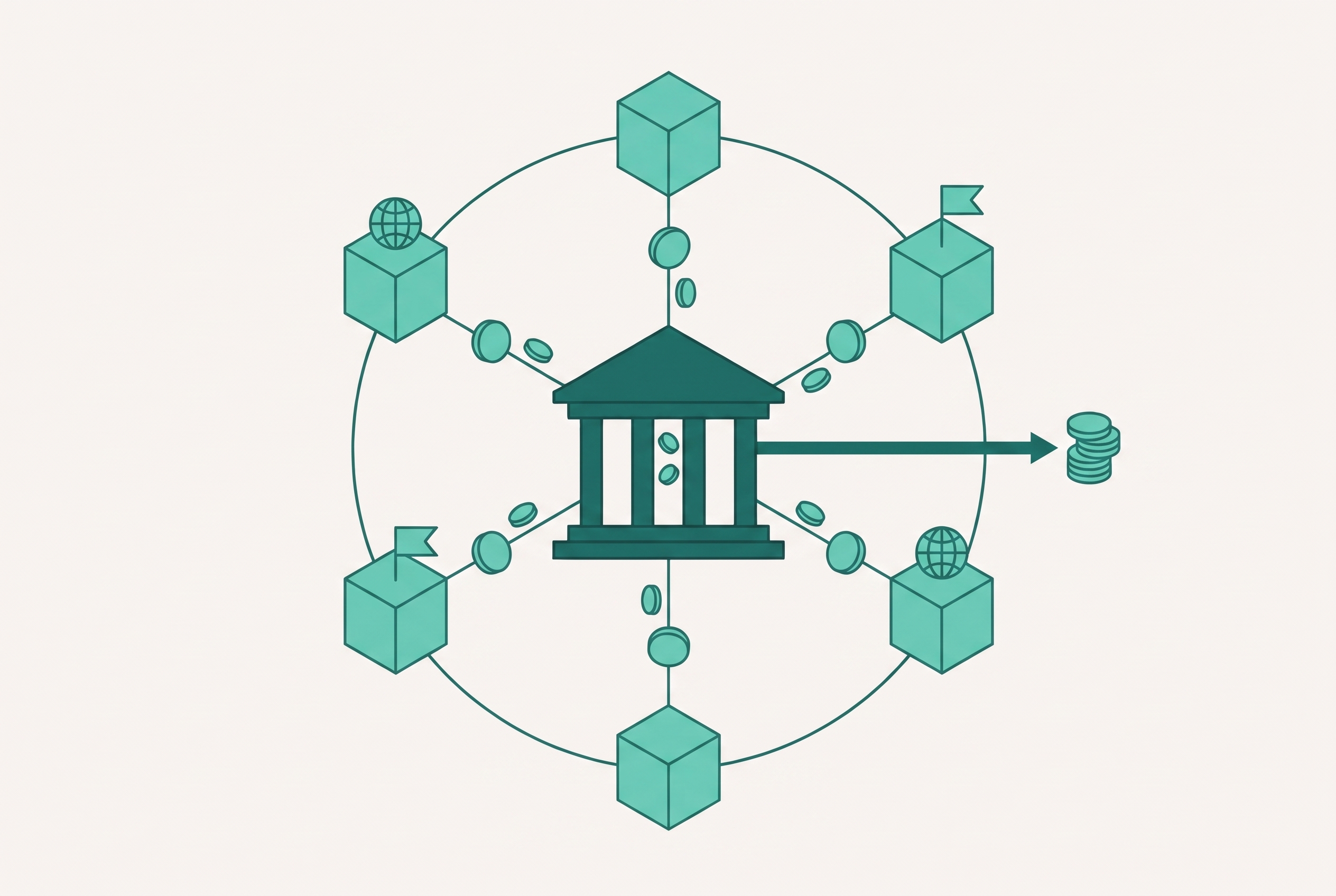
An in-house bank centralizes cross-border payments by replacing fragmented subsidiary banking arrangements with an internal financial hub. Its value comes from changing who holds balances, settles obligations, manages currency risk, funds operations, and processes payments. POBO/COBO, intercompany netting, centralized FX, and cash pooling explain how that structure works, while legal and platform requirements determine how far it can extend.
Why cross-border payments inside a multinational are structurally different from domestic ones
Each subsidiary has its own banking relationships, holds its own cash, and routes its own external payments. As the group expands, it repeats those arrangements across markets, keeping demand fragmented. The costs that follow come from more than payment infrastructure. They also come from an operating model in which local decisions make it hard to see the group’s financial position.
A BIS working paper on cross-border payments identifies limited interoperability between national systems as the most binding constraint behind payments that remain more costly, slower, less accessible, and less transparent than domestic payments. For a subsidiary-heavy group, correspondent banking compounds the internal fragmentation. Each hop from one institution to the next adds fees, exchange rate spreads, and delays, while each subsidiary uses its own chain. Meanwhile, one entity can hold surplus cash while another overdraws, and local FX decisions can overlook offsetting exposures elsewhere. Treasury lacks a consolidated view of what cash exists and where, even as the group pays to move and borrow it.
What an in-house bank actually is and what distinguishes it from a payment factory
An in-house bank, or IHB, is a dedicated group or legal entity that provides banking services to business units within the organization. Those services include cash management, payments-on-behalf-of, collections-on-behalf-of, and working capital. It acts as an internal bank to subsidiaries. Along with handling instructions, it acts as the go-between in their financial relationships and holds the intercompany positions that result.
That role distinguishes it from a payment factory, which centralizes payment execution but does not act as the subsidiaries’ counterparty. Kyriba’s IHB guide describes the intercompany account as the mechanism through which flows and balances are centralized. Payments debit the operating company’s account with the IHB, while collections credit it. A captive finance company or captive bank serves external customers and dealers. Its external lending book should not be commingled with the IHB’s netting and pooling activity, because those structures serve different governance purposes.
How POBO and COBO replace the web of subsidiary bank accounts
Under payments-on-behalf-of, or POBO, a subsidiary instructs the IHB to pay a third-party supplier. The IHB pays from its own external bank account and debits the subsidiary’s intercompany account. The subsidiary does not use an external bank for that transaction. Its obligation is reflected in its balance with the IHB rather than settled through its own banking relationship.
Collections-on-behalf-of, or COBO, reverses that flow. A customer pays into the IHB’s bank account on behalf of the subsidiary, and the IHB credits the subsidiary’s intercompany account. Together, these arrangements allow the group to replace dozens or hundreds of subsidiary accounts with a much smaller set held at the IHB. With fewer accounts, the group pays less to maintain them, has fewer KYC obligations, and needs fewer correspondent banking relationships. Centralizing outgoing payments also creates a common point of approval and control, reducing reliance on dispersed authorization practices of varying strength.
How intercompany netting reduces the volume of actual cross-border cash movements
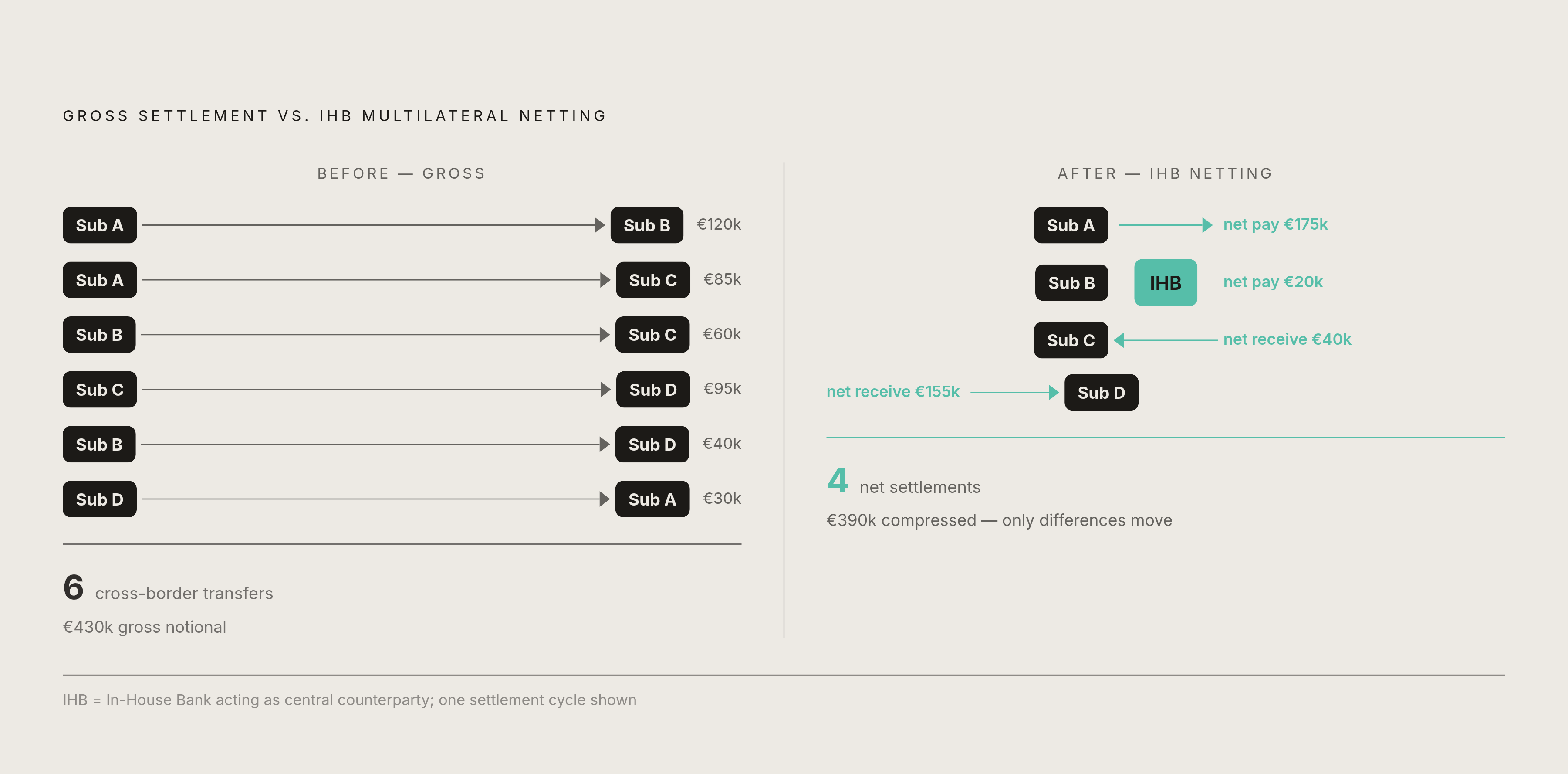
Account consolidation changes where external payments originate and arrive. Intercompany netting changes how much internal settlement requires cash to move at all. If Subsidiary A owes Subsidiary B a larger amount than B owes A, gross settlement requires two transfers. Bilateral netting reduces that to a transfer of the difference.
The IHB makes multilateral netting possible by holding all participating entities’ positions simultaneously as the central counterparty. The group works out a single net position for each entity in each settlement cycle instead of settling each bilateral obligation on its own. This cuts the number of transactions and the amount of cash moved. The guide identifies fewer internal transfers and lower cross-border payment fees as direct consequences of multilateral netting. Where FX transactions can also be netted before execution, the group trades a smaller gross notional externally. Concentrating the remaining trades can improve bank pricing as well as reduce transaction costs, establishing the link between settlement efficiency and centralized currency management.
How the IHB centralizes FX risk and why that changes the economics of hedging
Local FX management leaves each subsidiary hedging its own position, often in small amounts and without visibility into natural offsets elsewhere. A USD exposure in one entity may be partially offset by a USD receipt in another, yet separate treasury decisions can send both positions to the external market. The group then pays for hedging it does not need. Netting payment flows addresses part of that inefficiency, but centralized risk management extends the principle to the group’s exposure.
Subsidiaries book internal FX transactions with the IHB, which aggregates those positions and hedges only the net exposure externally. The IHB thus gives affiliates hedging services much as an external bank would, while keeping a view of the risk across the group. This reduces both hedged notional and external trade count. Concentrated volume also allows the group to negotiate as a larger counterparty. Nium’s illustrative centralized treasury example projects a 35% reduction in group FX hedging costs. That figure illustrates a possible outcome for an IHB.
How cash pooling closes the loop by putting the centralized cash to work
Cash pooling turns consolidated liquidity into usable funding. Without it, cash can still sit idle in one subsidiary while another borrows externally, even when the group can see its cash more clearly. Physical concentration connects subsidiary accounts to IHB accounts at a central pooling center through automated sweeps. At the end of each business day, cash moves into the central accounts and participating subsidiaries return to zero balances.
Where the group still uses local accounts, daylight overdraft lines from the concentration bank can fund payments before evening sweeps bring the balances back to zero. Subsidiaries can therefore operate without holding precautionary cash buffers. Notional pooling offers a different mechanism. It aggregates balances for interest purposes without physically moving the cash, which can be useful where sweeping is restricted or tax-inefficient.
The IHB intermediates surplus and deficit positions through intercompany lending at arm’s-length rates, retaining the funding benefit within the group. Nium’s case analysis describes a European industrial group that reduced total cash holdings by €28M through centralized treasury pooling. This completes the structural response to fragmented local treasury. Within the permitted scope, a subsidiary no longer needs its own cash reserves, independent FX hedges, or separate banking relationships to operate.
What implementing an IHB actually requires and where it typically breaks down
Building that model takes work on legal, tax, operational, and technology needs together. An IHB needs a legal entity capable of acting as an internal bank, transfer pricing documentation for intercompany positions, and regulatory clearance across participating jurisdictions. A payment made for another entity can be treated as a loan. Every intercompany balance must thus be priced at arm’s-length rates that follow the OECD Transfer Pricing Guidelines, and local tax authorities can change rates that fall outside that range.
Jurisdictional restrictions define the model’s practical perimeter. Withholding tax can complicate intercompany settlements, while restrictions on POBO/COBO, intercompany lending, or centralized hedging can prevent full participation. In capital-controlled markets, local treasury may have to keep control of its own work. Elsewhere, the friction is organizational, as subsidiaries surrender banking relationships and some local agility. The group thus needs to redesign governance and get local finance teams on board as it puts the model in place, before deployment is complete.
Platform capability introduces another dependency. SAP S/4HANA In-House Banking was released in 2022 as a component of Advanced Payment Management, which was released in 2019. It deals with limits in its predecessor, In-House Cash, on cut-off times, payment approval workflows, and native withholding tax support.
What the shift to ISO 20022 and multi-rail settlement means for IHB architecture
The IHB’s internal structure must connect to an external settlement environment that is also changing. By 2026, correspondent banking, domestic instant rails that reach across borders, and stablecoin settlement all run alongside one another. Stablecoin settlement moved from experimentation into production infrastructure over 2025 and 2026, creating a potential third route beside SWIFT and domestic real-time systems. Yet interoperability between those routes remains incomplete. The cheapest and fastest choice depends on the corridor.
For the IHB architect, the implication is adaptable routing and a data layer that can accommodate ISO 20022 requirements. Connectivity should not be locked to one correspondent relationship or settlement rail. The Federal Reserve’s proposal to expand FedNow into cross-border use cases would allow banks to settle the domestic leg through FedNow while relying on intermediaries for the international component.
The BIS paper finds that private actors on their own cannot fix the market failures behind limited interoperability. Standards harmonization and public-sector coordination remain prerequisites. An IHB can centralize the group’s interface with that infrastructure, but it cannot make the external fragmentation disappear.
How Kyriba's platform supports IHB implementation across these components
Kyriba’s IHB and Payments Hub framework addresses the connection between centralized execution, intercompany accounting, and working capital. Its POBO and COBO approach supports outgoing payment control and consolidates collections into IHB bank accounts, with intercompany postings handled within the system. That links external settlement to the subsidiary’s internal position. The control model also supports fraud mitigation by bringing outgoing payment authorization into a central structure.
For FX, the platform supports netting payments so there are fewer transactions and more volume in each trade. The framework also connects cash-flow visibility with opportunities for sweeps, repatriation, and improved returns. Better visibility in a POBO or payments hub model can create more opportunities for discounting. These capabilities meet some of the needs of the IHB design, while the group still has to work out the legal scope, transfer pricing framework, and jurisdictional permissions to put it in place.
What to assess before choosing between a payment factory, a full IHB, or a phased approach
A full IHB is proportionate when its scope fits the group’s entity count, currency exposure, regulatory diversity, and appetite for intercompany governance. A payment factory can centralize execution and reduce banking relationships without the complete legal and transfer pricing infrastructure of an internal bank. For a simpler group, it may be sufficient. It can also be a useful intermediate step where broader centralization remains constrained.
The case for an IHB strengthens as entities, currencies, and dispersed liquidity increase. Netting gains grow with internal settlement complexity, FX aggregation gains with exposure volume, and pooling gains with the separation of surplus and deficit cash. Those benefits still have jurisdictional boundaries. Capital controls, withholding taxes, and POBO restrictions can be grounds for a hybrid structure that keeps some markets outside the pool and lets others take part.
The practical assessment is therefore which components can operate now and which depend on regulatory or platform groundwork. External connectivity also needs room to adapt to ISO 20022 and multiple settlement rails. For most large multinationals moving toward an IHB, the destination does not imply a single implementation speed or scope.
Methodology & sources
- Centralized Treasury: Managing Global Cash
Provided the illustrative FX hedging cost reduction and the European group cash reduction example.
- BIS Papers No 167 Cross-border payment technologies: innovations and
Supplied the finding that limited interoperability is the binding constraint and that private actors cannot fix it alone.
- Cross-border payment technologies: innovations and challenges
Full text of the BIS paper behind the interoperability and public-sector coordination points.
- Centralizing Payments with an In-House Bank: Why & How — Kyriba
Described the IHB intercompany account, POBO/COBO mechanics, netting benefits and platform capabilities.
- Understanding the Difference: Payment Factory VS Payment Hub - Datalog Finance
Informed the distinction between a payment factory and an in-house bank.