EUR to TRY Corridor Pricing and Settlement Rails
Hidden costs in EUR-to-TRY transfers extend far beyond the advertised fee.

- Written by
- Catalina Restrepo-Vidal
- Published
- October 19, 2026
- Reading time
- 8 min read
- Sources cited
- 5 sources ↓
What this covers
EUR-to-TRY transfer pricing reflects more than the fee shown at checkout. Persistent lira depreciation, Turkish inflation and fragmented settlement rails shape both the exchange rate senders receive and the cost of delivering their money. The central distinction is between the advertised fee and the full cost of conversion and payout.
Why the EUR/TRY rate behaves unlike most major corridors
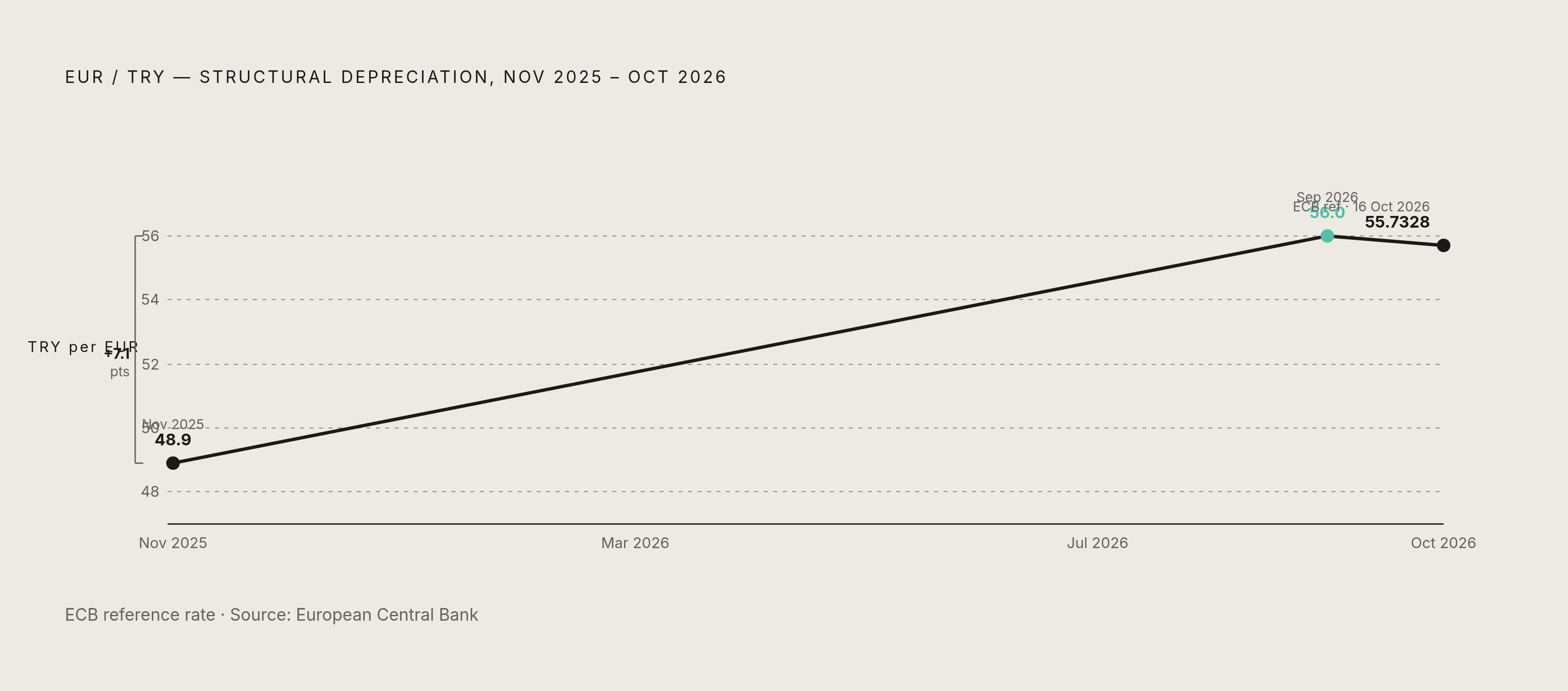
Turkey’s macroeconomic position gives lira depreciation a persistent direction. That distinguishes EUR/TRY from corridors such as EUR/PLN or EUR/SEK, where providers do not face the same structural conditions. The ECB’s reference rate stood at 55.7328 on 16 October 2026. That followed a near-linear move from roughly 48.9 in November 2025 to 56.0 in September 2026.
A high CBRT policy rate sits against an official 2026 inflation target and the CBRT’s August 2026 revised forecast, which remained well above that target. The target and forecast therefore describe different destinations. The CBRT also estimates that a permanent currency depreciation feeds significantly into prices over a year. This exchange-rate pass-through completes a reinforcing loop in which inflation drives depreciation and depreciation feeds further inflation.
The CBRT conducts TRY-settled FX forward selling to support the sound functioning of the FX market and prevent volatility. At the same time, it states that it has no exchange-rate target and will not intervene directionally. The pricing consequence is not a prediction of uninterrupted depreciation, but a need to carry risk without a dependable policy floor.
The gap between the interbank rate and what senders actually receive
The interbank rate is a market benchmark, whereas the retail rate is the price a provider offers a sender. Confusing those two makes the cost of a transfer difficult to judge. The ECB publishes its reference rate for informational purposes only and explicitly discourages its use for transactions. It is therefore a point of comparison. On EUR/TRY, the gap between the benchmark and the customer rate is wider and more variable than on stable-currency corridors.
That gap is the exchange-rate spread, and it sits apart from any visible transfer fee. German banks impose exchange-rate markups on top of SWIFT fees, so the stated charge captures only part of the sender’s cost. The markup is a regular feature of the pricing structure. A transfer can consequently look inexpensive on its fee line while returning less TRY through its conversion rate.
Wise quotes a very low FX markup against mid-market on this corridor and charges an explicit transfer fee. Remitly embeds its margin in the rate and also charges a separate flat fee. The total cost can be much the same even when providers split it differently between the fee and the rate. A zero-fee promotion changes one component, but it does not by itself establish how much TRY the recipient will receive.
OFX’s rate page makes the benchmark distinction explicit by stating that its displayed interbank rate is not indicative of customer rates. OFX shows standard rates without registration, but requires registration or login for personalised customer rates. The relevant comparison is the amount delivered for the same euro outlay after both the fee and FX markup.
How daily rate volatility creates a hidden cost that no fee schedule shows
A spread describes the cost at a point in time, but settlement introduces a second dimension. The market rate when a provider quotes a transfer need not be the market rate when it pays out. Even with a quote close to mid-market, someone still bears the risk that the rate will move before settlement. A locked customer rate leaves the provider managing the gap between its commitment and the market.
XE’s live data shows that EUR/TRY moved enough to matter over the seven days to mid-October 2026. Daily volatility was mild by historical standards, but still sufficient to change the TRY value of a transfer materially between quote and settlement. This is a particular risk when a provider buys TRY ahead of time to ensure a fast payout. This pre-funded inventory loses value in euro terms on days when the lira depreciates. The provider recovers that holding cost through the spread.
The lira needed for prompt delivery is already available, but buying it early creates a period in which its value can fall. The cost is not simply the act of moving money through a payment network. It also includes carrying the currency before it reaches the recipient. The gap between the CBRT’s inflation target and forecast gives reason to expect further depreciation, but it is no sure guide to the next day’s rate.
For senders, timing also has to be considered against the recipient’s spending needs. A rising EUR/TRY rate delivers more nominal lira, but that is not the same as preserving purchasing power under high inflation. Persistent depreciation and inflation can leave a fixed euro payment buying fewer real goods in Turkey over time. For recipients who need TRY for daily expenses, smaller and more frequent transfers reduce the risk of concentrating the conversion at an unfavourable moment.
Why Germany dominates this corridor's volume and what that means for how it is served
Germany is the centre of the EUR-to-TRY corridor. Its total outbound remittance flows run to tens of billions of euros annually, and the Turkish corridor is among its strongest. That concentration creates a large, recurring and price-sensitive customer base. For providers, recurring demand makes the corridor an infrastructure opportunity. It helps explain why fintechs have entered a market that could otherwise remain heavily dependent on legacy banking.
Average corridor costs on German outbound transfers suggest that providers could earn enough revenue to make a large investment worthwhile. With that steady demand, fintechs can make their unit economics work over the long term. In turn, competition has pushed fintech pricing toward and below the G20’s target. Germany’s importance therefore explains both the corridor’s competitive structure and the amount of money moving through it.
Competitive pricing does not, however, mean the two ends of the transfer fit neatly together. The provider has to connect those different systems to complete delivery. This fragmentation raises per-transaction costs and limits straight-through processing. As a result, the advantage of efficient euro collection depends on how well the provider manages the separate Turkish payout leg.
That split also explains why offers can look much the same to customers even when the costs of delivery differ. Providers address much the same concentrated sending market, but must manage the conversion and local settlement behind it. The fee and exchange rate are the visible result of those choices. Germany supplies the scale that attracts investment, while Turkey’s payout arrangements determine how far that investment can reduce cost. The next distinction is therefore not simply between banks and fintechs, but between the rails each uses.
The rails providers actually use — and what each costs them
Settlement rail choice is the largest variable in a provider’s unit economics on this corridor. It determines the cost of moving the payment and the time over which currency risk must be managed. SWIFT still dominates large-value and B2B EUR-to-TRY flows, including trade finance between German manufacturers and Turkish suppliers. These transfers pass through a series of correspondent banks, each adding fees and delay. The resulting delivery time runs to multiple business days, making cost and latency part of the legacy route.
SEPA Instant serves a different function because its benefit sits on the euro leg. OFX, Wise, Xe and Remitly operate on that leg through regulated European payment infrastructure. Their access to efficient euro-side settlement does not itself complete a TRY payout. Instead, it brings the transfer to the point where conversion and Turkish delivery must be managed. How well they compete therefore depends largely on how they arrange local payouts and use FX hedging to cover the gap between the two legs.
Local Turkish rails perform the delivery function that the European system cannot complete on its own. Wallets and local payment networks give providers routes outside traditional correspondent banking. But providers still have to link the euros they collect to those routes. Providers must manage the payout network as well as the currency needed to fulfil the transfer.
Stablecoins offer an emerging alternative with cross-border settlement costs at a fraction of those on conventional rails. Turkey leads the world in stablecoin transfers relative to GDP, and TRY has substantial stablecoin trading volume. Zodia Markets ranked TRY-denominated stablecoins second globally behind the dollar in 2025. These indicators show that the market has support for stablecoin settlement, although frictionless mass retail acceptance remains limited.
The main pricing objection is that cheap settlement does not necessarily mean cheap end-to-end conversion. TRY-denominated stablecoins, notably BiLira/TRYB, exist but remain small relative to dollar-pegged tokens. A stablecoin route therefore involves converting EUR into a stablecoin and then converting that token into TRY. The second conversion adds another FX spread on top of the depreciation costs that the corridor already has. That can narrow or erase the saving on the settlement leg, so network cost alone does not establish the cheaper route.
What Turkey's potential SEPA membership would actually change — and what it would not
The EU’s March 2026 proposal to admit Turkey to SEPA addresses the corridor’s main remaining settlement divide. SEPA Instant has made it all but frictionless to bring euros in, so most settlement cost and delay now comes from the Turkish payout side. Accession is therefore the systemic change on the horizon that could alter how the two sides connect. Its significance is structural rather than promotional. It concerns the payment framework available to providers.
That change is conditional and would take years to implement. SEPA membership requires domestic regulatory alignment with EU payment law, including equivalent payment-services frameworks. Political will would be needed on both sides, and it is not fully present. EU–Turkey membership talks remain effectively stalled, with both sides seeking alternative channels short of full accession.
A more direct settlement framework would address fragmentation, but it would not itself change Turkey’s inflation regime or remove the need to convert euros into lira. The distinction between settlement friction and FX exposure remains essential. Until accession materialises, providers will continue using a patchwork of correspondent relationships and local fintech networks for TRY delivery. That keeps the corridor’s cost floor above what is achievable within SEPA.
Digital fintech providers offer the cheapest and fastest EUR-to-TRY transfers because they have built efficient local payout networks on the Turkish side. Wise, Remitly, OFX and Xe are credible options serving this corridor, with different pricing and payout arrangements. Comparing total cost, including the fee and FX markup, reveals the difference that an advertised fee alone cannot show. The decision rests on what reaches the recipient, while the underlying price reflects both the currency risk and the route used to deliver it.
Methodology & sources
- EUR to TRY Exchange Rate and Currency Converter
Sourced the detail that OFX explicitly states its displayed interbank rate is not indicative of customer rates and requires registration for personalised rates.
- Euro foreign exchange reference rates - European Central Bank
Provided the ECB reference rate of 55.7328 on 16 October 2026 and the ECB's stated policy that its rate is for informational purposes only.
- Turkish lira (TRY) - European Central Bank
Provided the historical EUR/TRY rate data showing the move from approximately 48.9 in November 2025 to 56.0 in September 2026.
- 1 EUR to TRY - Euros to Turkish Lira Exchange Rate
Supplied live EUR/TRY movement data showing daily volatility over the seven days to mid-October 2026.
- Sending money from Germany to Türkiye
Provided data on average corridor costs and Germany's outbound remittance flows to Turkey, including the competitive pricing relative to G20 targets.