FX Risk in Subscription and Recurring Revenue Businesses
Recurring foreign revenue keeps FX exposure open for the whole customer relationship.

- Written by
- Priya Subramaniam
- Published
- November 24, 2026
- Reading time
- 8 min read
- Sources cited
- 6 sources ↓
What this covers
- Why FX risk in subscription businesses is structurally different from export FX risk
- Three distinct exposure types that arise in recurring revenue structures
- How recurring FX exposure distorts the metrics subscription businesses actually manage by
- What large public subscription companies reveal about the magnitude and volatility of this exposure
FX risk in subscription and recurring revenue businesses comes both from selling abroad and from how the revenue model works. Foreign-currency receipts that keep coming in, deferred revenue and home-currency costs leave the business exposed for as long as it serves the customer. The appropriate response is a framework built around recurring revenue, with pricing, ARR measurement and cash-flow forecasts determining how much risk to accept and how to manage it.
Why FX risk in subscription businesses is structurally different from export FX risk
A conventional exporter issues a foreign-currency invoice and faces rate risk until payment arrives, when the exposure ends. EDC’s export framework illustrates this through an auto parts manufacturer that receives payment months after signing a contract, at a worse exchange rate. The loss has a boundary. That model does not describe a subscription business receiving hundreds or thousands of small recurring payments each month.
Each subscription receipt has its own conversion event. An annual contract billed monthly or quarterly therefore creates exposure points throughout its life. Foreign-currency revenue also accumulates as deferred revenue, while translation into the reporting currency extends across reporting periods. A framework that looks only at unpaid invoices misses part of that exposure.
The cost base compounds this mismatch. Engineering, infrastructure and payroll are often predominantly in the home currency, so foreign-currency revenue has no natural offset. Local-currency pricing makes that imbalance a feature of the commercial model. Most US-headquartered SaaS vendors still use USD pricing by default, but more are using local-currency billing, which leaves the seller with the exchange-rate risk.
Three distinct exposure types that arise in recurring revenue structures
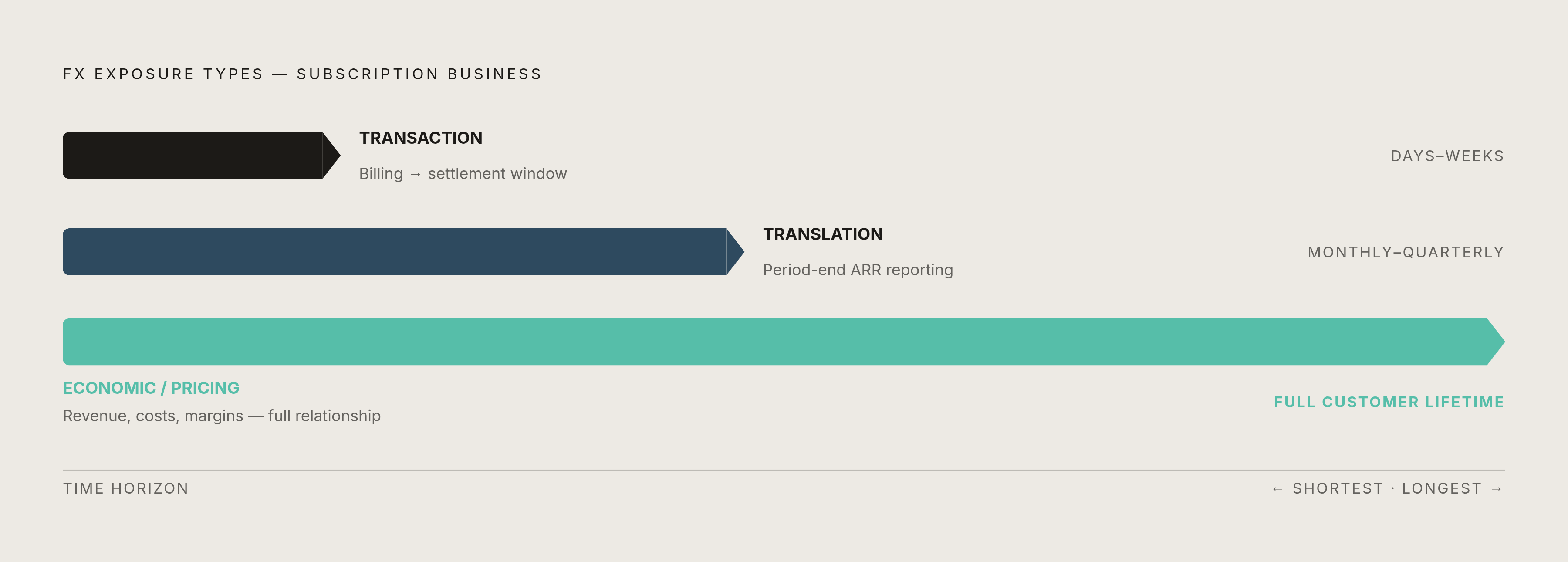
Translation exposure changes what foreign-currency ARR is worth in the reports while the customer relationship stays the same. The customer base can remain entirely unchanged. Period-end measurement makes that effect visible, while differences in companies’ rate policies complicate comparisons across businesses and cohorts. Translation is therefore a measurement problem before it becomes a hedging question.
Transaction exposure concerns the value of a particular payment between contracting and settlement. In subscriptions, each billing cycle brings a receipt with its own rate-risk window. An annual agreement billed monthly thus has a series of transaction exposures within a single contract.
Economic or pricing exposure lasts for as long as the customer relationship. EDC’s currency risk framework describes how movements between quoting, contracting and payment affect revenue, costs, cash flow and profit margins, including for subscription software businesses billing in USD and EUR. This is the broadest strategic exposure because it affects the economics of serving the customer. Annual local-currency contracts lock in those economics for the contract term. Deferred revenue brings that risk onto the balance sheet too, so looking only at invoices leaves even more of it out.
How recurring FX exposure distorts the metrics subscription businesses actually manage by
FX can obscure operating performance before it produces an obvious cash loss. A strengthening home currency reduces reported foreign-currency ARR even when customer numbers, prices and churn are unchanged. A weakening home currency produces the reverse effect. Because ARR informs valuation and operating decisions, this distortion can alter the apparent trajectory of the business without any corresponding change in demand.
Cambridge Currencies’ SaaS FX guide shows how margins suffer with a worked example of a UK SaaS business whose USD and EUR revenue loses £49,151 over a year as rates move moderately against it. VTEX provides a public-company illustration of the reporting effect. Its Q4 2025 subscription revenue grew in USD but grew materially less on an FX-neutral basis, within a business where subscriptions represented the overwhelming majority of revenue. Constant-currency reporting separates that currency contribution from underlying growth.
Current remaining performance obligation, or cRPO, extends the problem into the forward view. This measure of contracted revenue to be recognized in the near term can shrink in reporting currency without a lost or renegotiated contract. Planning is exposed as well as investor communications. Headcount decisions, quotas and investment in new markets can all rest on figures containing an unidentified FX component. At public-company scale, these effects become a standing feature of financial disclosure.
What large public subscription companies reveal about the magnitude and volatility of this exposure
ServiceNow’s January 2025 Form 8-K reported full-year 2024 subscription results, and its reported and constant-currency subscription revenue growth were the same in Q4. The company routinely discloses both measures, including for cRPO, because currency movements can separate them in other periods. Strong subscription growth can therefore coexist with an adverse dollar effect on the reported forward revenue figure.
VTEX’s February 2026 Form 6-K shows a different complication. Global Markets subscription revenue grew much faster than the core regional business in FX-neutral terms during FY2025, but the difference was smaller in the reported USD figures. Currency effects vary across the customer base. Its Q4 2025 GMV growth also differed substantially between reported and FX-neutral measures, showing that translation can obscure the trajectory of commerce flowing through the platform as well as subscription revenue.
Asana’s Form 10-Q for the period ended July 31, 2025 documents another posture. A meaningful portion of sales was denominated outside USD, but the company had not entered derivative or hedging transactions and said it might do so if exposure became more significant. These disclosures show exposure across different geographies and management approaches, while exchange-rate reversals mean a headwind in one fiscal year can become a tailwind in another.
The pricing decision that determines how much FX risk a subscription business accepts
Pricing currency establishes the exposure before treasury selects an instrument. Pure local-currency pricing sets USD, EUR, GBP and AUD prices independently, with quarterly or annual refreshes. It offers the strongest conversion proposition but accepts the greatest FX exposure. The seller promises to keep the local price steady, while the amount it receives in its home currency can change.
USD-anchored global pricing instead derives other currency prices from a USD reference at periodic refreshes. This is common in B2B SaaS where the US is the primary market, and it reduces some exposure at the expense of competitive positioning elsewhere. Home-currency-anchored pricing with multi-currency display goes further toward limiting FX risk, but is structurally less competitive globally for most subscription businesses. The guide identifies the first two structures as the usual destinations for businesses at meaningful ARR scale.
Pricing pass-through can bring revenue back to its home-currency-equivalent level without using a financial instrument. If the home currency strengthens, an upward refresh of the foreign-currency price offsets the movement. Existing contracts constrain that response. Prices for new customers may change each year, while prices for existing customers change only at renewal, and multi-year enterprise agreements leave the business exposed for much longer. Accepting those constraints in return for local-currency conversion benefits is a deliberate trade-off, whose remaining exposure must then be measured.
Measurement before management — how to track and report subscription FX exposure accurately
ARR should be stored in both contract currency and reporting currency, with dated FX rates. Consolidated reporting needs one written policy on whether to use monthly average or period-end rates. Consistency makes changes in ARR interpretable. Without it, the same set of contracts can give different totals depending on when the reports are run, so finance and revenue operations teams cannot tell currency movements apart from changes in the business.
EDC’s framework recommends forecasting inflows by currency and payment date, comparing forecasts with actual receipts each month, and establishing thresholds for reviewing the response. Total ARR is not enough. Committed in-term revenue must be separated from expected renewals and pipeline because their probabilities of receipt differ. Currency concentration, contract size, payment timing and margin sensitivity then determine which exposures warrant attention first.
EDC’s prioritization logic focuses on the largest transactions, longest timelines, greatest concentration and thinnest margins. Applied to subscriptions, it directs attention toward currency cohorts rather than simply toward the largest individual invoice. Operational ownership must be explicit as well. Currency risk needs to be part of pricing approval, with written rules on who can act later and what thresholds call for action. Regular reconciliation is necessary because failed payments, churn and upgrades shift receipts, while new markets and billing currencies require the policy itself to be reviewed.
The range of management responses and when each one fits a subscription business
Natural hedges are the simplest way to offset the risk when the business already has work abroad that supports them. Hiring in a major revenue market’s currency or procuring infrastructure locally can match costs with receipts. The operational rationale must come first. Creating an international cost base purely to hedge currency is not efficient, while pricing pass-through and invoicing-currency choices remain constrained by customer expectations and contractual commitments.
Billing infrastructure can help manage some of the risk without a formal treasury program. Platforms can show local-currency prices, handle conversion and use stability buffers to keep renewal amounts the same from one billing cycle to the next even when rates change. Some management shifts to the payments layer. This can fit smaller subscription businesses that cannot justify dedicated treasury capability, although it does not remove the need to understand the exposure retained by the company.
Forward contracts and options become relevant where exposure is sufficiently large, concentrated and predictable to justify the operational work. MSCI Inc. manages FX-exposed subscription revenues concentrated in euros, British pounds sterling and Japanese yen partly through foreign-currency forward contracts not designated as hedging instruments for accounting purposes. For UK subscription businesses assessing forwards and documenting an FX policy, Cambridge Currencies provides a practical resource through its guide’s treatment of recurring revenue, ARR mix and instrument selection.
Predictability must not be confused with certainty. Churn can leave a business unwinding contracts against receipts that never materialize if it hedges too much budgeted foreign revenue. Deliberate tolerance may therefore fit smaller or dispersed exposures better than formal instruments, provided the volatility is measured and the decision is explicit. Asana illustrates that posture. The appropriate response can change as a currency pair becomes a larger share of ARR or enterprise contracts extend the exposure horizon.
Why the measurement and management framework must be built for recurring revenue, not retrofitted from export templates
The central design choice is the unit of risk. An export template starts with an invoice and asks how to protect its settlement value. A recurring-revenue framework starts with a currency cohort and asks how its reported value, expected receipts and margin behave over the customer relationship. That distinction changes what finance must measure. Invoice coverage alone cannot explain an ARR translation movement, a renewal-sensitive forecast or a fixed local price that constrains future proceeds.
Pricing-currency decisions need their FX consequences modeled before the go-to-market choice is made, while formal coverage must reflect churn-adjusted receipt probabilities. Billing infrastructure can absorb part of the operational burden, but cannot make those judgments for the business. Policy remains a company-level responsibility. The gap between reported and constant-currency metrics then becomes both a management signal and an investor-relations adjustment.
The practical principle is to build measurement and management around how subscription revenue actually works. That means treating contract duration, renewal uncertainty and recurring conversion as inputs to the risk decision. The result need not be more hedging. It should be a deliberate relationship between the exposure the business accepts through pricing and the response its revenue economics can support.
Methodology & sources
- FX Risk for UK SaaS Businesses: Pricing, ARR Mix and Hedging Subscription Revenue
Supplied the worked UK SaaS loss example and the pricing-structure discussion.
- How to manage currency risk before signing your next export contract
Provided the export-contract framework, the auto parts example, and the forecasting and prioritization guidance.
- Asana, Inc. - Form 10-Q - FY2025
Showed Asana's non-USD sales and its decision not to use hedging derivatives.
- VTEX - Form 6-K - FY2025
Supplied the FX-neutral versus reported USD growth figures for VTEX subscription revenue, Global Markets and GMV.
- ServiceNow, Inc. - Form 8-K - FY2025
Provided ServiceNow's reported versus constant-currency subscription and cRPO disclosures.
- MSCI Inc. - Form 10-Q - FY2026
Documented MSCI's use of FX forwards for subscription revenues in euros, pounds and yen.