Currency Risk in Cross-Border M&A Transactions
Exchange rates can shift the deal's value by millions between signing and closing.

Currency risk in a cross-border acquisition builds up across the whole life of the deal, not at one point on the calendar. A buyer who treats it as a closing-day problem, something to check on the morning the wire goes out, has already carried months of exposure without managing any of it. The exposure exists because time exists: the longer a deal takes to move from signature to completion, the more chances the exchange rate has to move against the terms both sides agreed to. That accumulation is structural, built into how cross-border deals are timed and sequenced, not an accident of bad luck or poor planning.
Currency does not only threaten a deal's economics. It can be the reason the deal exists. When the euro weakened relative to its 2023 levels, U.S. buyers found themselves with real purchasing-power advantages on European assets, able to buy more for the same number of dollars. The same shift that hands one side an advantage hands the other side a matching exposure, because a favorable rate for the buyer is a less favorable one for whoever is on the other side of the eventual conversion. That double role is why FX needs its own line of analysis in cross-border M&A, distinct from the standard checklist of legal, tax, and operational deal risks. The rest of this piece works through where that risk enters, where it concentrates, and what a buyer can actually do about it.
The three distinct forms of currency exposure a cross-border deal creates
"Currency risk" is really three separate risks, and they arise through different mechanisms at different points in a deal's timeline. Treating them as one problem leads to mismatched fixes, a hedge bought for the wrong kind of exposure, or no hedge at all where one was needed.
The first is transaction risk. Transaction risk appears when the purchase price is set in a currency that isn't the buyer's own. Picture a U.S. buyer agreeing to pay a fixed price in euros for a German manufacturer. The euro price is locked in, but the dollar cost of that price is not, because it depends on where the euro-dollar rate stands on the day the money actually changes hands. If the euro strengthens between signing and closing, the buyer ends up paying more dollars than the deal was priced on, even though nothing about the underlying business changed. This is the sharpest and most immediate form of currency exposure in a deal, and it's also the one most within reach of active hedging, because it has a known size, a known currency pair, and a known (if uncertain) closing date.
The second is translation risk, and it starts the moment the deal closes rather than ending there. Once a foreign subsidiary sits on the parent company's books, its results in the local currency have to be converted into the parent's reporting currency every single period, quarter after quarter, year after year. If that local currency weakens after the deal closes, the dollar or sterling value of profits the subsidiary earns can shrink in the consolidated numbers even though the business itself is performing exactly as planned. Translation risk doesn't expire. It persists for as long as the subsidiary remains part of the group.
The third is economic risk, the slowest-moving and hardest to manage of the three. It's the effect that sustained currency movement has on the competitive position of the combined company over years rather than months. If the acquirer's home currency appreciates for a long stretch, the foreign target's exports can become less price-competitive, and the very cost synergies that justified the acquisition in the first place can lose value in real terms. Economic risk resists hedging because there's no single contract that can be written against a multi-year trend, only structural choices about where revenue and costs sit.
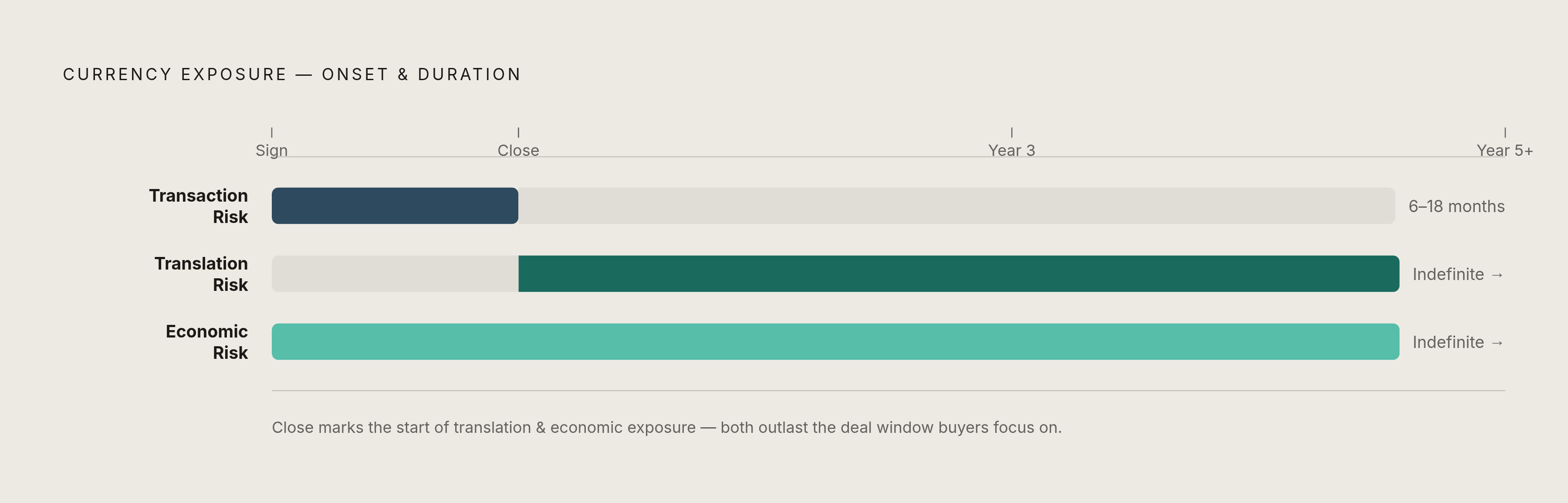
All three exposures exist in a deal at the same time, but they crest at different moments: transaction risk is at its peak in the window between signing and closing, translation risk runs for the entire life of the subsidiary, and economic risk compounds across the strategic holding period. Keeping the three separate is what allows a buyer to match the right tool to the right risk, instead of reaching for one hedge and hoping it covers everything.
Currency exposure at valuation and deal pricing
By the time the purchase price is agreed and the paperwork is signed, currency assumptions are already baked into the deal's economics, and they're difficult to unwind after the fact. This happens well before anyone starts thinking about hedging, at the point the valuation model is first built.
Valuing a foreign target with a discounted cash flow model forces a currency choice early on. The analyst can project the target's cash flows in its own local currency and convert the resulting value at the end, or convert the cash flows up front and discount everything at the buyer's own rate using an explicit assumption about where the exchange rate will sit. Either path bakes a currency view into the number that comes out the other end, and if the actual exchange rate moves away from that view before the deal closes, the value the model implied in the buyer's own currency moves with it.
The purchase price itself then gets fixed in one currency or the other, and that choice is a negotiated term of the deal, not something that defaults one way or the other. If the price is set in the target's currency, the buyer carries the FX risk between signing and closing. If it's set in the buyer's currency, that risk shifts to the seller. That single line in the purchase agreement determines who has an incentive to push the deal toward a faster close and who might be content to let the clock run.
The stakes of getting this wrong are not abstract. On a deal of meaningful size, a currency move of 10% shifts the value of the transaction by enough to turn a multiple that looked attractive at signing into one that looks poor by closing, and the exchange rate doesn't need to move by anything dramatic to do that kind of damage. The risk compounds when a currency advantage motivated the deal itself. A buyer that moves because a weak euro or a weak yen has opened a window is building its entire investment case on an FX assumption that has to survive not just the months until closing but the years of the holding period that follow. Currency risk is first locked into a deal at valuation, well before any instrument shows up to manage it.
The regulatory gap: why the signing-to-closing window is the highest-risk exposure period
Transaction risk is largest, and most manageable, in the stretch of time between signing and closing. It's the one phase in the life of a cross-border deal where the exposure is fully formed, fully quantifiable, and still open to active hedging, since both the price and the currencies involved are already fixed but the money hasn't moved yet.
The length of that window is set almost entirely by regulators, and the buyer has little say over it. CFIUS review in the U.S. and FIRB review in Australia each run six to twelve months and sit squarely on the deal's critical path, so nothing closes until they clear. The stakes of this delay have grown: the rate at which cross-border deals get blocked has risen in recent years. More deals now fail during this exact window, undermining any hedging plan built on the assumption that a deal now announced will eventually close.
Nippon Steel's acquisition of U.S. Steel is the clearest recent illustration of what that window can cost. Eighteen months is not an abstraction: it was eighteen months of live, continuous yen-dollar exposure sitting on one of the largest cross-border transactions of the period. Nippon Steel's financial projections for the deal rested on a specific yen-dollar exchange rate holding, so the company's post-deal economics depended directly on that single assumption surviving the entire regulatory process and beyond it. To fund the acquisition, Nippon Steel arranged large loan facilities from a group of lenders, and managing the currency exposure across those loan currencies, the acquisition costs themselves, and ongoing operating cash flows became a central part of structuring that financing. After the deal closed, S&P cut Nippon Steel's credit rating from BBB+ to BBB with a negative outlook, pointing to growing financial pressure from the acquisition, a consequence tied in part to the FX and financing strain built up over the extended approval process.
The lesson from Nippon Steel isn't about the specifics of steel or of U.S. industrial policy. It's about scale and preparation not being a shield. The Nippon Steel case shows that even a sophisticated, well-financed buyer on a landmark deal cannot assume that size or preparation immunizes against the FX consequences of regulatory delay. Size buys options. It doesn't buy immunity from the clock.
Hedging instruments available at each stage, and their costs
The right hedge depends on where a deal sits in its own lifecycle, because the thing being protected against changes as the deal becomes more or less certain to actually happen.
During due diligence, before there's any real confidence the deal will close, options are usually the better fit. An option gives the buyer downside protection on the currency move without locking in an obligation to transact if the deal collapses. A forward contract, by contrast, is a commitment: if the deal falls apart and the forward is still outstanding, the buyer is left holding a currency position it never wanted in the first place, created by a deal that no longer exists.
As a deal moves through regulatory approval and the odds of closing rise, forwards become more sensible, along with window forwards and collar structures covering a portion of the exposure. A collar caps the downside on an unfavorable currency move while still allowing some benefit if the rate moves the right way, which suits a buyer confident the deal will close but unsure which direction the currency will go.
Financial instruments aren't the only tool. Deal structure itself can reduce exposure without buying anything. Where the combined company's revenue and costs sit in the same currency, net exposure shrinks on its own, no hedge required. Earn-out payments denominated in the target's local currency push FX risk for that contingent piece of consideration onto the seller rather than the buyer. Borrowing in the target's own currency to help fund the deal creates a natural offset against the purchase price, since the debt and the asset move together.
No accounting standard was built specifically to govern hedges on M&A transactions, yet FX gets hedged in these deals as standard practice regardless. The practice exists because risk managers need it, not because an accounting framework invited it.
None of this is free. Hedging costs on a deal typically run to low single digits as a percentage of deal value, a real line item once the transaction reaches meaningful size. Those costs climbed after 2022, when the Federal Reserve's rate hikes widened the gap between U.S. That widening made hedging more expensive right as volatility made it more necessary, a bad combination for any buyer trying to plan a hedging budget alongside the rest of the deal costs.
Hedging: the case for and against
The strongest argument against hedging every dollar of currency exposure on a deal concerns precision, not cost. It's about precision: a hedge sized or structured incorrectly can add currency risk rather than remove it, and some of the largest, most sophisticated acquirers in the world choose to carry the exposure on purpose rather than hedge it away.
The evidence in favor of hedging is broad and consistent in direction. A study covering more than 6,000 companies across dozens of countries found that firms hedging their FX exposure had lower volatility in cash flows and returns, lower systematic risk, and higher market values than firms that didn't. A separate study focused on U.S. companies found that FX hedging raised market valuation.
The case against reflexive, full-coverage hedging rests on evidence too. Over-hedging, covering more currency exposure than the deal actually has, can raise net currency risk instead of lowering it, the mirror image of the more familiar problem of under-hedging. Contract-level research on European firms found that currency risk tends to concentrate in specific exposures rather than spread evenly, and that firms typically hedge substantially but not completely, suggesting full coverage isn't the norm and isn't necessarily the right target. Three of the largest U.S. technology companies, Amazon, Meta, and Tesla, were not hedging their FX exposure, though Meta started using short-term FX forwards in 2025, a sign that large and sophisticated buyers sometimes decide deliberately to carry the exposure rather than pay to remove it. Part of the academic case against hedging over a long strategic horizon rests on mean reversion, the idea that exchange rates tend to drift back toward long-run equilibrium levels over time, an argument that carries real weight for deals meant to be held for years rather than months.
Put together, the evidence doesn't support a single rule for every deal. It supports matching the hedge to the exposure: tight, well-sized coverage on the transaction risk that sits in the signing-to-closing window, where the size and timing of the exposure are both known, and a more deliberate, case-by-case judgment on the economic risk that plays out over the years after close, where mean reversion and strategic conviction carry more weight than any single instrument can.
Sources
- Cross-Border M&A in 2026: A Guide to International Acquisitions
- Cross-Border M&A: Why December’s Global Deal Sprint Signals a 2026 Transformation - M&A Alerts
- Cross-Border M&A: Key Considerations and Challenges
- Exchange rate exposure and valuation effects of cross-border acquisitions
- Nonfinancial Firms Hedging Currency Risk
- Hedging in Volatile FX Markets To Reduce Risk in Cross-Border M&A - Article
- Cross-Border M&A Currency Hedging Strategies: Integrating FX Derivatives into Deal Models
- Types of Foreign Exchange Exposure