Sanctions Screening Requirements for Cross-Border Payments
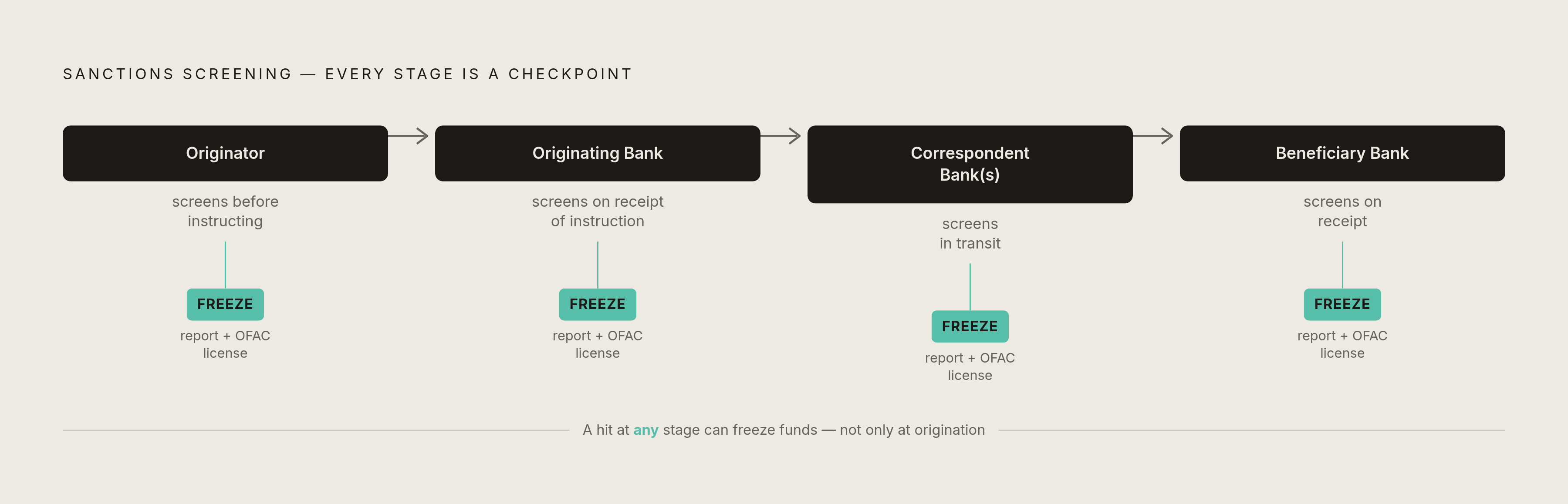
Payments crossing borders trigger screening at every step, not just the start.

- Written by
- Marcus Oyelaran
- Published
- October 10, 2026
- Reading time
- 10 min read
- Sources cited
- 1 sources ↓
What this covers
- The legal architecture that creates the obligation: OFAC, the SDN list, and the sanctions programs most likely to affect a cross-border payment
- Which Lists Must Be Screened
- What the FATF Travel Rule and ISO 20022 require at the transaction level
- The speed-versus-screening conflict in real-time payment rails
Sanctions screening for a cross-border payment is not one checkpoint that happens when a payment originates. A hit at any single step can freeze the funds, trigger a reporting obligation, and force the originator to wait on an OFAC license before the money moves again. That structure holds even when neither the sender nor the receiver is based in the country whose currency is used: if the payment clears in that currency, it routes through that country's financial system at some point, and that routing alone brings it inside the regulator's reach. dollars, it routes through the U.S. financial system at some point, and that routing alone brings it inside OFAC's reach.
The reach extends further than most finance teams assume. It still held the obligation to screen what came in.
The practical consequence for any company that thinks of itself as a domestic operation with the occasional overseas vendor payment: that company sits inside the sanctions perimeter already. It does not need to run an international bank, hold a money transmitter license, or process high transaction volumes to carry screening exposure. It needs to send money across a border, and the obligation follows from there.
The legal architecture that creates the obligation: OFAC, the SDN list, and the sanctions programs most likely to affect a cross-border payment
The U.S. runs several distinct kinds of sanctions programs, and you need to know which kind applies to a given counterparty, because that determines both what is barred and what kind of review a payment needs before it moves. Comprehensive country programs sit at the strict end: they prohibit nearly all transactions with a covered jurisdiction. That list is not fixed. A compliance program built on a static mental map of "sanctioned countries" will misread both situations.
List-based sanctions work differently. One of the least understood pieces of this framework is OFAC's ownership rule: an entity that is not itself named on the SDN list is still treated as blocked if it is majority-owned by one or more SDN parties. A counterparty can look entirely clean on a name-match screen and still be a prohibited party once its ownership structure is traced back far enough. That rule is responsible for a large share of the sanctions exposure businesses encounter without ever intending to deal with a sanctioned party.
Sectoral sanctions form a middle category, restricting specific sectors of an economy, such as a targeted country's financial services or energy sector, while allowing other dealings with that country. A finance team that genuinely intended to pay a legitimate vendor, and simply made a screening error, is exposed to the same enforcement framework as a company that deliberately tried to route funds around a sanctions program.
Which Lists Must Be Screened
No single list covers the full scope of a compliant screening program, and the set of lists that matters depends heavily on where an institution operates and which jurisdictions its payment touches. The lists that come up most often in cross-border work span OFAC's SDN list, the separate OFAC Consolidated Sanctions List, the EU Consolidated List, the UN Security Council Consolidated List, and the UK Sanctions List. Treating OFAC's SDN list as the whole job, rather than one piece of a broader set, leaves a program blind to the EU, UN, and UK regimes that a given transaction may also fall under.
Look at how fast the UK swapped out even this baseline set of sources. The UK retired its OFSI Consolidated List on January 28, 2026, and replaced it with the UK Sanctions List, now the sole authoritative UK source. If a screening program still points at the old OFSI feed, it is screening against a dataset the UK government no longer maintains, so the compliance gap looks, from the outside, like a working program.
Neither extreme works, and the design of screening scope is itself a decision with real compliance and business consequences, not a settled technical default.
Screening scope also has to extend past the two named parties on a payment instruction. Know-your-business due diligence has to identify Ultimate Beneficial Owners behind a corporate counterparty, because under the ownership rule a company with a clean name can still be a blocked party if its majority owner sits on the SDN list. No single screening configuration handles all three without jurisdictional logic deliberately built into the system.
What the FATF Travel Rule and ISO 20022 require at the transaction level
A screening engine is only as good as the data it receives, and two regulatory developments running in parallel are reshaping what that data looks like. An international standard-setting body sets the standard through a formal recommendation, commonly called the Travel Rule, and it governs what originator and beneficiary information has to travel with a payment. FATF sets the standard; national legislation implements it, and the Travel Rule operates at that handoff between international rule and domestic law.
The ISO 20022 messaging migration determines how that required information actually gets structured inside a payment message. The European Payments Council had set November 15, 2026 as the deadline after which SEPA scheme messages could no longer carry unstructured address fields; SWIFT, which runs the parallel CBPR+ requirement for cross-border messaging, announced on August 27, 2026 that it was deferring its own version of that deadline, with a new date yet to be set. ISO 20022 messages carry structured party data instead: full names, addresses, identifiers, and purpose codes broken into distinct fields, which gives a screening engine a cleaner input and narrows the ambiguity the matcher has to resolve.
That transition has not finished cleanly. If institutions still run mixed infrastructure, or rely on translation services to convert between the older MT format and the newer MX format, they stay exposed to data integrity problems during conversion, and those errors feed straight into less reliable name matching. The Travel Rule's reach extends past traditional fiat transfers, too: it applies to cryptocurrency and stablecoin transactions as well, with stablecoins classified as virtual assets under Recommendation 16 but drawing additional, tailored regulatory attention. OFAC treats virtual currency transactions the same as fiat for sanctions purposes, and it has issued guidance just for the virtual currency industry.
The speed-versus-screening conflict in real-time payment rails
Instant settlement is the feature customers and regulators both want from modern payment rails, and it compresses, sometimes to nothing, the window a screening system has to act before funds move.
You can see this tension playing out inside an actual regulatory proceeding: the proposed expansion of FedNow into cross-border payments. In a June 2026 comment letter on the proposed rule, the Bank Policy Institute and The Clearing House flagged that FedNow participants would need to run real-time sanctions screening on FedNow payment messages to meet their own sanctions obligations, even though the Federal Reserve Banks' own terms do not currently require real-time transaction screening. The industry itself is telling its regulator that the expectation has outpaced what many institutions can currently execute.
False positives as the central operational problem in sanctions screening
The dominant fact about sanctions screening in cross-border payments is that the overwhelming majority of alerts a screening system generates turn out to be legitimate payments, and resolving each one consumes compliance staff time and delays funds that never needed to be delayed.
This is a structural problem, not evidence of a poorly tuned system. When a screening engine has to match names and addresses against sanctions lists using unstructured input data, it can only flag broadly, because flagging narrowly would create regulatory risk the institution can't accept. Before structured ISO 20022 data became standard, SWIFT messages carried address information in free-text fields of limited length, so the matching engine had to guess broadly against unstructured SDN records. The data architecture feeding the engine, not the matching algorithm running on top of it, has been the primary driver of false positives. If institutions still run mixed infrastructure, or still rely on MT-to-MX translation services during the ongoing transition, they remain exposed to the same data integrity problems.
The cost of this falls on compliance teams who spend their time clearing payments that were never a problem. The screening system, in its current state, mostly produces work rather than catches, and that shapes where compliance investment goes and what risks slip through while staff clear routine alerts. The ISO 20022 structured-data mandate is the real fix for this, but only once the transition finishes and institutions retire the mixed-format infrastructure sitting in between. Until then, institutions have to face real-time screening expectations on top of data that is still legacy quality.
How enforcement actions reveal where screening programs break down
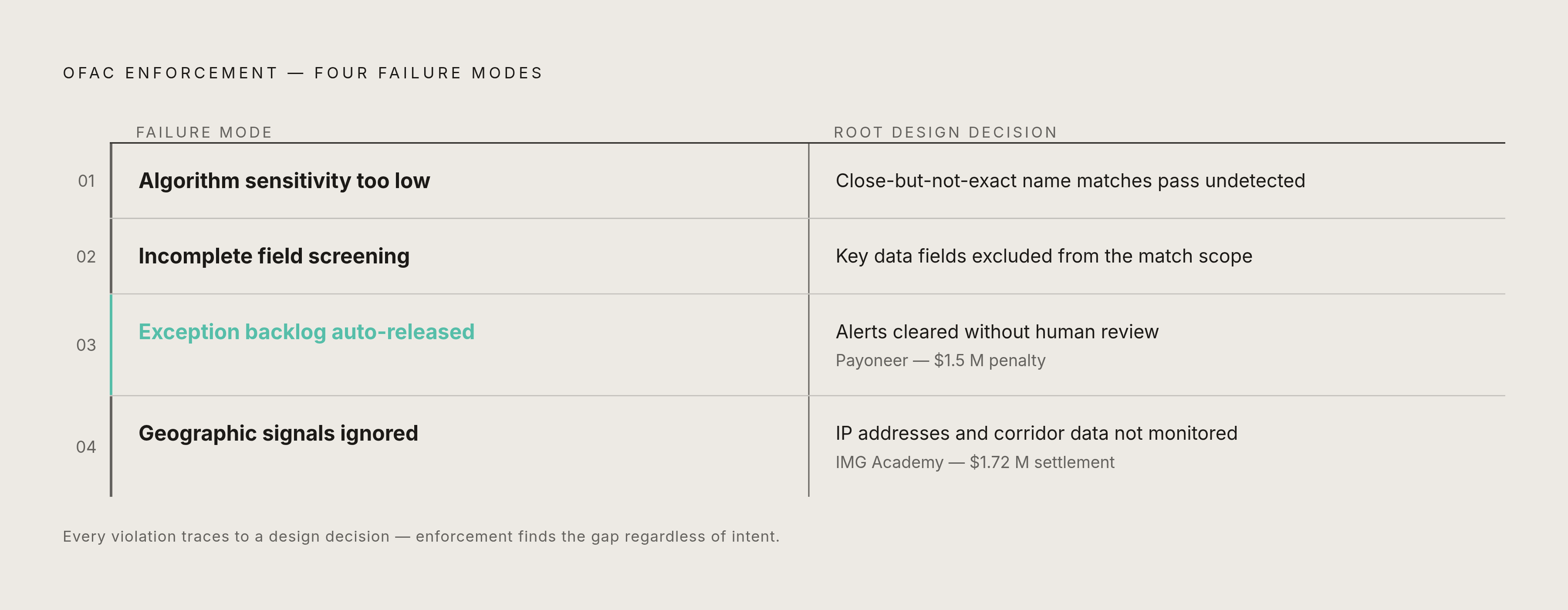
OFAC's enforcement record shows a consistent pattern: violations cluster around a small number of identifiable failure modes, and those failures trace back to how a screening program was designed and run, not to deliberate attempts at evasion.
Each of those four failures points to a different design decision: how sensitive the matching algorithm was set, what fields the system screened, how exceptions got handled during a backlog, and whether geographic signals were monitored.
IMG Academy's February 2026 settlement, at $1.72 million, involved tuition payments it received from parties connected to a sanctioned Mexican cartel, routed through third-party wire transfers and credit cards rather than paid directly by the academy's usual counterparties. The case establishes that receiving funds connected to a sanctioned party through an intermediary is a violation even for an institution with no intention of dealing with that party. Across all three cases, OFAC's expectation is the same: look past the legal form of a relationship to its underlying economic reality. Beneficial ownership, indirect flows of funds, and geographic signals like IP addresses all sit within the scope of what a screening program is expected to catch.
Sanctions risk as a form of liquidity risk through correspondent banking de-risking
A payment can be clean. The counterparty on each end can be clean. The transaction can still become commercially impossible because a correspondent bank several hops down the chain has been designated, or warned, and the route it provided no longer exists.
OFAC's warning to foreign financial institutions in October 2026 made the stakes explicit: institutions that continue transacting with sanctioned parties can themselves be targeted "at any time without advance notification," and OFAC pointed to recent actions against banks that had given sanctioned actors, including Iran, access to correspondent banking relationships. If designation can arrive without warning, the only defensible position for a correspondent bank is to de-risk before that warning ever comes, pulling back from clients, corridors, and sometimes entire jurisdictions, even where the underlying transactions involved are entirely legal. That is a rational response to the incentives OFAC has created, not a failure of judgment on the correspondent bank's part.
The consequence for the businesses on the other end of that decision is what matters here. The growing divergence between U.S., UK, and EU rules on Russia sanctions compounds this further: a corridor that remains legal for a global business under one regime can be practically closed under another, forcing route decisions that add another layer of complexity on top of an already difficult compliance picture.
What a sanctions screening program that works looks like in practice
A screening program built to meet current regulatory expectations is a set of controls that runs continuously across the full life of a payment relationship, built to address the specific failure modes enforcement actions have already exposed.
Screening has to run at multiple points, not once. Ongoing monitoring and periodic review belong alongside transaction-level screening as a required part of any sound AML and sanctions program, and that is what answers the automatic-release failure that cost Payoneer part of its $1.5 million penalty.
The scope of what gets screened has to extend past the two named parties on a payment. Under the Customer Due Diligence rule, financial institutions have to identify and verify beneficial owners who hold 25% or more of a legal entity, plus at least one individual with significant control regardless of ownership percentage, and that answers the ownership-rule exposure described earlier in this piece. Intermediate correspondent banks, along with the countries and sectors a transaction touches, need to sit inside that same scope, not outside it.
Handling this manually gets harder as the number of payees, jurisdictions, and regulatory regimes a business deals with grows, and manual processes tend to produce incomplete documentation and missed screening precisely at the volume where the risk is highest. False positive governance, testing, and validation are explicit expectations from the FATF and the Basel Committee, not optional extras, so a program that screens transactions but has no documented process for resolving the alerts it generates does not meet the standard regulators are applying. For any EU-connected institution, that is a direct supervisory relationship, and not just another national-level enforcement risk sitting in the background.
The compliance burden for non-bank businesses making cross-border payments
For a business that is not a bank but still pays vendors or suppliers across borders, none of this obligation disappears just because a bank or payment provider handles execution. When a U.S. business pays an international vendor, that payment touches the compliance programs of every financial institution in the chain, but the business that sent it still has to answer for its own OFAC screening before it ever instructs the transfer.
That responsibility breaks down into a specific set of controls. It needs beneficial ownership verification on corporate counterparties, because under the SDN ownership rule a counterparty can have a perfectly clean name while its underlying owner is a blocked party. And it needs the standard elements of any sound AML program: a written sanctions policy, a designated compliance owner, employee training, and independent testing, the same elements that apply to any institution carrying AML obligations, not just to banks.
Businesses that treat sanctions screening as a standing operational capability can keep their payments moving as that landscape keeps shifting, even when the only check they ran was at onboarding.
Methodology & sources
- BPI and TCH Comment on FedNow Cross-Border Payments Rule - Bank Policy Institute
Provided the detail on the Bank Policy Institute and The Clearing House's June 2026 comment letter flagging real-time sanctions screening challenges in the proposed FedNow cross-border payments rule.