FATF Travel Rule Compliance for Cross-Border Crypto Transfers
Compliance failures happen at onboarding, not transmission—build the KYC foundation first.

- Written by
- Tobias Fenner
- Published
- October 8, 2026
- Reading time
- 10 min read
- Sources cited
- 8 sources ↓
What this covers
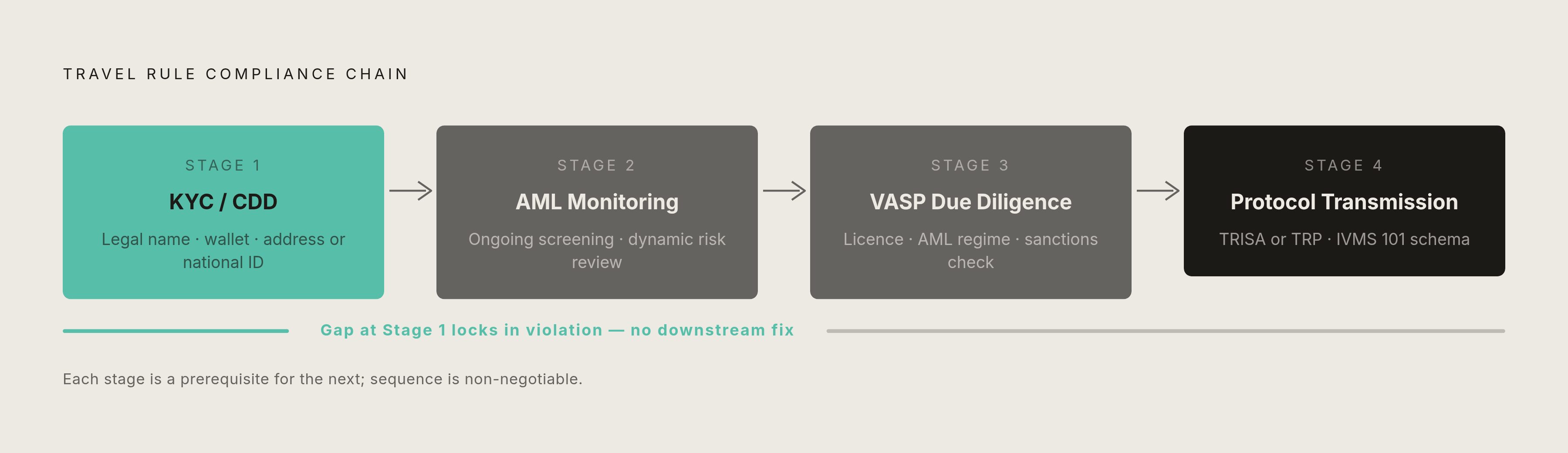
The FATF Travel Rule is a compliance chain that links customer identification, counterparty verification, sanctions screening, and secure data exchange into a single obligation, and a failure at any link breaks the whole chain. You need to understand each of those links separately, because enforcement-ready operations are built link by link, not purchased as a single protocol integration.
What the Travel Rule actually requires and why it is more than a messaging obligation
A completed Travel Rule message for the beneficiary side of a transfer carries a full legal name, an account number, IBAN, or wallet address, and, where local regulation demands it, a physical address or national ID. That payload looks simple on paper. What makes it hard is everything that has to be true before the message can be assembled, because the Travel Rule does not generate this data itself. It transmits data that another compliance process already collected. FATF Recommendation 16 was extended to virtual assets in June 2019 through the Interpretive Note to Recommendation 15, which brought virtual asset service providers within its scope, and it requires both the originating and the beneficiary VASP to collect, verify, and transmit specified originator and beneficiary information for qualifying transfers. FATF's own assessment found that 83% of surveyed jurisdictions have now written this obligation into national law, which makes the Travel Rule one of the most widely adopted elements of the FATF virtual asset framework.
The rule exists so that law enforcement can trace funds and screen transactions against sanctions lists across an entire payment chain, not just at the moment one institution hands a transaction to another. That purpose only holds if the data travels intact through every intermediary until it reaches the beneficiary institution. This is where the chain logic becomes unavoidable: the Travel Rule sits downstream of know-your-customer collection. If onboarding never captured a customer's physical address, and the destination jurisdiction requires one, there is no way to complete that message at the moment of transfer. The violation does not occur because a VASP mishandled a protocol. It occurs because a KYC gap from months or years earlier finally came due. The rule also is not self-executing. VASPs need procedures to reject, suspend, or report transactions when required information is missing, and both the originating and beneficiary institutions have to retain records for five years. None of that is optional, and none of it can be fixed retroactively once a qualifying transfer has already gone out incomplete.
How Jurisdiction-Specific Thresholds Fragment a Single FATF Standard
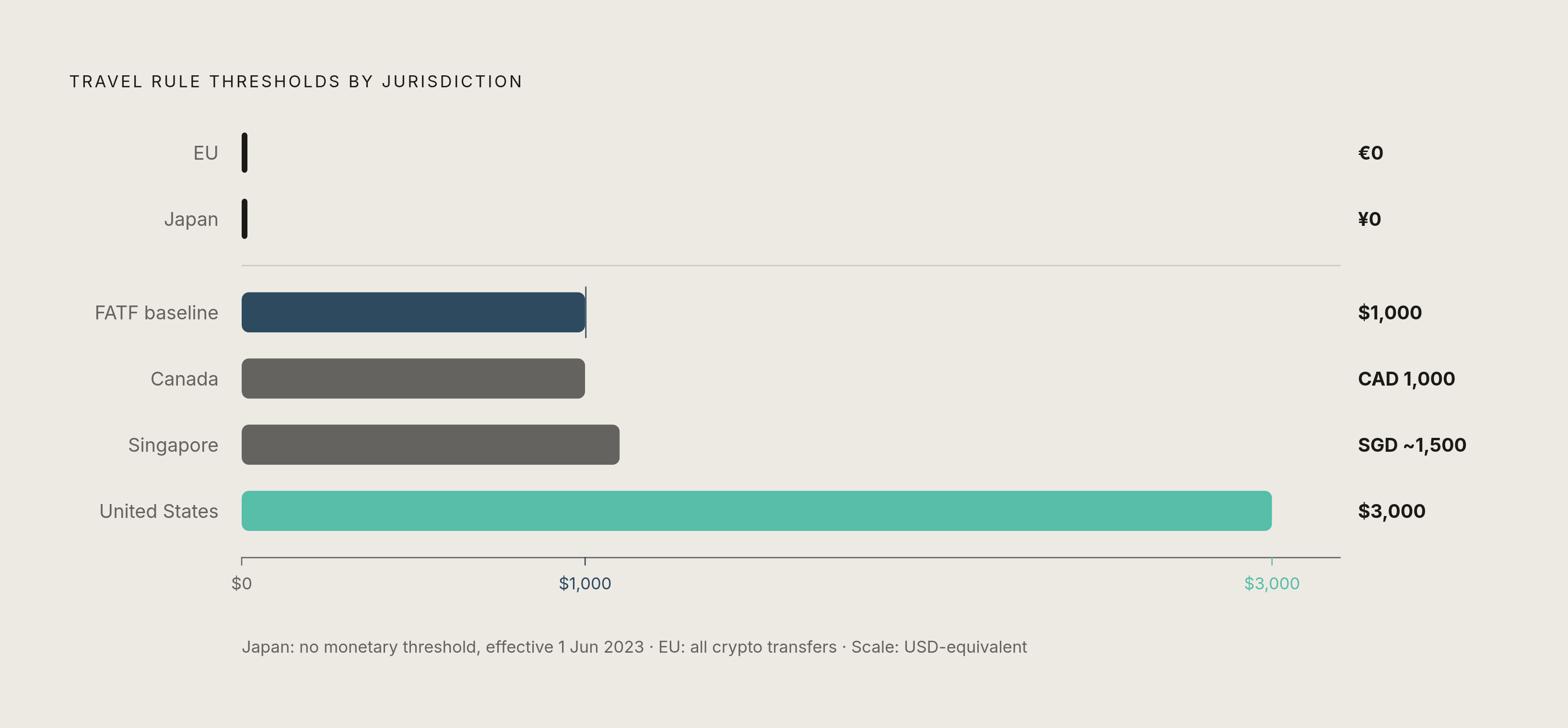
FATF sets a baseline, a four-digit USD/EUR threshold, below which the Travel Rule does not apply, but it allows each jurisdiction to set its own threshold above or below that baseline. A single global standard produces a patchwork of national triggers.
| Jurisdiction | Threshold | |---|---| | FATF baseline | Four-digit USD/EUR threshold | | United States (FinCEN/BSA) | Higher than the FATF baseline for qualifying transmittals | | Singapore (MAS) | SGD-denominated threshold for digital payment token transfers | | Canada | CAD 1,000 for virtual currency | | Japan (JFSA) | No monetary threshold, effective 1 June 2023 |
The gap between the United States and the European Union is the most operationally acute one. The US threshold runs roughly three times the FATF baseline, but the EU applies a zero threshold to crypto transfers. That asymmetry is not academic for a US firm receiving transfers from EU-based crypto-asset service providers: the EU counterparty has already assembled Travel Rule data on a transfer that might fall well under the US trigger on its own, and the US firm now has to handle that data regardless of whether its own domestic threshold would have required it.
The consequence for any VASP operating across borders is structural. A compliance programme built only around the home-jurisdiction threshold will be under-inclusive for every transfer that touches a stricter counterparty jurisdiction. The only approach that holds up under scrutiny is to comply with the stricter of the two applicable thresholds on any given transfer pair, treating the national minimums as a floor.
The KYC Layer as the Real Determinant of Travel Rule Readiness
A Travel Rule programme appears to fail at the moment of transmission, when a message goes out incomplete or gets rejected by a counterparty, but the actual failure happened earlier, at onboarding, whenever KYC collection did not capture the data elements the rule later requires. By the time a qualifying transfer occurs, it is too late to go back and ask a customer for a physical address or a date and place of birth that was never recorded. The Travel Rule sits downstream of customer due diligence rather than replacing it, so the originator's physical address, national ID, or date and place of birth has to exist in the KYC record before that transfer happens. The required elements that feed a Travel Rule message are specific: full legal name rather than a username or alias, an account number or wallet address tied to the customer, and at least one of physical address, national identity number, customer identification number, or date and place of birth.
The most common implementation failure seen across the industry in 2026 is sequencing the work backward: VASPs deploy a Travel Rule protocol before auditing whether their underlying KYC stack actually captured every required field. That produces messages that are structurally transmitted, with the protocol working and the data moving, while the fields a regulator would check are missing or malformed. A message that transmits successfully but lacks a required field is still a violation. For corporate originators and beneficiaries, this extends into know-your-business checks: ultimate beneficial owner identification, company registration details, and registered addresses all have to be captured at onboarding for legal-entity transfers, adding a second data set that has to be complete before any qualifying transfer involving a business customer can proceed. KYC is not a one-time event in this framework. Ongoing AML monitoring and dynamic risk scoring mean a customer whose risk profile shifts after onboarding may need re-verification before the next qualifying transfer goes out, which makes KYC a continuous feed into the Travel Rule process rather than a gate that closes once an account opens. Sanctions screening sits alongside this as its own checkpoint: screening against the OFAC SDN list, the EU consolidated list, and UN lists has to happen before transmission on the originating side and again upon receipt on the beneficiary side, because a message with perfectly correct data fields sent to a sanctioned counterparty is not a compliance success by any measure. A compliance officer auditing readiness in 2026 should be looking at the KYC stack before evaluating a single protocol vendor, because the protocol only moves data that already has to exist.
Counterparty due diligence on the receiving VASP, not just the customer
Knowing a customer thoroughly solves only half the problem. Sending that customer's Travel Rule data to a counterparty VASP that turns out to be unvetted or unlicensed does not discharge the obligation. It compounds it, because the originating VASP has just become the entry point through which funds, and the personal data attached to them, move into an environment nobody is controlling. Before transmission, the originating VASP needs to confirm that the beneficiary VASP holds a valid licence or registration in its home jurisdiction, operates under a functioning AML regime, and does not itself appear on a sanctions or enforcement list.
Offshore VASPs represent the sharpest version of this risk. Some have been documented soliciting customers in markets where they hold no licence at all, coaching those users toward VPNs and false information to obscure their actual location, and opening accounts at licensed onshore firms while misrepresenting themselves as ordinary retail users in order to obtain liquidity and fiat on- and off-ramps they would not otherwise qualify for. That pattern illustrates how illicit funds move into jurisdictions that have not implemented the Travel Rule at all, using a chain of misrepresentation at each hop. Where a counterparty VASP sits in a jurisdiction without Travel Rule implementation, the originating VASP runs into a genuine legal gap: it cannot obtain the originator and beneficiary information the rule calls for, yet it is not necessarily prohibited outright from transacting with that entity. The compliance answer under most frameworks is to apply enhanced due diligence or decline the transfer when information is incomplete. Gray-listed jurisdictions sharpen this further. As of February 2026, 21 countries sit on the FATF gray list following the addition of Kuwait and Papua New Guinea, and multiple national frameworks, including the UK's, require enhanced scrutiny for any transfer touching a VASP based in one of those jurisdictions. Counterparty due diligence is a separate verification obligation running parallel to the customer relationship, and treating it as secondary is how funds end up moving through unlicensed intermediaries with a fully compliant-looking data trail attached.
Protocol selection and the interoperability problem no single vendor solves
Once the data exists and the counterparty has been vetted, the transfer still has to move through an actual protocol, and no single protocol reaches every VASP a firm might need to transact with. TRISA, the Travel Rule Information Sharing Architecture, is an open-source protocol built on gRPC, and it has its own directory of certified VASPs. TRP, the Travel Rule Protocol, is an open API standard using RESTful, signed JSON payloads, backed by a consortium that includes Standard Chartered, ING, BitGo, and Fidelity Digital Assets. Both converge on IVMS 101, the InterVASP Messaging Standard ratified in 2020, as the underlying data schema. The payload itself stays portable even when the transport mechanism carrying it differs. That shared schema is the technical foundation that makes any interoperability possible at all between VASPs running different protocols.
A VASP that commits to only one of these protocols will be structurally unable to transmit to, or receive from, counterparties that have standardized on the other, and that gap covers a material share of the market. SaaS aggregation platforms such as Notabene and Sumsub Travel Rule have emerged to sit on top of these protocols, letting a firm maintain a single integration that reaches counterparties across multiple networks, which is a practical middle path for VASPs that cannot justify building and maintaining separate protocol integrations in-house. VASP directories embedded in these protocols, including TRISA's certified-VASP directory and Notabene's network, cover only some counterparties, leaving others undiscoverable through those channels. If a counterparty does not appear in any directory, it still needs out-of-band verification, typically an email-based exchange of legal entity identifiers or compliance attestations done manually. FATF guidance has not closed this gap. Updated FATF standards have, if anything, intensified long-standing challenges around interoperability and the asynchronous pace at which different jurisdictions implement their own versions of the rule, and no unified protocol mandate exists to force convergence. Data protection law adds a further constraint on top of protocol choice: where GDPR or an equivalent regime applies, the personal data embedded in a Travel Rule message cannot move freely to a counterparty in a jurisdiction lacking an adequacy decision or an equivalent safeguard. The protocol a VASP selects has to support encrypted, permissioned transmission. Multi-protocol support, against that backdrop, is the baseline condition for reaching the full range of counterparties the business needs to transact with.
Self-hosted wallets and DeFi: where the Travel Rule chain breaks by design
So far, all of this assumes two regulated VASPs sit on either end of a transfer, each able to collect data, verify the other, and exchange a message. That assumption collapses the moment one end of the transfer is a self-hosted wallet or a DeFi protocol, because there is no second institution to exchange a message with. The obligation does not disappear in that case. It shifts entirely onto the regulated VASP, which now has to verify wallet ownership or assess control unilaterally rather than rely on a counterparty's compliance process.
The European Union's Transfer of Funds Regulation addresses this directly: for transfers above a set threshold to or from a self-hosted wallet, the crypto-asset service provider must verify that its customer actually owns or controls that wallet, typically through a Satoshi test, an AOPP signature, or visual proof such as a screenshot of the wallet address. The United Kingdom applies a comparable verification requirement above its own sterling threshold. In the United States, a proposed FinCEN rule would require recordkeeping and reporting for self-hosted wallet transfers above specified thresholds, but as of the most recent sources available for this guide, that rule has not been finalized, leaving American VASPs without a settled standard for this category of transfer. DeFi presents an even wider regulatory vacuum. FATF has found that only 18% of responding jurisdictions have assessed DeFi risks at all, which means the overwhelming majority of national regulators have not yet worked out how, or whether, the Travel Rule's logic of originator and beneficiary identification applies to a transaction routed through a smart contract with no VASP on either end. Regulators have started filling these gaps with asymmetric rules that place the full compliance burden on the one regulated party in the chain, the VASP, instead of extending Travel Rule obligations to wallets or protocols never built to hold or transmit this kind of data.
Methodology & sources
- FATF Travel Rule Requirements: A 2026 Guide For Financial Institutions, VASPs And Crypto Businesses
Provided context on jurisdiction-specific threshold variations and the FATF baseline framework discussed in the threshold comparison section.
- Virtual Assets July 2026 Targeted Update on Implementation of
Supplied the key statistics used in the article: 83% of jurisdictions adopting the Travel Rule into national law, and 18% of jurisdictions having assessed DeFi risks.
- Targeted Update on Implementation of the FATF Standards on Virtual Assets and
Informed the article's discussion of ongoing interoperability challenges and the asynchronous pace of jurisdictional implementation of Travel Rule standards.
- FATF Recommendation 16: Key Insights for Compliance
Provided detail on the required data elements under FATF Recommendation 16 for originator and beneficiary information in Travel Rule messages.
- FATF Crypto Standards 2026: VA, VASP & Recommendation 15 Guide
Informed the article's account of the June 2019 Interpretive Note to Recommendation 15 that brought VASPs within the Travel Rule's scope.
- Best Practices Travel Rule Supervision June 2025
Informed the discussion of supervisory expectations, enhanced due diligence for gray-listed jurisdictions, and counterparty verification obligations.
- Travel Rule compliance for crypto VASPs
Provided information on SaaS aggregation platforms such as Sumsub Travel Rule that enable multi-protocol connectivity for VASPs.
- Crypto Travel Rule by Country: 2026 Implementation Map
Supplied jurisdiction-specific threshold data for Canada, Japan, Singapore, and the EU zero-threshold rule used in the comparison table.